
Why Some Handheld Inkjet Printers Become More Expensive Over Time
2026-02-16(164)Views
Handheld inkjet printers are often chosen for their low upfront cost and flexibility. For many buyers, the initial price feels like a safe, low-risk investment. However, some handheld inkjet printers become significantly more expensive over time, surprising users who expected long-term savings.
Understanding why this happens is essential for making smarter equipment decisions and avoiding hidden cost traps.
The Illusion of a Low Entry Price
A low purchase price lowers the barrier to entry—but it doesn’t guarantee low lifetime cost.
Many buyers focus on:
1.Hardware price
2.Basic feature list
3.Short-term needs
What’s often missing is a realistic assessment of long-term operational impact.
Proprietary Ink Cartridges and Vendor Lock-In
One of the most common cost drivers is ink dependency.
Some handheld inkjet printers rely on:
1.Proprietary cartridges
2.Limited supplier options
3.Restricted ink formulations
Over time, this can lead to:
1.Higher ink prices
2.Limited negotiation power
3.Inflexibility when production needs change
Ink becomes a recurring cost multiplier rather than a controllable expense.
Rising Labor Costs as Volume Grows
Handheld inkjet printers depend heavily on manual operation.
As production increases:
1.More operator time is required
2.Fatigue affects speed and accuracy
3.Additional shifts or staffing may be needed
What starts as a flexible manual solution can quietly turn into a labor-intensive bottleneck.
Inconsistent Output Leads to Rework and Waste
Print consistency is influenced by:
1.Operator technique
2.Surface variation
3.Environmental conditions
Small inconsistencies may seem harmless, but over time they result in:
1.Rejected cartons or products
2.Reprinting and rehandling
3.Increased material waste
These indirect costs accumulate faster than expected.
Downtime from Small, Frequent Interruptions
Unlike automated systems, handheld printing often introduces micro-downtime:
1.Operators switching tasks
2.Cartridge changes
3.Content updates done manually
Each interruption may only take minutes—but across days and months, lost productivity becomes measurable cost.
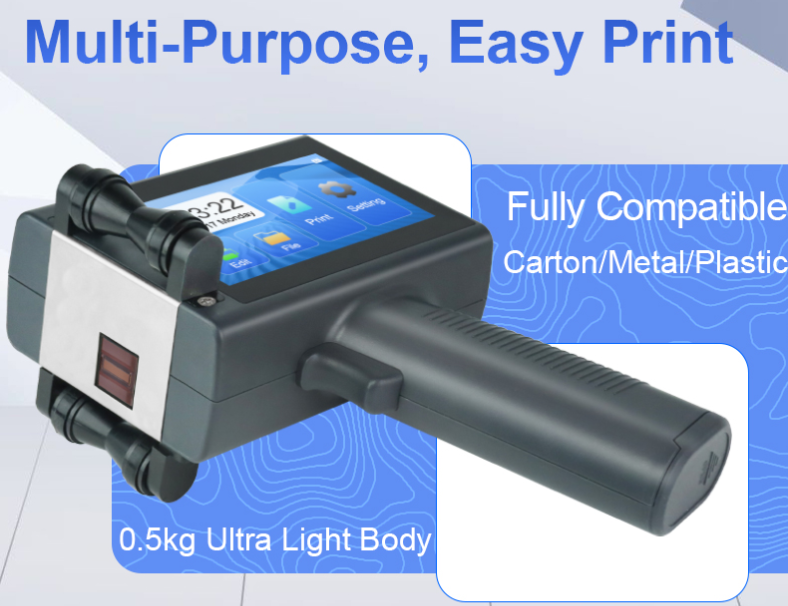
Maintenance Neglect Shortens Equipment Lifespan
Handheld inkjet printers are marketed as “low maintenance,” but they are not maintenance-free.
Without consistent care:
1.Nozzles clog
2.Print quality degrades
3.Components wear prematurely
Replacing equipment sooner than planned increases total ownership cost.
Scaling Problems Reveal Hidden Limitations
Many handheld inkjet printers perform well in early-stage operations.
Costs rise when:
1.Production scales faster than expected
2.More SKUs and codes are introduced
3.Manual processes fail to keep up
At this stage, companies often pay twice—once for the handheld system, and again for automation.
Opportunity Cost: Delayed Process Optimization
Continuing to rely on manual printing can delay:
1.Workflow standardization
2.Automation planning
3.Integration with traceability systems
The cost of not upgrading at the right time can exceed the cost of the printer itself.
When Higher Cost Doesn’t Mean Wrong Choice
It’s important to note: higher long-term cost doesn’t automatically mean the printer was a bad decision.
Handheld inkjet printers still make sense when:
1.Volumes remain low
2.Variability is high
3.Flexibility is more valuable than speed
The issue arises when usage evolves but the tool does not.
The Real Reason Costs Increase: Mismatch, Not Failure
Most cost overruns are not caused by poor-quality printers—but by application mismatch.
When a handheld inkjet printer is used beyond its ideal role, inefficiencies compound.
Talk to Our Company About Long-Term Cost Planning
Our company helps manufacturers and packaging teams evaluate not just which handheld inkjet printer to buy—but when, how, and for how long it makes financial sense.
We look at:
1.Ink strategy
2.Labor impact
3.Scalability
4.Workflow alignment
Contact our company today to avoid long-term cost surprises and build a smarter coding strategy.
+MoreRelated recommendations
-
Handheld Inkjet Printer Warranty Questions Buyers Should Ask Before Ordering
Ask these handheld inkjet printer warranty questions to clar...
-
Handheld Inkjet Printer Order Checklist: Printer, Ink, Accessories, and Spare Parts
Use this purchase checklist to confirm the printer, ink, acc...
-
What Information Should You Send for an Accurate Handheld Inkjet Printer Quote?
Use this RFQ worksheet to send the material, message, print ...
-
How to Print Scannable Barcodes and QR Codes on Plastic Packaging
Learn how to print scannable barcodes and QR codes on plasti...
Contact Us

Service phone number+8618759952301
—— Add WeChat communication


