
How to Stabilize Print Quality in Harsh Industrial Settings
2026-03-13(173)Views
Maintaining consistent print quality in harsh industrial settings is one of the biggest challenges manufacturers face. Dust, vibration, temperature fluctuation, humidity shifts, and high-speed production lines can quickly destabilize even advanced coding systems.
If your operation depends on legible, compliant, and durable codes, learning how to stabilize print quality in harsh industrial environments is not optional—it is essential for operational continuity.
What Defines a Harsh Industrial Printing Environment?
Before solving the problem, we must define it.
Harsh industrial settings typically include:
1.High temperature or rapid temperature fluctuation
2.Elevated humidity or condensation
3.Heavy dust, powder, or airborne particles
4.Strong airflow near production lines
5.Continuous mechanical vibration
6.High-speed material movement
Each of these factors directly affects ink behavior, droplet formation, and adhesion performance.
Why Print Quality Becomes Unstable in Harsh Conditions
Print instability usually results from interaction between three variables:
1.Environmental stress
2.Substrate inconsistency
3.System configuration gaps
In harsh industrial settings, small deviations amplify quickly, leading to:
1.Smudging
2.Incomplete characters
3.Faded codes
4.Poor barcode readability
5.Frequent maintenance interruptions
Understanding the root cause is more important than adjusting settings repeatedly.
Step 1: Control What You Can in the Environment
You cannot redesign the entire factory—but you can create micro-stability around the print zone.
Practical Environmental Stabilization Methods
1.Install protective enclosures around printheads
2.Shield against direct airflow from fans or HVAC
3.Use vibration-dampening mounting brackets
4.Maintain consistent temperature near printing area
Even partial environmental buffering significantly stabilizes print quality in harsh industrial settings.
Step 2: Match Ink to Real-World Surface Conditions
In harsh environments, substrate variability increases.
Surfaces may be:
1.Slightly dusty
2.Cold from storage
3.Moist from condensation
4.Coated inconsistently
Ink-substrate mismatch is a primary cause of instability.
Best Practice
1.Conduct adhesion testing at real production temperature
2.Test drying time under actual handling speed
3.Validate durability after packaging and transport simulation
Ink choice is not generic—it must match both surface and environment.
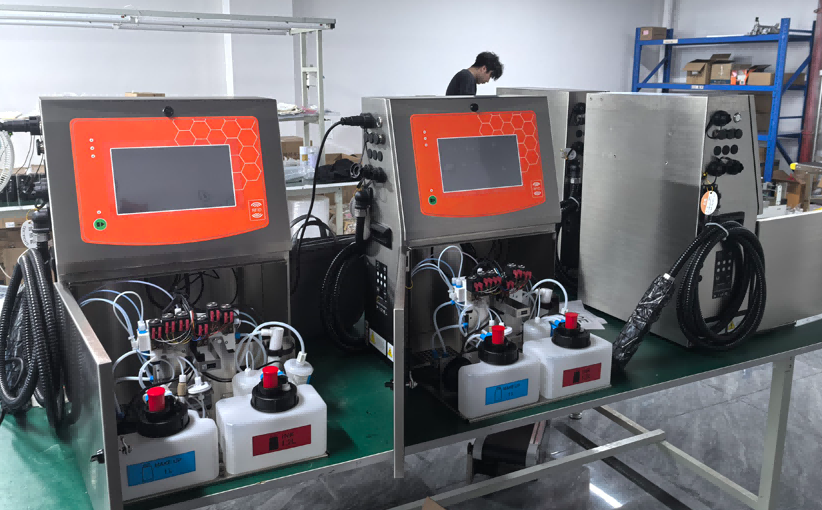
Step 3: Stabilize Mechanical and Mounting Conditions
Mechanical instability is often invisible but highly destructive.
Common issues include:
1.Printhead vibration
2.Inconsistent print distance
3.Product wobble during coding
To stabilize print quality:
1.Reinforce brackets
2.Shorten mounting arms
3.Minimize cantilever structures
4.Ensure consistent product guidance
Mechanical precision directly affects droplet placement accuracy.
Step 4: Optimize Print Parameters for Environmental Reality
Default settings are rarely optimal in harsh industrial environments.
Adjust:
1.Print resolution (DPI)
2.Ink density
3.Trigger delay timing
4.Print speed synchronization
Validation must occur at full production speed, not during slow trial runs.
Step 5: Implement Preventive Maintenance Discipline
Harsh industrial conditions accelerate wear and contamination.
A stabilization strategy should include:
1.Scheduled nozzle inspection
2.Controlled cartridge handling
3.Routine cleaning intervals
4.Documented maintenance logs
Reactive maintenance increases instability. Preventive structure increases consistency.
Step 6: Improve Operator Awareness and Training
In demanding environments, human factors magnify equipment sensitivity.
Operators should understand:
1.Environmental impact on print performance
2.Correct cartridge storage
3.Early signs of quality drift
4.Proper troubleshooting sequence
Training converts variability into controlled response.
Step 7: Monitor and Audit Print Quality Continuously
Stabilization is not a one-time fix—it is an ongoing process.
Implement:
1.Barcode grading checks
2.Random sample inspections
3.Real-time monitoring where possible
4.Escalation procedures for deviations
Continuous validation prevents small issues from becoming systemic failures.
Aggregated Insight: Stability Is a System Strategy
Across industries—food packaging, chemical production, building materials, logistics—the same pattern appears:
Print quality in harsh industrial settings becomes stable only when:
1.Environment is buffered
2.Ink is matched
3.Mounting is reinforced
4.Parameters are optimized
5.Operators are trained
No single adjustment solves the problem. Stability requires alignment across the system.
Why This Matters for Compliance and Cost
Unstable print quality leads to:
1.Product rejection
2.Rework and relabeling
3.Shipment delays
4.Regulatory risk
5.Increased ink consumption
6.Hidden labor costs
In harsh industrial environments, instability compounds financial exposure.
Stabilization protects both compliance and profitability.
The Strategic Advantage of Proactive Stabilization
Companies that proactively stabilize print quality gain:
1.Predictable output
2.Lower downtime
3.Reduced material waste
4.Stronger audit confidence
5.Higher long-term ROI
In volatile production conditions, stability becomes a competitive advantage.
Talk to Our Company About Stabilizing Print Quality in Harsh Industrial Settings
If your production environment involves dust, vibration, temperature fluctuation, or high-speed lines, you need more than standard printer setup—you need application-specific stabilization strategy.
Our company specializes in evaluating harsh industrial environments and designing print stability solutions that align with real production conditions. We assess environment, substrate, mechanical setup, and workflow before recommending adjustments.
Contact our company today for a professional print stability assessment and eliminate recurring quality issues before they escalate.
+MoreRelated recommendations
-
Printing on Plastic Packaging Without Smearing or Ink Transfer
Discover practical strategies to prevent smearing and ink tr...
-
Choosing the Right Ink for Non-Porous Plastic Surfaces
Learn how to choose the right industrial ink for non-porous ...
-
How Ink Adhesion Varies Across Different Plastic Materials
Learn why ink adhesion differs across PE, PP, PET, PVC, ABS,...
-
Printing on Different Materials with Handheld Inkjet Printers: The Complete Industrial Guide
Learn how to print on different industrial materials with ha...
Contact Us

Service phone number+8618759952301
—— Add WeChat communication


