
How to Choose a Handheld Inkjet Printer: The Complete Industrial Buying Guide for Manufacturers
2026-07-10(185)Views
Why Choosing the Right Handheld Inkjet Printer Matters for Modern Manufacturing
In modern manufacturing environments, product identification is no longer a simple printing task.
Manufacturers today need reliable coding solutions that can handle changing production requirements, different materials, variable information, and increasingly strict traceability standards.
Whether a factory needs to print:
1. Batch numbers
2. Manufacturing dates
3. Expiration dates
4. Serial numbers
5. Barcodes
6. QR codes
7. Product information
8. Logos or identification marks
the printing system directly affects production efficiency, compliance, and operational costs.
For many manufacturers, a handheld inkjet printer has become an effective alternative to traditional labeling systems and fixed coding equipment because it provides flexibility, mobility, and fast deployment without requiring complex production line modifications.
However, choosing the right handheld inkjet printer is not simply about comparing prices or checking technical specifications.
A printer that looks attractive on paper may create unexpected problems later:
1. Poor adhesion on certain materials
2. Unstable print quality
3. High ink consumption
4. Frequent maintenance requirements
5. Limited technical support
6. Difficulty adapting to new production needs
The right purchasing decision requires a complete understanding of your production environment, printing requirements, operating costs, and supplier capabilities.
This guide explains how to choose a handheld inkjet printer for industrial applications, helping manufacturers evaluate the most important factors before investment.
Need help selecting the right handheld inkjet printer for your production needs?
Tell us your material type, printing content, and production requirements. Our technical team can recommend a suitable industrial marking solution and provide a customized quotation.
What Makes a Handheld Inkjet Printer Different from Traditional Coding Methods?
A handheld inkjet printer is a portable coding and marking device designed to print variable information directly onto products, packaging, and industrial materials.
Unlike traditional labels or fixed printing systems, handheld inkjet printers allow operators to move freely between products and production areas.
This flexibility makes them suitable for manufacturers that require:
1. Small-batch production
2. Multiple product variations
3. Irregular product shapes
4. Temporary coding requirements
5. Warehouse marking
6. On-site identification
Common applications include:
1. Food packaging
2. Beverage containers
3. Pharmaceutical packaging
4. Electronics
5. Hardware products
6. Plastic components
7. Metal parts
8. Building materials
9. Logistics packages
The biggest advantage is not simply portability.
The real value comes from reducing production limitations.
A manufacturer does not need to stop production to install a complicated system. Operators can immediately start printing wherever identification is required.
Why Manufacturers Are Reconsidering Their Printing Methods
Many factories originally rely on:
1. Printed labels
2. Manual marking
3. Rubber stamps
4. Pre-printed packaging
5. Fixed coding machines
These methods can work for basic requirements, but they often create challenges as production becomes more complex.
Common Problems with Traditional Label-Based Identification

For example, a manufacturer producing hundreds of product variations may need different labels for each model.
This creates:
1. More inventory management
2. More risk of incorrect labeling
3. More production preparation time
Direct inkjet coding solves many of these issues by allowing manufacturers to print information only when needed.
This is why many companies are evaluating whether they should replace labels with direct inkjet coding solutions.
Manufacturers considering this transition should first understand the practical indicators that show whether their factory is ready for this change.
A detailed evaluation can be found in:
[How to Know If Your Factory Needs a Handheld Inkjet Printer]
The Strategic Importance of Selecting the Correct Handheld Inkjet Printer
A handheld inkjet printer is not only a piece of equipment.
It is part of a manufacturer's production workflow.
The wrong choice may create problems that are difficult to detect during initial purchasing.
For example:
A factory may purchase a low-cost printer because the specifications appear acceptable.
However, after several months of operation:
1. The ink does not adhere well to the substrate.
2. Operators need frequent cleaning.
3. Print quality decreases during continuous use.
4. Replacement parts are difficult to obtain.
5. Technical support is unavailable.
6.The initial savings can quickly disappear.
On the other hand, selecting a printer based on actual production requirements can provide:
1. Lower operating costs
2. Faster production changes
3. Better traceability
4. Reduced labor requirements
5. Improved product appearance
6. More reliable coding performance
This is why professional buyers evaluate handheld inkjet printers from a complete manufacturing perspective rather than only comparing purchase prices.
The Five Core Questions Every Manufacturer Should Answer Before Buying
Before selecting any handheld inkjet printer, manufacturers should answer five fundamental questions.
1. What Materials Need to Be Printed?
Different materials require different ink technologies.
Examples:

A printer that performs well on cardboard may not perform equally well on plastic or metal.
Material testing is one of the most important steps before purchase.
2. What Information Needs to Be Printed?
Different industries require different printing capabilities.
Basic applications:
1) Text
2) Numbers
3) Dates
Advanced applications:
1) Barcodes
2) QR codes
3) Variable data
4) Graphics
5) Logos
Manufacturers should consider future requirements, not only current needs.
A printer that meets today's requirements but cannot support future coding needs may require replacement sooner than expected.
3. How Often Will the Printer Be Used?
Usage frequency directly affects equipment selection.
A small workshop may need occasional marking.
A manufacturing plant may require:
1) Daily operation
2) Multiple operators
3) Continuous production support
4) Industrial durability
The expected workload determines:
1) Printer quality requirements
2) Battery capacity
3) Ink system selection
4) Maintenance expectations
4. Who Will Operate the Printer?
Operator experience matters.
A good industrial handheld inkjet printer should provide:
1) Simple interface
2) Easy message editing
3) Fast setup
4) Clear maintenance instructions
If operators need complicated training, productivity decreases.
5. What Support Does the Supplier Provide?
The printer itself is only part of the solution.
A reliable supplier should provide:
1) Application guidance
2) Sample testing
3) Installation support
4) Technical troubleshooting
5) Spare parts availability
This is especially important for manufacturers purchasing equipment for long-term production use.
Handheld Inkjet Printer Buying Decision Process
A professional purchasing process usually follows these steps:

Following this process helps manufacturers avoid purchasing decisions based only on price.
Which Manufacturers Benefit Most From Handheld Inkjet Printing?
Handheld inkjet printers are particularly valuable when production requires flexibility.
Typical users include:
Small and Medium Manufacturers
They often need:
1. Low investment
2. Flexible operation
3. Multiple product marking
A handheld system allows professional coding without investing in expensive automated equipment.
Manufacturers With Multiple Product Sizes
Factories producing different products often face frequent changeovers.
Examples:
1. Different packaging sizes
2. Different models
3. Different customer requirements
Portable printing allows operators to adjust quickly.
Manufacturers Printing on Large or Irregular Products
Some products cannot easily pass through fixed printers.
Examples:
1. Large metal components
2. Construction materials
3. Industrial equipment
4. Wooden products
Handheld printers allow direct marking on these surfaces.
Warehouses and Distribution Operations
Logistics environments often require:
1. Box identification
2. Tracking codes
3. Temporary markings
Portable printers provide immediate solutions.
Who Should Buy a Handheld Inkjet Printer? Understanding Manufacturing Applications and Use Cases
Choosing a handheld inkjet printer starts with one important question:
Does your production environment actually benefit from portable direct coding technology?
Many manufacturers purchase printing equipment based on product specifications alone. However, the most successful implementations begin by analyzing the production process itself.
A handheld inkjet printer is not designed to replace every type of industrial printer.
Instead, it provides unique advantages in situations where manufacturers need:
1. Flexible product marking
2. Fast changeovers
3. Low-volume or variable production
4. Printing on oversized products
5. Multiple production locations
6. Immediate coding without additional packaging steps
Understanding where handheld inkjet printing creates the highest value helps companies avoid unnecessary investment and select the right technology.
Manufacturing Environments Where Handheld Inkjet Printers Create the Most Value
1. Small-Batch and Customized Manufacturing
Modern manufacturing is moving toward more customized production.
Many factories no longer produce only one standard product for long periods.
Instead, they handle:
1) Multiple SKUs
2) Customer-specific orders
3) Short production runs
4) Frequent product changes
Traditional fixed coding systems may become inefficient because every change requires adjustments.
For example:
A packaging manufacturer producing 50 different box designs may need different printed information for each order.
A handheld inkjet printer allows operators to quickly update:
1) Product codes
2) Customer information
3) Batch numbers
4) Dates
5) Tracking information
without changing physical labels or modifying production equipment.
This flexibility is especially valuable for manufacturers that prioritize agility over maximum automation.
2. Food and Beverage Manufacturing
Food manufacturers require accurate and readable coding because product traceability is essential.
Common printing requirements include:
1) Production dates
2) Expiration dates
3) Batch numbers
4) Lot codes
5) Regulatory information
Handheld inkjet printers are often used for:
1) Secondary packaging
2) Cartons
3) Storage containers
4) Large packages
5) Temporary production marking
For food-related applications, manufacturers should evaluate:
1) Ink compliance requirements
2) Drying speed
3) Adhesion performance
4) Cleaning requirements
Different packaging materials require different ink characteristics.
For example:
A cardboard carton may require a different solution compared with a plastic pouch or coated surface.
Manufacturers should conduct real print testing before final selection.
3. Plastic Product Manufacturing
Plastic surfaces are one of the most common challenges in industrial printing.
Many plastics have:
1) Low surface energy
2) Smooth surfaces
3) Poor ink absorption
This means ordinary ink may fail to provide reliable adhesion.
Applications include:
1) Plastic pipes
2) Plastic containers
3) Injection molded parts
4) Automotive plastic components
5) Electrical housings
When selecting a printer for plastic printing, manufacturers should focus on:

For factories working with plastic products, choosing the correct ink technology is often more important than simply selecting the printer model.
4. Metal Parts and Industrial Components
Many industrial manufacturers need to identify:
1) Machine parts
2) Metal components
3) Tools
4) Equipment assemblies
These products are often:
1) Heavy
2) Large
3) Difficult to move
A fixed printer may not be practical.
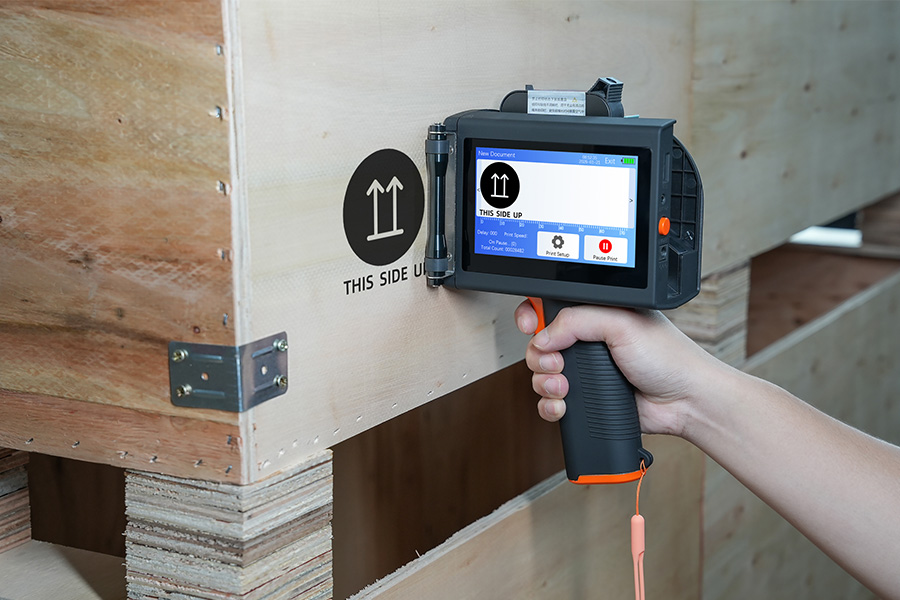
A handheld inkjet printer allows operators to bring the marking system directly to the product.
Typical applications include:
1) Steel components
2) Aluminum parts
3) Mechanical equipment
4) Automotive components
5) Hardware products
For metal marking, manufacturers usually evaluate:
1) Ink durability
2) Chemical resistance
3) Surface preparation
4) Long-term readability
5. Construction Materials and Large Products
Some products cannot easily move through an automated printing line.
Examples:
1) Wooden boards
2) Pipes
3) Building materials
4) Large packaging
5) Industrial containers
Portable printing technology solves this problem by changing the traditional workflow.
Instead of:
Product → Conveyor → Printer
the process becomes:
Operator → Portable Printer → Product
This reduces installation requirements and improves operational flexibility.
Which Manufacturing Processes Benefit Most From Handheld Inkjet Printing?
Different production processes receive different levels of benefit.
The following comparison helps manufacturers understand where handheld printing creates the strongest advantage.

A deeper analysis of these applications can be found in:
[Which Manufacturing Processes Benefit Most from Handheld Inkjet Printing?]
How to Determine If Your Factory Is Ready for a Handheld Inkjet Printer
Not every factory needs portable inkjet technology.
The following signs indicate that your operation may benefit significantly.
Sign 1: Your Product Information Changes Frequently
If your production team regularly changes:
1) Batch numbers
2) Dates
3) Product models
4) Customer information
manual labeling becomes inefficient.
A handheld inkjet printer provides faster adjustment without requiring new label inventory.
Sign 2: Your Products Are Difficult to Label
Some surfaces create problems for traditional labels:
1) Dusty environments
2) Rough surfaces
3) Curved products
4) Heavy industrial parts
5) Outdoor products
Direct printing can provide a more permanent identification method.
Sign 3: Labor Costs Are Increasing
Manual labeling requires:
1) Worker time
2) Label preparation
3) Inventory management
4) Quality checks
Direct coding can reduce unnecessary labor steps.
Sign 4: Your Factory Needs Better Traceability
Modern supply chains increasingly require manufacturers to track:
1) Production history
2) Batch information
3) Product origin
4) Quality records
Clear coding supports better inventory management and customer confidence.
Sign 5: Your Current Printing System Limits Production Flexibility
Many companies discover that their existing system creates bottlenecks.
Common problems:
1) Long setup times
2) Limited product compatibility
3) Expensive maintenance
4) Difficult operation
A portable system can complement existing equipment and improve flexibility.
Direct Inkjet Coding vs Labels: When Should Manufacturers Consider Switching?
Labels remain useful for many applications.
However, direct inkjet coding becomes more attractive when manufacturers experience repeated problems with labeling systems.

Manufacturers considering this transition should evaluate whether labels are creating hidden operational costs.
A detailed buying evaluation is covered in:
[Signs It's Time to Replace Labels with Direct Inkjet Coding]
Real Manufacturing Example: Reducing Label Dependency in Custom Packaging Production
A custom packaging manufacturer produced more than 200 product variations.
Originally, the company used pre-printed labels.
The challenges included:
1. Excess label inventory
2. Frequent label replacement
3. Incorrect label selection risks
4. Additional warehouse management
After introducing handheld inkjet printing:
The company could update product information directly through the printer interface.
Results:

The key lesson:
The value of a handheld inkjet printer is not only the printing function.
The value comes from improving the entire production workflow.
Application Selection Checklist
Before purchasing, manufacturers should review: What products require marking?
√ What materials need printing?
√ What information must be printed?
√ How often does production change?
√ Are products stationary or moving?
√ Is traceability required?
√ Are labels creating operational problems?
√ Does the printer need to support future expansion?
A clear understanding of these factors creates the foundation for selecting the correct machine.
Key Factors to Consider Before Buying a Handheld Inkjet Printer
Selecting a handheld inkjet printer is not simply a matter of choosing the model with the highest resolution, largest screen, or lowest price.
For manufacturers, the best printing solution is the one that matches the actual production environment.
A professional purchasing decision should consider multiple factors:
1. Printing requirements
2. Material compatibility
3. Ink performance
4. Print quality expectations
5. Production frequency
6. Operating environment
7. Maintenance requirements
8. Supplier capability
Many purchasing mistakes happen because buyers compare only technical specifications while ignoring real-world performance.
For example:
A printer with higher DPI does not automatically guarantee better industrial printing results.
A printer with more functions does not always provide higher productivity.
A lower purchase price does not always mean lower operating costs.
The correct approach is to evaluate the complete printing system.
1. Understand Your Printing Requirements Before Comparing Machines
Before reviewing different handheld inkjet printer models, manufacturers should clearly define their requirements.
A proper evaluation begins with five questions:
What information needs to be printed?
Common requirements include:
1) Text
2) Numbers
3) Batch codes
4) Date codes
5) Serial numbers
6) Barcodes
<How to Know If Your Factory Needs a Handheld Inkjet Printer Why More Manufacturers Are Switching to Handheld Inkjet Printers> return
+MoreRelated recommendations
-
Handheld Inkjet Printer Warranty Questions Buyers Should Ask Before Ordering
Ask these handheld inkjet printer warranty questions to clar...
-
Handheld Inkjet Printer Order Checklist: Printer, Ink, Accessories, and Spare Parts
Use this purchase checklist to confirm the printer, ink, acc...
-
What Information Should You Send for an Accurate Handheld Inkjet Printer Quote?
Use this RFQ worksheet to send the material, message, print ...
-
How to Print Scannable Barcodes and QR Codes on Plastic Packaging
Learn how to print scannable barcodes and QR codes on plasti...
Contact Us

Service phone number+8618759952301
—— Add WeChat communication


