
How to Maintain Consistent Print Quality in 24/7 Production
2026-05-14(124)Views
Maintaining stable print quality in 24/7 continuous production environments is one of the most challenging tasks in industrial inkjet printing. Unlike short-run printing, continuous operation exposes every weakness in ink systems, printheads, environmental control, and maintenance routines.
In high-volume manufacturing—such as packaging, food, pharmaceuticals, and logistics—even small fluctuations in print quality can lead to large-scale defects, rework costs, and compliance risks.
This guide explains how to achieve long-term, stable print performance in nonstop industrial production.
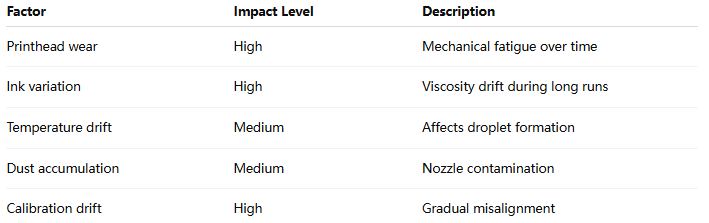
Why Print Quality Becomes Unstable in 24/7 Production
Print instability is usually not caused by a single failure, but by accumulated system stress over time.
Stability Degradation Factors
Core Principles of Stable Industrial Printing
To maintain consistent print quality, three principles must be controlled:
1. Stability of Ink System
Ink must remain:
1)Chemically consistent
2)Thermally stable
3)Free of sedimentation
2. Stability of Printhead Performance
Key requirements:
1)Constant droplet size
2)Stable firing frequency
3)Nozzle cleanliness
3. Stability of Production Environment
Includes:
1)Temperature control
2)Humidity control
3)Vibration reduction
Common Causes of Quality Fluctuation in 24/7 Operation
1. Thermal Drift in Continuous Operation
Long-term printing causes:
1)Heat buildup in printhead
2)Slight droplet size variation
3)Gradual density inconsistency
2. Ink Viscosity Drift Over Time
Ink properties change due to:
1)Evaporation
2)Continuous circulation
3)Environmental temperature shifts
3. Mechanical Misalignment
Over time:
1)Mounting brackets loosen
2)Print distance changes slightly
3)Alignment shifts occur
4. Nozzle Fatigue and Micro-Clogging
Even without full blockage:
1)Partial nozzle loss occurs
2)Print density becomes uneven
3)Characters lose sharpness
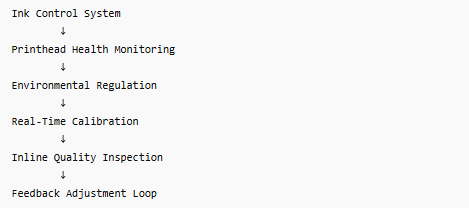
Industrial Stability Control Framework
24/7 Print Stability System Model
How to Maintain Stable Print Quality
1. Implement Real-Time Calibration
Modern systems should:
1)Auto-adjust voltage output
2)Compensate for temperature drift
3)Correct alignment deviations
2. Establish Preventive Maintenance Cycles

3. Control Environmental Conditions
Recommended Range:

4. Use Closed-Loop Print Monitoring
Advanced systems include:
1)Camera-based inspection
2)Barcode verification
3)Automatic rejection systems
5. Standardize Ink Supply System
To prevent inconsistency:
1)Use single ink batch per production cycle
2)Avoid mixing suppliers
3)Monitor ink aging
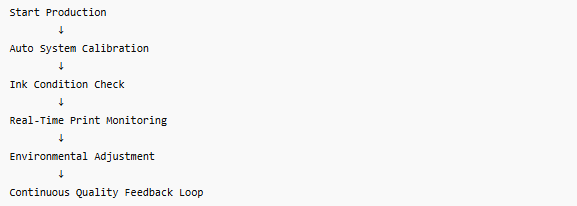
Production Stability Optimization Flow
Industrial Insight
In real-world manufacturing environments, most print instability issues do not occur suddenly—they develop gradually due to lack of closed-loop control systems.
Factories that implement real-time monitoring and automated calibration typically achieve:
1、30–50% reduction in print defects
2、20–40% improvement in uptime efficiency
3、Significantly lower maintenance intervention rates
Common Mistakes in 24/7 Printing Operations
× Mistake 1: Relying only on manual inspection
Human inspection cannot detect micro-level drift.
× Mistake 2: Ignoring environmental fluctuations
Small temperature changes accumulate into print instability.
× Mistake 3: Running without preventive maintenance
Reactive maintenance leads to unplanned downtime.
FAQ
Why does print quality change during long production runs?
Because ink, temperature, and printhead conditions gradually drift over time.
Can industrial printers run 24/7 without quality loss?
Yes, but only with proper calibration, maintenance, and monitoring systems.
What is the most important factor in stable printing?
Closed-loop control of ink system and printhead performance.
If your production line requires stable 24/7 printing but you are experiencing quality drift, inconsistent barcodes, or increasing defect rates, the issue is usually system-level control—not just the printer itself.
Get a Free 24/7 Print Stability Optimization Report
We help manufacturers improve:
1、Continuous print consistency
2、Production uptime efficiency
3、Industrial coding reliability
Ready to Improve Your Printing Efficiency?
Get expert advice and the best solution tailored to your business.
Get Your Free Quote Within 24 Hours✔ Fast response ✔ Custom solution ✔ No obligation
+MoreRelated recommendations
-
Why More Manufacturers Are Switching to Handheld Inkjet Printers
In the past, industrial coding was dominated by fixed-positi...
-
Handheld Inkjet Printer Cost: Initial Investment and Operating Expenses
When businesses evaluate handheld inkjet printers, the first...
-
Handheld Inkjet Printer Maintenance Guide for Long-Term Reliability
In industrial environments, equipment reliability is not det...
-
How to Choose the Right Handheld Inkjet Printer for Your Business
Learn how to choose the right handheld inkjet printer for yo...
Contact Us

Service phone number+8618759952301
—— Add WeChat communication


