
How Handheld Inkjet Printers Influence Workflow Design on the Shop Floor
2026-02-24(170)Views
Shop floor workflows are shaped not only by machines and layout, but by the tools operators use every day. Handheld inkjet printers subtly but significantly influence how work is organized, sequenced, and executed on the shop floor.
Understanding this impact helps manufacturers design workflows that are more flexible, resilient, and efficient.
Workflow Design Is About Movement, Timing, and Decisions
At its core, workflow design determines:
1.Where work happens
2.When decisions are made
3.How materials and people move
Introducing handheld inkjet printers changes all three.
Shifting Coding from Fixed Stations to Flexible Points
Traditional coding systems anchor printing to specific locations.
Handheld inkjet printers:
1.Decouple coding from fixed lines
2.Enable printing at multiple points
3.Allow coding closer to final inspection or shipment
This flexibility reshapes material flow.
Reducing Bottlenecks During Changeovers
Changeovers often disrupt workflow.
With handheld inkjet printers:
1.Coding adjustments happen without stopping lines
2.Operators bypass bottleneck stations
3.Flow continuity improves
This is especially valuable in high-mix environments.
Enabling Parallel Tasks Instead of Sequential Ones
Fixed coding systems enforce sequence.
Handheld printing allows:
1.Coding to occur in parallel with packing
2.Rework without rerouting materials
3.Faster recovery from interruptions
Parallelization improves throughput.
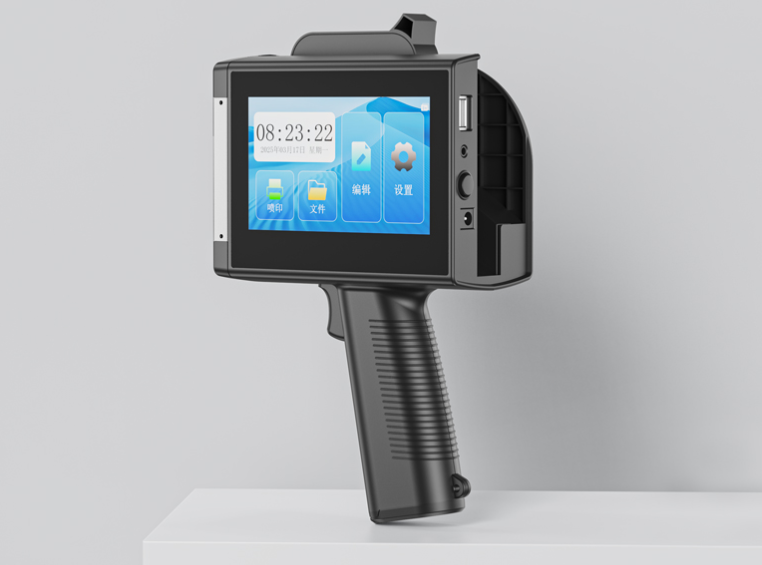
Supporting Exception Handling Without Workflow Collapse
Exceptions are inevitable.
Handheld inkjet printers act as:
1.Workflow safety valves
2.Rework enablers
3.Last-step correction tools
They prevent exceptions from derailing the entire process.
Changing Operator Roles and Responsibilities
When coding becomes mobile:
1.Operators take on more ownership
2.Decision-making moves closer to execution
3.Communication loops shorten
This influences how roles are defined and trained.
Impact on Space Utilization and Layout
Removing fixed coding stations can:
1.Free up floor space
2.Simplify layout constraints
3.Enable more modular setups
Workflow becomes easier to reconfigure.
Improving Responsiveness to Real-Time Information
Handheld inkjet printers allow:
1.Immediate response to data changes
2.Real-time corrections
3.Faster implementation of instructions
This aligns workflows with dynamic production environments.
Managing the Trade-Off Between Flexibility and Control
Flexibility introduces variability.
Effective workflow design balances:
1.Clear process boundaries
2.Defined usage scenarios
3.Quality checkpoints
Structure preserves control.
When Handheld Printing Enhances Lean Principles
Used intentionally, handheld inkjet printers support:
1.Waste reduction
2.Shorter lead times
3.Continuous flow
They are tools—not shortcuts.
Designing Workflows with the Tool in Mind
Workflow success depends on aligning tools with intent.
Handheld inkjet printers should be:
1.Planned into the process
2.Governed by clear rules
3.Supported by training
Ad hoc use leads to inefficiency.
Talk to Our Company About Smarter Shop Floor Workflow Design
Our company helps manufacturers integrate handheld inkjet printers into well-designed workflows. We focus on flow, control, and practical execution—not just equipment placement.
Contact our company today to design shop floor workflows that adapt without breaking.
+MoreRelated recommendations
-
Handheld Inkjet Printer Warranty Questions Buyers Should Ask Before Ordering
Ask these handheld inkjet printer warranty questions to clar...
-
Handheld Inkjet Printer Order Checklist: Printer, Ink, Accessories, and Spare Parts
Use this purchase checklist to confirm the printer, ink, acc...
-
What Information Should You Send for an Accurate Handheld Inkjet Printer Quote?
Use this RFQ worksheet to send the material, message, print ...
-
How to Print Scannable Barcodes and QR Codes on Plastic Packaging
Learn how to print scannable barcodes and QR codes on plasti...
Contact Us

Service phone number+8618759952301
—— Add WeChat communication


