
Using Handheld Inkjet Printers for Temporary or Pilot Production Lines
2026-02-25(151)Views
Temporary and pilot production lines play a critical role in modern manufacturing. They allow companies to test products, validate processes, and respond quickly to market opportunities. In these environments, handheld inkjet printers offer unmatched flexibility and speed.
Understanding how to use them correctly helps teams avoid overinvestment while maintaining operational control.
Why Temporary and Pilot Lines Exist
Manufacturers rely on temporary or pilot lines to:
1.Validate new products
2.Test packaging designs
3.Support limited-time contracts
4.Respond to demand spikes
These lines are built for speed, not permanence.
Why Permanent Coding Systems Often Don’t Fit
Traditional automated coding systems assume:
1.Stable layouts
2.Long-term volume
3.Fixed data structures
Temporary lines rarely meet these conditions.
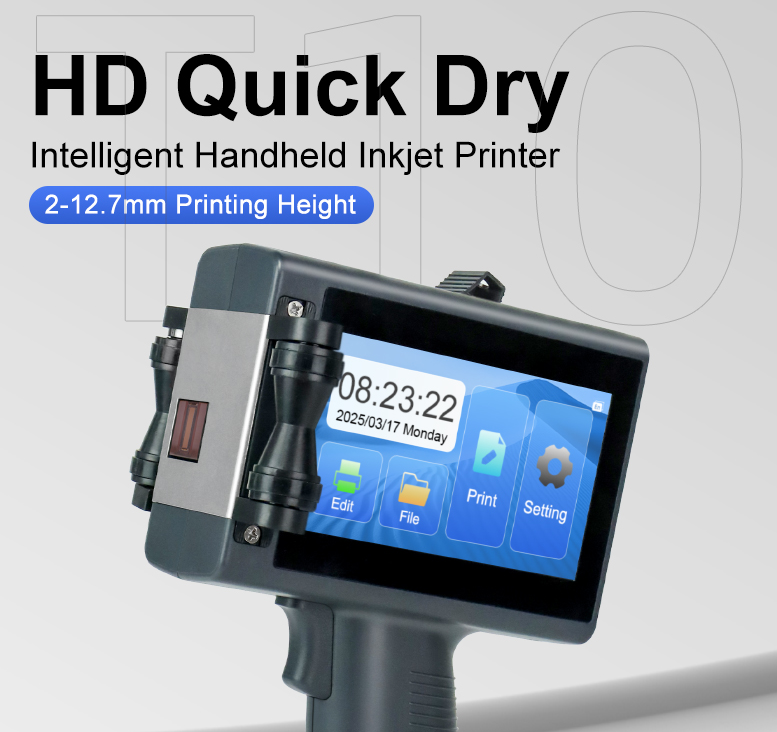
Handheld Inkjet Printers Enable Rapid Deployment
Handheld inkjet printers can be:
1.Deployed in minutes
2.Used without infrastructure changes
3.Relocated as needed
This minimizes setup time and disruption.
Supporting Fast Iteration and Learning
Pilot production is about learning quickly.
Handheld inkjet printers allow:
1.Immediate data updates
2.Easy format changes
3.Real-time corrections
This accelerates validation cycles.
Minimizing Capital Risk During Early Phases
Investing heavily before proof creates risk.
Handheld solutions:
1.Require lower upfront cost
2.Avoid long-term commitment
3.Preserve capital flexibility
This aligns with staged investment strategies.
Maintaining Coding Accuracy Without Overengineering
Accuracy still matters—even in pilot runs.
With proper controls, handheld inkjet printers deliver:
1.Clear, legible codes
2.Reliable batch identification
3.Traceability-ready output
Simplicity does not mean sacrificing compliance.
Adapting to Layout and Process Changes
Temporary lines change frequently.
Handheld inkjet printers adapt easily to:
1.Layout adjustments
2.Process redesigns
3.Volume fluctuations
Mobility supports experimentation.
Enabling Small Teams and Lean Staffing
Pilot lines often operate with limited personnel.
Handheld printers:
1.Reduce dependency on specialists
2.Empower operators
3.Simplify training
This keeps teams agile.
Knowing When to Transition Away from Handheld Printing
As volume stabilizes, limitations emerge.
Signals to upgrade include:
1.Increased throughput
2.Tightening quality tolerance
3.Higher automation demands
Planning this transition avoids disruption.
Best Practices for Controlled Temporary Use
To succeed, companies should:
1.Define usage scope
2.Set quality expectations
3.Document processes
Temporary does not mean unstructured.
Turning Temporary Lines into Strategic Assets
When supported by the right tools, pilot lines become engines of innovation—not cost centers.
Handheld inkjet printers help bridge the gap between concept and scale.
Talk to Our Company About Flexible Coding for Pilot Production
Our company helps manufacturers deploy handheld inkjet printers safely and effectively for temporary and pilot production lines. We support scalable strategies that grow with your operation.
Contact our company today to reduce risk and accelerate validation.
+MoreRelated recommendations
-
Handheld Inkjet Printer Warranty Questions Buyers Should Ask Before Ordering
Ask these handheld inkjet printer warranty questions to clar...
-
Handheld Inkjet Printer Order Checklist: Printer, Ink, Accessories, and Spare Parts
Use this purchase checklist to confirm the printer, ink, acc...
-
What Information Should You Send for an Accurate Handheld Inkjet Printer Quote?
Use this RFQ worksheet to send the material, message, print ...
-
How to Print Scannable Barcodes and QR Codes on Plastic Packaging
Learn how to print scannable barcodes and QR codes on plasti...
Contact Us

Service phone number+8618759952301
—— Add WeChat communication


