
What Causes Ink Adhesion Issues on Plastic Surfaces
2026-05-09(272)Views
Ink adhesion failure on plastic is one of the most persistent and costly problems in industrial coding and marking. When ink does not properly bond to plastic packaging, it leads to smudging, fading, and complete loss of traceability information.
Unlike paper or porous materials, plastic has low surface energy, which makes ink bonding technically challenging. This article breaks down the real engineering reasons behind adhesion failure and how to solve them in production environments.
Why Plastic Surfaces Are Difficult for Ink Adhesion
Plastic materials such as PE, PP, PET, and PVC share a common characteristic: non-porous and chemically inert surfaces.
Surface Energy Comparison Table
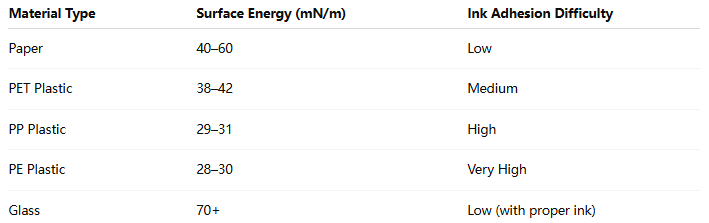
The lower the surface energy, the harder it is for ink to bond.
Main Causes of Ink Adhesion Failure on Plastic
1. Low Surface Energy (Primary Cause)
Most plastic packaging is chemically resistant, meaning:
1)Ink sits on surface instead of bonding
2)Drying does not equal adhesion
3)Smudging occurs under friction
2. Surface Contamination (Oil, Dust, Additives)
Plastic production often leaves:
1)Mold release agents
2)Processing oils
3)Anti-static coatings
These invisible layers block ink bonding.
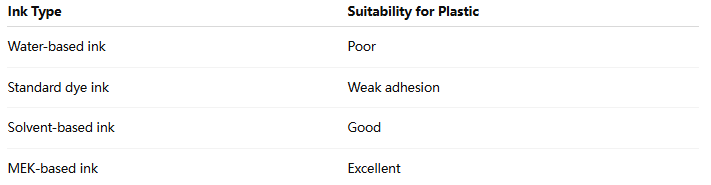
3. Incorrect Ink Chemistry
Not all inks are designed for plastics.
4. Insufficient Drying Time
High-speed production lines reduce drying time:
1)Ink remains semi-liquid
2)Contact friction removes print layer
3)Barcode degradation occurs
5. Improper Printhead Distance
If distance is too large:
1)Ink droplets lose velocity
2)Poor surface penetration
3)Weak bonding strength
Surface Treatment Solutions (Industrial Grade Fixes)
1. Corona Treatment
Increases surface energy by:
1)Electrical discharge
2)Micro-level oxidation
3)Improved ink anchoring
2. Plasma Treatment
More advanced than corona:
1)Cleaner surface activation
2)Better long-term stability
3)Suitable for high-end packaging
3. Flame Treatment (Heavy Industry Use)
1)Burns surface impurities
2)Increases bonding capability
3)Used in pipe, bottle, and container production
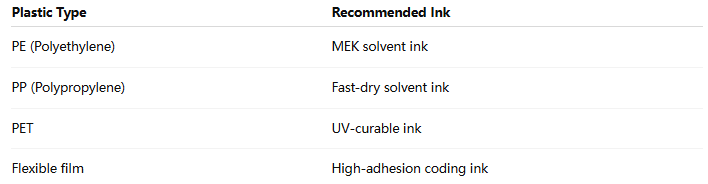
Ink Selection Strategy for Plastic Surfaces
Ink Compatibility Matrix
Production Line Optimization Tips
Control Environmental Humidity
1. Ideal range: 40%–60%
2. Too high → slow drying
3. Too low → static issues
Reduce Conveyor Contact Friction
1. Minimize rubbing immediately after printing
2. Add buffer distance for drying
Increase Ink Penetration Efficiency
1. Adjust printhead angle
2. Optimize droplet velocity
3. Reduce print distance
Ink Adhesion Failure Diagnostic Flow
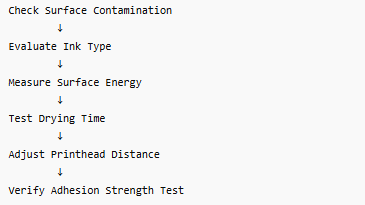
Industrial Insight
In packaging production environments, over 60% of ink adhesion issues on plastics are not ink-related—but surface treatment-related failures.
Factories that integrate corona or plasma treatment before printing typically achieve:
1. 3–5x stronger ink adhesion
2. 40% reduction in reprint waste
3. Higher barcode durability under friction testing
FAQ
Why does ink wipe off plastic even after drying?
Because drying is physical evaporation, not chemical bonding—plastic requires surface activation for adhesion.
What is the best ink for plastic packaging?
MEK-based or solvent-based industrial inks are most effective for PP and PE materials.
Can adhesion be improved without surface treatment?
Yes, but only partially—ink selection and drying optimization help, but cannot fully replace surface activation.
Why does ink stick better on some plastics than others?
It depends on surface energy and chemical composition of the polymer.
If your production line is facing ink peeling, smudging, or unreadable codes on plastic packaging, the issue is usually deeper than just ink selection.
Get a Free Ink Adhesion Diagnostic Report for Your Material
We help manufacturers optimize:
1. Ink–substrate compatibility
2. Surface treatment strategy
3. Print stability in high-speed production
Ready to Improve Your Printing Efficiency?
Get expert advice and the best solution tailored to your business.
Get Your Free Quote Within 24 Hours✔ Fast response ✔ Custom solution ✔ No obligation
+MoreRelated recommendations
-
How to Print Lot and Expiry Codes on Plastic Cups, Tubs, and Food Containers
Learn how to print lot and expiry codes on plastic cups, tub...
-
How to Print Durable Codes on Plastic Caps, Lids, and Closures
Learn how to print durable lot and date codes on plastic cap...
-
How to Print Batch Codes on Flexible Plastic Bags and Pouches
Learn how to print durable batch codes on flexible plastic b...
-
How to Print Expiry Dates on Plastic Bottles Without Smudging
Learn how to print expiry dates on plastic bottles without s...
Contact Us

Service phone number+8618759952301
—— Add WeChat communication


