
Printing on Different Materials with Handheld Inkjet Printers: The Complete Industrial Guide
2026-07-28(9)Views
A handheld inkjet printer may look like a simple coding tool, but achieving consistent, durable print quality depends on much more than selecting the right printer model. In industrial production, the surface being printed often has a greater impact on code durability than the printer itself.
Manufacturers frequently ask questions such as:
1. Why does ink bond perfectly to one plastic but smear on another?
2. Why do codes remain permanent on stainless steel yet peel from painted metal?
3. Why can the same ink cartridge produce excellent results on corrugated cartons but struggle on glossy packaging film?
These issues are rarely caused by the printer alone. Instead, they are influenced by a combination of material properties, surface energy, ink chemistry, environmental conditions, production speed, and curing time.
As manufacturing continues to adopt product traceability, barcode verification, anti-counterfeiting measures, and regulatory identification, printing reliability has become a critical quality factor rather than a simple production task. A faded batch code, an unreadable QR code, or poor ink adhesion can interrupt logistics, increase rework, or even create compliance risks.
Modern handheld inkjet printers have evolved into highly flexible industrial marking systems capable of printing on a wide variety of materials, including plastics, metals, paper packaging, flexible films, wood, rubber, glass, and construction products. However, every material presents unique challenges that require different printing strategies.
This guide explains how different substrates influence industrial coding performance and how manufacturers can optimize print quality across diverse production environments. Instead of focusing only on printer specifications, we'll examine the factors that truly determine long-term printing success—from surface compatibility and ink adhesion to production conditions and material-specific best practices.
Need Advice Before Choosing a Printing Solution?
Every production environment is different. Tell us what material you need to print on, and our engineering team will recommend the most suitable handheld inkjet printer, compatible ink, and optimized printing parameters.
Why Material Compatibility Is the Foundation of Successful Industrial Printing
Many purchasing decisions begin by comparing printer resolution, print height, or cartridge capacity. While these specifications are important, experienced production engineers often evaluate something else first:
Can the selected ink form a durable bond with the target material?
Without proper material compatibility, even the highest-resolution printer cannot deliver reliable industrial coding.
The interaction between ink and substrate determines whether printed information remains readable throughout manufacturing, transportation, storage, and final use.
Several physical characteristics influence this interaction:
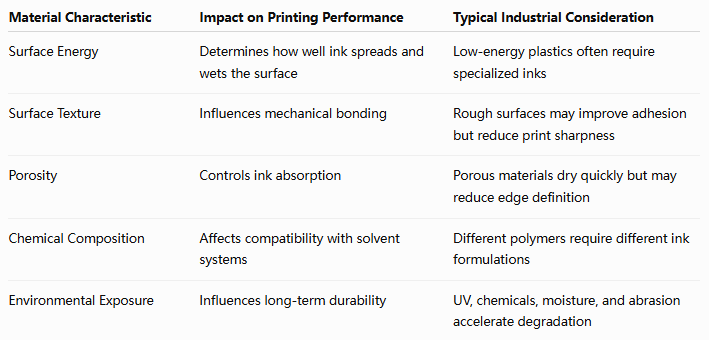
Rather than asking whether a handheld inkjet printer can print on a material, manufacturers should ask whether the complete printing system—including ink formulation, drying characteristics, and operating conditions—is optimized for that material.
This distinction becomes increasingly important as production lines handle multiple product types using a single coding system.
Understanding Surface Energy: Why Similar Materials Behave Completely Differently
One of the most misunderstood concepts in industrial coding is surface energy.
Surface energy determines how easily liquid ink spreads across a material before drying. Materials with high surface energy allow ink droplets to wet the surface evenly, creating strong adhesion. Low-energy materials resist wetting, causing ink to bead, smear, or peel away after curing.
The difference is significant enough that two visually similar products may require completely different printing strategies.
Typical Surface Energy Characteristics
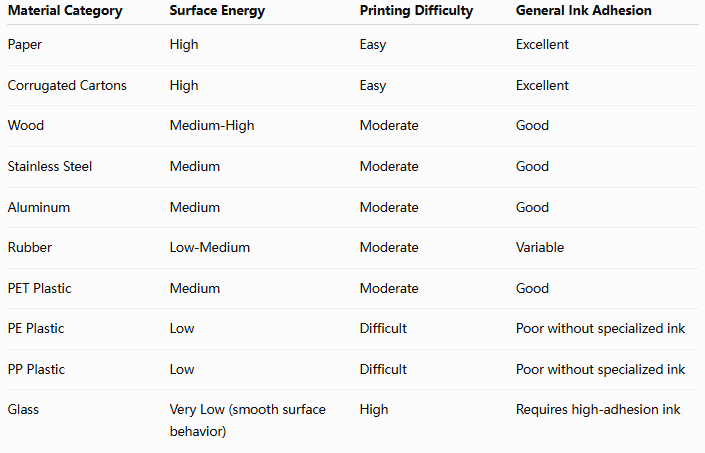
Understanding these differences explains why manufacturers often experience inconsistent results when changing packaging materials without changing ink formulations.
For example, many factories producing multiple plastic products assume that all plastics behave similarly during coding. In reality, polyethylene (PE), polypropylene (PP), PET, ABS, PVC, and acrylic all exhibit different adhesion characteristics because of their molecular structures and surface energies.
Manufacturers dealing with multiple polymer types should understand How Ink Adhesion Varies Across Different Plastic Materials, since selecting one universal printing setup rarely produces consistent long-term results across every plastic substrate.
Beyond the Printer: Five Variables That Actually Determine Print Quality
Reliable industrial coding is the result of an integrated process rather than a single machine. Production engineers typically evaluate five interconnected variables before approving a printing solution.
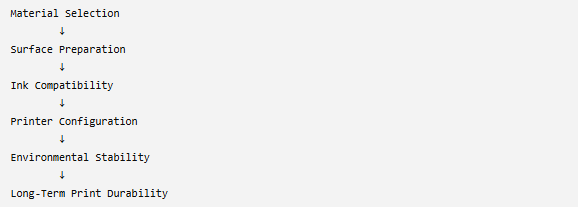
Ignoring any one of these factors increases the likelihood of print failures, regardless of the printer brand or resolution.
1. Material Properties
Every substrate reacts differently to ink.
Smooth, glossy plastics require different wetting behavior than porous paper bags. Painted metals behave differently from untreated stainless steel. Flexible films stretch during packaging, while wooden pallets absorb solvents unevenly.
Understanding the material itself should always be the starting point of any coding project.
2. Ink Formulation
Industrial inks are designed for specific substrate categories.
Some prioritize rapid evaporation for high-speed packaging lines, while others emphasize chemical resistance or abrasion resistance.
Selecting the wrong ink often causes more printing problems than selecting the wrong printer.
For manufacturers working with glossy polymers, understanding Choosing the Right Ink for Non-Porous Plastic Surfaces can significantly improve print permanence and reduce production rejects without changing equipment.
3. Production Speed
A code printed successfully at low speed may fail during full-scale production.
Fast conveyor systems reduce available drying time and increase the risk of smearing, especially on non-absorbent materials.
Production speed should always be considered alongside ink drying characteristics.
4. Environmental Conditions
Temperature, humidity, dust, and airflow all influence solvent evaporation.
Cold production environments often slow drying.
High humidity may delay curing.
Dust contamination reduces adhesion.
Outdoor production introduces UV exposure and moisture.
Industrial coding systems must remain stable under actual operating conditions—not just laboratory testing.
5. Expected Product Life Cycle
Temporary warehouse identification requires very different durability than permanent product traceability.
Manufacturers should define expected service life before selecting ink.
A shipping carton may only require readable codes for several weeks, while automotive components may require permanent identification throughout years of operation.
Industrial Reality: One Printer, Many Materials
Modern factories rarely manufacture products using a single substrate.
A packaging facility may simultaneously print on:
1. Corrugated shipping cartons
2. Plastic shrink film
3. Laminated labels
4. Paper bags
5. Plastic containers
An automotive supplier might code:
1. Stainless steel brackets
2. Aluminum housings
3. Rubber seals
4. Plastic connectors
5. Painted assemblies
This diversity explains why experienced manufacturers evaluate material compatibility before comparing printer specifications.
Instead of purchasing multiple dedicated systems, many businesses optimize a handheld inkjet printer through appropriate ink selection and printing parameters for each production scenario.
The following sections examine how different material categories influence coding performance and what practical strategies manufacturers use to achieve reliable, durable industrial marking across a wide range of substrates.
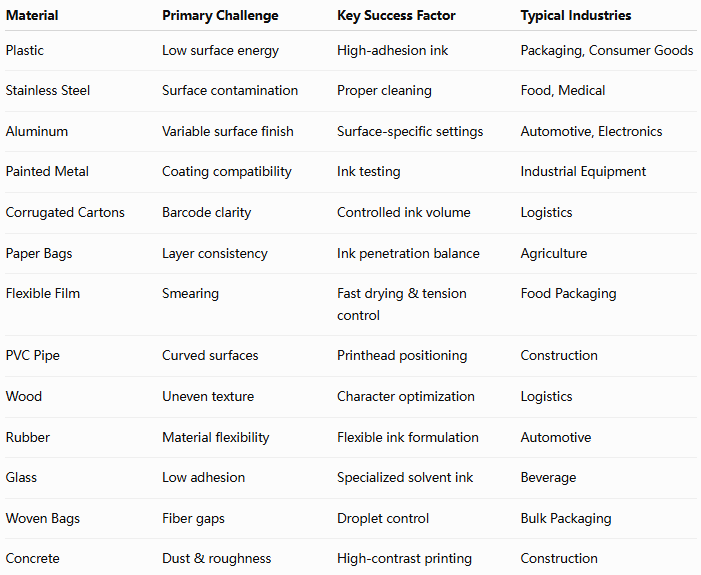
Material Compatibility Matrix: How Different Industrial Materials Respond to Inkjet Printing
Not all materials interact with ink in the same way. Even within the same product category, differences in chemical composition, surface treatment, texture, and manufacturing processes can significantly affect print quality.
Instead of evaluating materials simply as "easy" or "difficult" to print, industrial engineers often classify substrates according to several key performance indicators that directly influence coding reliability.
The following matrix provides a high-level comparison of common industrial materials used across manufacturing, packaging, logistics, and construction.
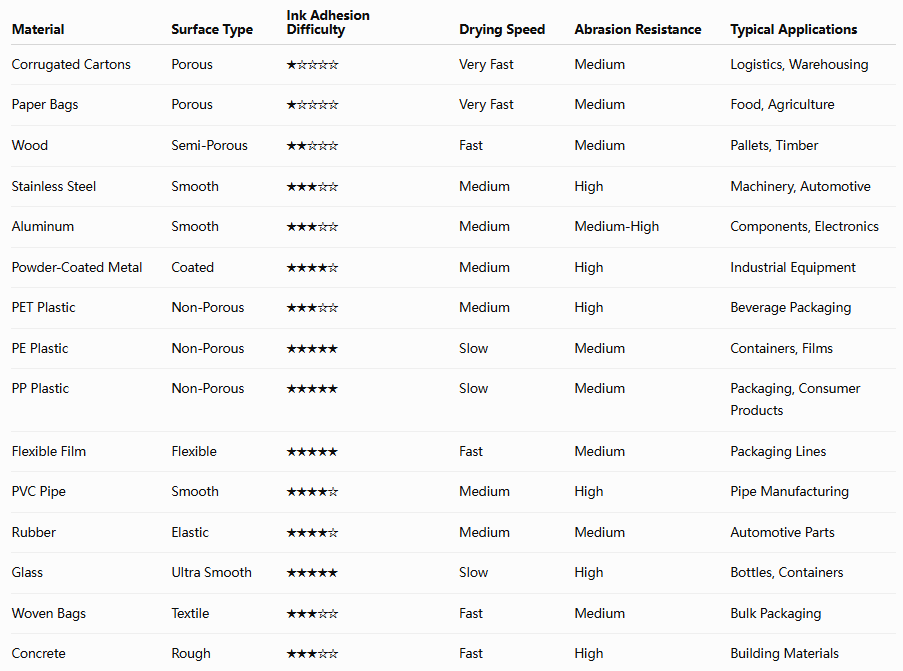
The table highlights an important reality: printing difficulty is not determined by hardness or appearance, but by how the material interacts with ink during and after deposition.
For example, stainless steel appears smoother than corrugated cardboard, yet cardboard is generally much easier to print because its porous structure absorbs ink rapidly. Conversely, smooth plastics and glass require ink to bond primarily through surface adhesion rather than absorption, making ink selection considerably more important.
Understanding Three Material Categories That Influence Print Performance
Although manufacturers work with hundreds of different substrates, most industrial printing challenges fall into three broad categories.
Understanding these categories helps engineers predict potential coding issues before production begins.
1. Porous Materials: Fast Drying, Reliable Adhesion
Porous materials absorb a portion of the ink immediately after contact.
This natural absorption shortens drying time and generally improves resistance to smearing during handling.
Typical examples include:
1) Corrugated shipping cartons
2) Kraft paper bags
3) Cardboard packaging
4) Untreated wood
5) Fiberboard products
These materials are among the easiest substrates for handheld inkjet printers because the ink penetrates microscopic pores instead of remaining entirely on the surface.
However, porous materials introduce a different challenge.
Excessive absorption can reduce print density, soften character edges, or slightly distort high-resolution QR codes if inappropriate ink formulations are used.
Rather than maximizing ink volume, manufacturers often achieve better results by balancing droplet size with substrate absorption characteristics.
2. Non-Porous Materials: Adhesion Becomes the Primary Challenge
Non-porous materials present almost the opposite situation.
Since ink cannot penetrate the surface, every printed droplet remains exposed until solvent evaporation and chemical bonding are complete.
This increases the likelihood of:
1) Smearing
2) Ink transfer
3) Finger marking
4) Poor scratch resistance
5) Delayed drying
Materials commonly found in this category include:
1) Polyethylene (PE)
2) Polypropylene (PP)
3) PET bottles
4) Acrylic
5) Glass
6) Stainless steel
7) Aluminum
8) PVC
9) Laminated packaging
Many production managers initially assume that increasing printer resolution or slowing production speed will solve these problems.
In reality, the underlying issue is often ink compatibility rather than printer capability.
Manufacturers working with glossy polymers, molded containers, or laminated packaging materials frequently improve print durability simply by Choosing the Right Ink for Non-Porous Plastic Surfaces, rather than replacing existing equipment.
This distinction is particularly valuable for facilities seeking to increase production efficiency without investing in new printing systems.
3. Flexible and Deformable Materials: Maintaining Print Integrity During Handling
A third category includes materials that change shape after printing.
Unlike rigid substrates, flexible materials may stretch, compress, bend, or wrinkle during packaging, transportation, or installation.
Examples include:
1) Plastic films
2) Woven polypropylene bags
3) Flexible packaging
4) Rubber products
5) Industrial hoses
For these applications, the printed image must remain readable even after the substrate has been mechanically deformed.
Ink flexibility therefore becomes just as important as adhesion.
This explains why packaging manufacturers evaluate ink elasticity alongside drying speed when selecting industrial coding solutions.
Printing on Plastic: Why It Remains the Most Challenging Industrial Material
Plastic is one of the most widely used manufacturing materials worldwide, yet it is also one of the most technically demanding substrates for industrial coding.
Unlike paper or cardboard, plastics generally resist liquid wetting.
Many common polymers—including PE and PP—have naturally low surface energy, making it difficult for conventional inks to establish a durable bond.
As a result, identical printers may produce dramatically different results depending on which plastic is being coded.
For example:
1. PET beverage bottles often provide relatively stable adhesion.
2. HDPE containers may require specialized fast-drying ink.
3. Polypropylene packaging films frequently present smearing risks.
4. Injection-molded plastic components may behave differently depending on mold release agents and manufacturing residues.
This is why successful industrial coding begins with understanding the substrate—not simply selecting a printer.
Manufacturers processing multiple polymer types should first understand How Ink Adhesion Varies Across Different Plastic Materials, because each resin family responds differently to industrial inks.
Ignoring these differences often leads to inconsistent batch coding, barcode failures, and unnecessary production downtime.
Plastic Packaging Requires More Than Fast-Drying Ink
Consumer packaging continues to evolve toward higher production speeds, thinner materials, and increasingly glossy finishes.
While these changes improve packaging efficiency, they also create new challenges for industrial coding.
Freshly printed packages may immediately pass through:
1. Conveyors
2. Heat tunnels
3. Shrink wrapping
4. Automated stacking systems
5. Palletizing equipment
Under these conditions, even slight delays in drying can cause transferred codes, blurred expiration dates, or unreadable QR codes.
Many manufacturers initially focus on purchasing faster printers, but experienced engineers know that stable coding depends on balancing printer speed, ink chemistry, drying time, and packaging movement.
Facilities producing food, beverage, pharmaceutical, and consumer goods packaging can significantly reduce rework by following the principles discussed in Printing on Plastic Packaging Without Smearing or Ink Transfer, where production-line conditions are analyzed in greater technical detail.
Common Plastic Printing Challenges
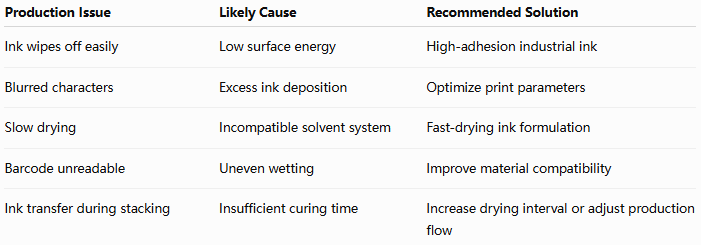
These issues demonstrate why successful plastic coding requires coordination between material selection, ink chemistry, production speed, and environmental control rather than focusing on printer specifications alone.
Planning to Print on Plastic, Metal, Glass, or Other Challenging Materials?
Choosing the correct printer is only part of the solution. Our engineering team can evaluate your substrate, production speed, environmental conditions, and durability requirements to recommend the most suitable handheld inkjet printing solution.
Industrial Printing on Metal Surfaces: Durability Depends on More Than the Material
Metal products are found throughout modern manufacturing—from automotive components and food processing equipment to electrical enclosures and industrial machinery. While many manufacturers assume that metals are easy to print because of their rigid surfaces, real production environments reveal a much more complex picture.
Unlike porous substrates, metal surfaces do not absorb ink. Every printed character relies almost entirely on the interaction between the ink formulation and the substrate surface. Even slight differences in surface preparation can significantly influence adhesion, scratch resistance, and long-term readability.
More importantly, "metal" is not a single printing surface. Stainless steel, aluminum, galvanized steel, powder-coated parts, and painted components each behave differently during industrial coding.
Before selecting an ink or printer, engineers typically evaluate:
1. Surface cleanliness
2. Surface finish
3. Protective coatings
4. Exposure to chemicals
5. Operating temperature
6. Expected product lifetime
These variables often have a greater influence on print durability than printer resolution.
Stainless Steel: A Durable Material That Requires Careful Surface Preparation
Stainless steel is widely used because of its corrosion resistance, strength, and clean appearance. It is commonly found in:
1. Food processing equipment
2. Pharmaceutical machinery
3. Medical devices
4. Chemical processing systems
5. Industrial valves and fittings
Although stainless steel provides a stable surface for printing, it is also susceptible to invisible contaminants such as machining oil, polishing compounds, fingerprints, or protective films.
These contaminants reduce surface wetting and prevent ink from forming a strong bond.
Successful coding therefore begins long before the printer is switched on. Surface cleaning, drying, and selecting the correct solvent-based ink are essential steps in achieving permanent identification.
Manufacturers producing equipment for demanding industrial environments often need to understand Permanent Coding on Stainless Steel: Challenges and Best Practices, where factors such as passivation, abrasion resistance, and chemical exposure are examined in greater detail.
Typical Factors Affecting Stainless Steel Printing
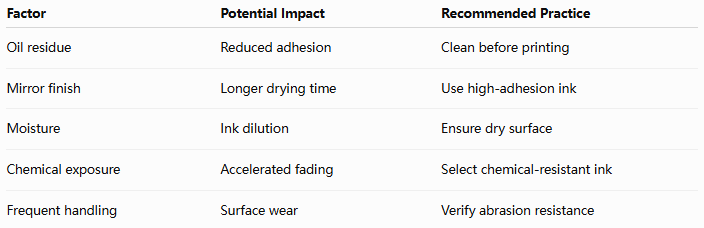
Aluminum Components: Surface Finish Changes Everything
Aluminum is another common industrial substrate, but unlike stainless steel, it can exhibit dramatically different printing behavior depending on how the surface has been processed.
For example:
1. Polished aluminum reflects more light and offers fewer microscopic anchor points.
2. Sandblasted aluminum provides a rougher texture that often improves mechanical adhesion.
3. Anodized aluminum introduces an oxide layer that changes surface chemistry.
4. Machined aluminum may retain lubricants that interfere with ink bonding.
These differences explain why one aluminum component may print perfectly while another produced in the same factory experiences poor adhesion.
Rather than treating all aluminum parts as identical, engineers evaluate the manufacturing process before selecting ink.
Manufacturers looking for more consistent coding performance should also review How Surface Finish Affects Inkjet Printing on Aluminum Parts, particularly when products move through multiple machining or finishing operations before marking.
Powder-Coated and Painted Metals Introduce Additional Variables
Industrial equipment, electrical cabinets, machinery frames, and consumer products are frequently protected by powder coating or industrial paint.
These coatings improve corrosion resistance and appearance, but they also create a completely different printing surface from bare metal.
The coating itself determines:
1. Surface energy
2. Drying characteristics
3. Scratch resistance
4. Solvent compatibility
5. Long-term durability
Even coatings that appear visually identical may use different resin systems, resulting in different ink performance.
This is one reason why experienced manufacturers rarely approve a new coding project without sample testing on actual production parts.
Facilities producing coated machinery, fabricated assemblies, or painted components can further improve coding reliability by understanding Printing on Powder-Coated and Painted Metal Products, especially when products are exposed to outdoor conditions or frequent handling.
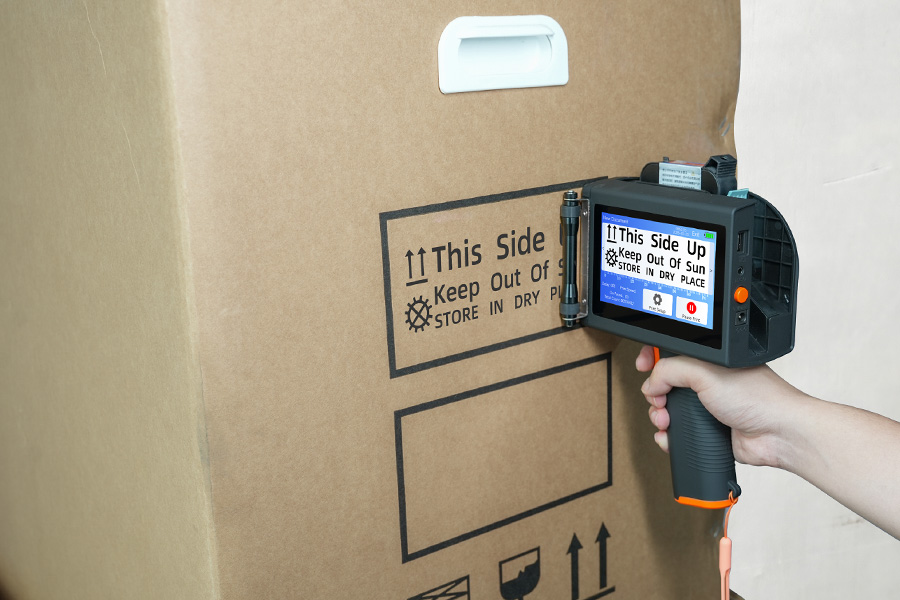
Not sure which printer fits your application?
Request a Custom Solution TodayPaper-Based Packaging: Simple Materials Still Require Smart Printing Strategies
Compared with plastics and metals, paper-based packaging is generally one of the easiest categories for handheld inkjet printing.
Paper fibers naturally absorb ink, allowing rapid drying and reducing the likelihood of smearing during production.
However, "paper packaging" includes a wide range of substrates with very different characteristics.
Examples include:
1. Corrugated cartons
2. Kraft paper bags
3. Multi-wall industrial sacks
4. Laminated paper packaging
5. Recycled paperboard
6. Coated paper labels
Each responds differently to industrial inks.
Corrugated Shipping Cartons: Balancing Speed and Barcode Quality
Corrugated cartons remain one of the most common substrates for industrial coding.
Typical printed information includes:
1. Shipping labels
2. Product identification
3. Batch numbers
4. Manufacturing dates
5. GS1 barcodes
6. QR codes
Although corrugated cardboard absorbs ink effectively, excessive absorption may reduce print sharpness, especially when high-density barcodes are required.
Production managers therefore balance three objectives:
1. Fast drying
2. High barcode readability
3. Minimal ink consumption
Maintaining this balance becomes increasingly important on high-speed packaging lines where thousands of cartons pass through every hour.
Manufacturers seeking to optimize secondary packaging identification can learn more from Printing Durable Codes on Corrugated Shipping Cartons, which explores print parameter optimization, barcode verification, and warehouse durability.
Paper Bags and Multi-Layer Industrial Packaging
Industrial paper bags are widely used in industries such as:
1. Agriculture
2. Animal feed
3. Cement
4. Chemicals
5. Flour
6. Food ingredients
Unlike ordinary paper, many industrial bags consist of multiple layers or include protective coatings that influence ink penetration.
Some bags absorb ink quickly, while others behave more like laminated packaging.
As a result, engineers often evaluate paper density, fiber composition, and coating materials before selecting an ink.
Manufacturers working with industrial sacks, kraft packaging, or multi-layer bags can benefit from the recommendations outlined in Industrial Coding on Paper Bags and Multi-Layer Packaging, particularly when codes must remain legible throughout transportation and long-term storage.
Flexible Packaging: Maintaining Print Quality on Moving Surfaces
Flexible packaging has become one of the fastest-growing sectors in industrial manufacturing.
Products are increasingly packaged using:
1. Plastic film
2. Laminated pouches
3. Shrink sleeves
4.Flexible sachets
Roll stock materials
These materials improve packaging efficiency but also introduce new challenges for coding.
Unlike rigid containers, flexible films move, stretch, wrinkle, and change tension throughout the packaging process.
A code that appears perfect immediately after printing may become distorted if the substrate is stretched or compressed during sealing or filling.
For this reason, engineers evaluate not only drying speed but also ink flexibility and resistance to cracking.
Manufacturers producing high-speed flexible packaging can further improve reliability by following the practices discussed in Printing on Flexible Film Without Compromising Packaging Quality, where film tension, sealing temperatures, and packaging line dynamics are analyzed in greater depth.
Comparing Typical Packaging Materials
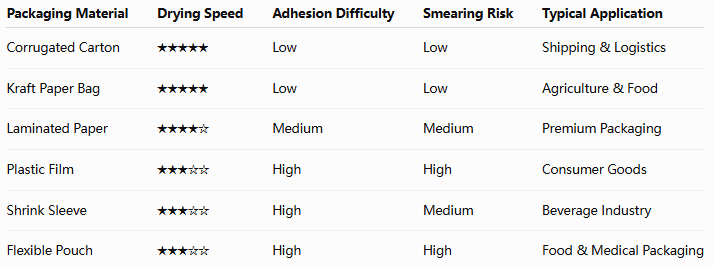
Specialized Industrial Materials: Adapting Printing Strategies for Challenging Surfaces
As manufacturing processes become more diverse, handheld inkjet printers are increasingly used beyond traditional packaging and metal products. Many industries now require direct coding on construction materials, piping systems, textile packaging, rubber components, and wooden logistics products.
These substrates present unique challenges because their physical properties differ significantly from conventional printing materials.
Successful industrial marking depends on understanding how each material behaves under real production conditions rather than assuming one printer configuration can handle every application.
PVC Pipes and Plastic Tubing: Printing on Curved Non-Porous Surfaces
PVC pipes are widely used in plumbing, electrical infrastructure, irrigation systems, and industrial manufacturing. Plastic tubing is equally common in medical equipment, chemical processing, and fluid transfer systems.
Unlike flat packaging materials, pipes introduce two additional challenges:
1. Curved printing surfaces
2. Continuous production movement
The curvature changes the distance between the printhead and the substrate, while extrusion lines often operate continuously at high speed.
Typical information printed includes:
1. Product specifications
2. Manufacturing dates
3. Batch numbers
4. Production shift identification
5. Company logos
Traceability codes
Maintaining consistent character height and edge sharpness requires careful adjustment of print distance, conveyor synchronization, and ink drying characteristics.
Manufacturers seeking stable identification on extrusion lines should also review Best Coding Practices for PVC Pipes and Plastic Tubing, where printhead positioning, line speed, and ink compatibility are discussed in greater depth.
Wooden Pallets and Timber Products: Surface Consistency Is the Biggest Challenge
Wood is generally considered easier to print than plastic because of its porous structure. However, industrial timber products vary greatly depending on species, moisture content, grain direction, and surface treatment.
A freshly cut pallet behaves very differently from kiln-dried lumber or pressure-treated timber.
Common coding applications include:
1. ISPM compliance markings
2. Pallet identification
3. Warehouse inventory numbers
4. Production dates
5. Supplier traceability
Because wood naturally absorbs ink, drying is usually rapid. The greater challenge is maintaining consistent print quality across uneven surfaces with visible grain patterns, knots, or rough saw marks.
Rather than increasing ink volume, manufacturers often improve readability by optimizing print height and selecting character sizes appropriate for rough surfaces.
Businesses producing export pallets, timber products, or wooden packaging can further improve consistency by understanding Product Identification on Wooden Pallets and Timber Products, especially when long-term outdoor storage is involved.
Rubber Components and Industrial Hoses: Flexibility Requires Flexible Ink Performance
Rubber presents a unique challenge because the substrate itself is elastic.
Automotive seals, conveyor belts, industrial hoses, molded gaskets, and synthetic rubber parts are frequently stretched, compressed, or bent during use.
An ink formulation that adheres well initially may crack or flake once the material begins to flex repeatedly.
Engineers therefore evaluate more than adhesion alone.
Additional considerations include:
1. Elasticity after curing
2. Resistance to oils
3. Abrasion resistance
4. Heat stability
5. Chemical exposure
Production testing often includes repeated bending or compression cycles to verify long-term readability.
Manufacturers operating in automotive, industrial equipment, or hydraulic industries can learn more through Industrial Marking on Rubber Components and Hoses, where substrate flexibility and environmental durability are explored in detail.
Glass Containers: Smooth Surfaces Demand Stronger Ink Chemistry
Glass is one of the most visually appealing materials for consumer products, yet it remains among the most demanding substrates for industrial coding.
Unlike porous materials, glass provides virtually no absorption.
Instead, successful printing depends almost entirely on:
1. Surface cleanliness
2. Ink chemistry
3. Drying conditions
4. Expected handling
Additional complications arise because glass bottles frequently experience condensation, washing processes, refrigeration, or repeated transportation.
Typical industries include:
1. Beverage production
2. Cosmetics
3. Pharmaceuticals
4. Laboratory containers
5. Specialty chemicals
For these applications, durability often means more than resisting scratches—it also involves surviving moisture, temperature changes, and continuous product handling.
Manufacturers requiring permanent bottle coding should understand Printing on Glass Containers: Improving Adhesion and Durability, particularly when products move through cold-chain logistics or humid environments.
Woven Bags and Textile Packaging: Balancing Ink Penetration and Readability
Woven polypropylene bags and textile packaging are widely used for transporting:
1. Rice
2. Animal feed
3. Fertilizer
4. Chemicals
5. Cement
6. Minerals
Their woven structure creates microscopic gaps between fibers, making the surface neither fully porous nor completely smooth.
If too little ink is applied, characters may appear broken because droplets fall between fibers.
If excessive ink is used, characters may spread, reducing readability.
Achieving consistent results requires balancing droplet size, print resolution, and ink viscosity.
Manufacturers supplying bulk packaging industries should also consider the recommendations presented in Printing on Woven Bags and Textile Packaging Materials, where fiber structure, ink penetration, and production efficiency are discussed in greater detail.
Concrete Blocks and Construction Materials: Prioritizing Visibility Over Cosmetic Appearance
Construction materials present a different set of priorities.
Concrete blocks, paving stones, bricks, prefabricated panels, and cement products generally have rough, highly porous surfaces.
Unlike consumer packaging, appearance is usually less important than:
1. Permanent identification
2. Production traceability
3. Batch management
4. Outdoor durability
Because these materials generate dust during production, print quality often depends on proper surface preparation and equipment maintenance.
Manufacturers serving the construction industry frequently optimize print size and contrast rather than pursuing maximum resolution.
Companies seeking dependable marking for heavy building materials can learn more from Coding on Concrete Blocks and Construction Materials, where outdoor exposure, dust control, and durability requirements are analyzed in detail.
Comparing Material Performance Across Industrial Applications
The following comparison summarizes how common industrial materials influence handheld inkjet printing performance.
Industry Application Examples: Why One Printing Strategy Never Fits Every Factory
Although the same handheld inkjet printer may be used across different industries, successful implementation depends on adapting the printing process to each production environment.
Food & Beverage
Manufacturers prioritize fast drying, food-safe coding practices, and barcode readability on cartons, bottles, flexible films, and paper packaging. Codes must remain legible throughout filling, packaging, transportation, and retail handling.
Automotive Manufacturing
Components often include stainless steel brackets, aluminum housings, rubber seals, and plastic connectors. Production environments expose parts to oils, vibration, and abrasion, making ink durability and chemical resistance essential.
Building Materials
Concrete blocks, PVC pipes, timber products, and coated metal components require large, high-contrast identification that remains readable after storage, transportation, and outdoor installation.
Logistics & Warehousing
Shipping cartons, pallets, woven bags, and secondary packaging require clear identification that supports automated scanning and inventory management while maintaining high production efficiency.
These examples demonstrate an important principle:
The most successful industrial coding systems are designed around the material and production process—not around printer specifications alone.
Not Sure Which Ink or Printer Fits Your Material?
Whether you're printing on plastic, stainless steel, glass, wood, rubber, PVC, corrugated cartons, or construction materials, our engineering team can evaluate your application and recommend the most suitable handheld inkjet printer, compatible ink, and optimized print settings.
How to Select the Right Printing Solution for Any Material
Choosing a handheld inkjet printer should never begin with print resolution or price alone. In industrial production, long-term coding reliability depends on matching the complete printing solution—including the printer, ink, substrate, and production environment—to the application.
The following decision process can help manufacturers evaluate a new printing project before equipment is purchased or installed.
Material Selection Workflow
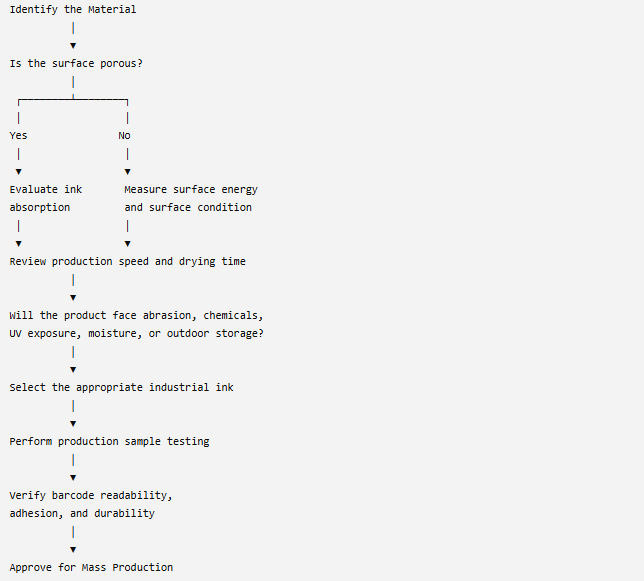
Although every production environment is unique, this workflow helps reduce unnecessary trial-and-error while improving print consistency across different materials.
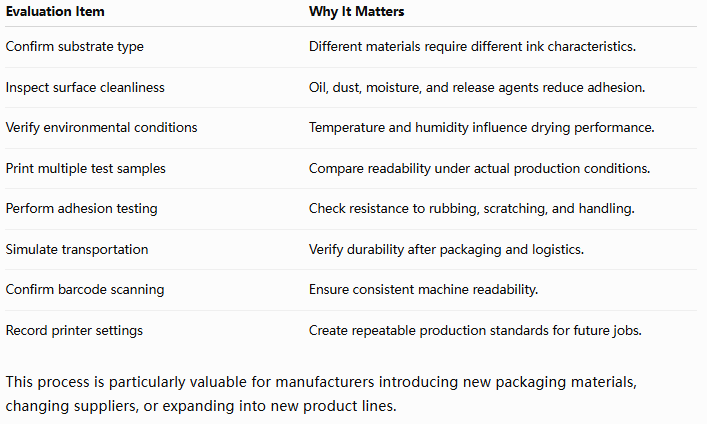
Best Practices Before Printing on a New Material
Even when using the same handheld inkjet printer, manufacturers should validate a new substrate before moving into full production.
A simple pre-production evaluation can prevent costly downtime and rejected products.
Recommended Evaluation Checklist
Frequently Asked Questions
Can one handheld inkjet printer print on every material?
Modern handheld inkjet printers can print on a wide range of industrial materials, but no single ink formulation is ideal for every substrate. The printer may remain the same, while the ink and printing parameters should be selected according to the material's surface characteristics and production requirements.
Why does ink adhere well to some plastics but not others?
Different plastics have different surface energies and chemical compositions. Materials such as polyethylene (PE) and polypropylene (PP) generally require higher-adhesion inks than PET or ABS because they are more resistant to ink wetting.
Is metal easier to print than plastic?
Not always.
Bare stainless steel may provide excellent printing performance after proper cleaning, while painted or powder-coated metal can be more challenging than certain plastics because the coating determines how the ink bonds to the surface.
Do rough surfaces always improve adhesion?
Roughness may improve mechanical bonding, but excessive texture can reduce print clarity, barcode quality, and character definition.
Successful industrial coding requires balancing adhesion with print readability.
Which material is usually the most difficult to print?
Highly polished glass, low-surface-energy plastics, glossy flexible films, and certain coated metals are generally among the most demanding industrial substrates because they provide little natural ink absorption.
How important is drying time?
Drying time directly affects production efficiency.
If ink has not fully cured before products are stacked, wrapped, or transported, codes may smear or transfer to adjacent products.
Should every new material be tested before production?
Yes.
Even materials that appear identical may vary because of different suppliers, manufacturing methods, coatings, additives, or surface treatments.
Production sample testing is one of the most effective ways to reduce printing failures.
Can handheld inkjet printers produce durable QR codes and barcodes?
Yes.
When the appropriate ink, print resolution, and substrate combination are selected, handheld inkjet printers can produce high-quality machine-readable codes suitable for traceability, warehouse management, and industrial identification.
How often should printing parameters be reviewed?
Whenever the production environment changes, including new materials, different suppliers, seasonal temperature changes, or faster production speeds.
Regular verification helps maintain consistent print quality.
How can manufacturers reduce printing failures across multiple materials?
Rather than relying on one universal setting, establish standardized printing parameters for each substrate, document successful configurations, and perform routine quality verification. This approach improves consistency while reducing waste and unplanned downtime.
Material Compatibility Is the Key to Reliable Industrial Coding
Industrial printing is no longer simply about placing text on a product. As manufacturing becomes increasingly automated and traceability requirements continue to expand, every printed code must remain clear, durable, and readable throughout the product lifecycle.
Choosing a handheld inkjet printer is only the first step.
Long-term success depends on understanding how different materials interact with ink, how production environments influence drying performance, and how substrate characteristics affect adhesion, abrasion resistance, and print durability.
Whether your operation involves plastics, stainless steel, aluminum, corrugated cartons, paper bags, flexible films, PVC pipes, wooden pallets, rubber components, glass containers, woven bags, or construction materials, selecting the right combination of printer, ink, and printing parameters will significantly improve production efficiency and reduce costly rework.
Manufacturers that evaluate materials systematically before implementation are better positioned to achieve consistent coding quality, support regulatory compliance, and maintain reliable product traceability across changing production environments.
Request Expert Support for Your Industrial Printing Project
Every production line presents unique challenges, and the best printing solution depends on much more than the printer itself.
If you are evaluating a new handheld inkjet printer or experiencing adhesion, drying, or durability issues on specific materials, our engineering team can help.
We can assist with:
1. Material compatibility evaluation
2. Recommended handheld inkjet printer selection
3. Industrial ink recommendations
4. Sample printing and adhesion testing
5. Barcode and QR code verification
6. Production parameter optimization
7. OEM and customized industrial coding solutions
A successful industrial coding system is built on a simple principle:
Print for the material—not just the machine.
When material compatibility, ink chemistry, environmental conditions, and production requirements are considered together, handheld inkjet printers can deliver reliable, high-quality marking across a remarkably wide range of industrial applications.
That approach not only improves print quality but also reduces operating costs, minimizes production interruptions, and supports long-term manufacturing efficiency.
Ready to Improve Your Printing Efficiency?
Get expert advice and the best solution tailored to your business.
Get Your Free Quote Within 24 Hours✔ Fast response ✔ Custom solution ✔ No obligation
+MoreRelated recommendations
-
Printing on Different Materials with Handheld Inkjet Printers: The Complete Industrial Guide
Learn how to print on different industrial materials with ha...
-
Common Buying Mistakes That Lead to Expensive Printing Problems
Discover the most common handheld inkjet printer buying mist...
-
What Technical Support Should You Expect from an Industrial Inkjet Printer Supplier?
Learn what technical support to expect from an industrial in...
-
How to Test Print Quality Before Purchasing a Handheld Inkjet Printer
Learn how to test print quality before purchasing a handheld...
Contact Us

Service phone number+8618759952301
—— Add WeChat communication


