
Printing on Flexible Film Without Compromising Packaging Quality
2026-08-10(45)Views
Flexible film is one of the most demanding packaging surfaces for industrial coding because the package is designed to move, bend, fold, seal, and compress.
That creates a different printing environment from rigid plastic containers, metal components, cartons, or paper bags.
A rigid substrate generally keeps its shape while information is applied.
Flexible film does not.
During production, a film web can move continuously through rollers, change tension, pass through forming equipment, enter a sealing operation, and eventually become a finished pouch or bag.
The printed code therefore has to fit into an existing packaging process without interfering with the functions that make flexible packaging effective.
This is the central challenge:
The coding process must work with the packaging process—not compete with it.
For manufacturers evaluating industrial inkjet solutions, this distinction is important. As part of the broader Printing on Different Materials with Handheld Inkjet Printers: The Complete Industrial Guide, flexible film deserves separate consideration because its mechanical behavior can be just as important as the surface itself.
Start With the Packaging Line, Not the Film
When a manufacturer says, "We need to print on flexible film," that description is incomplete.
The same film material can be used in very different production environments.
For example:
1. A flat film roll may be converted into pouches.
2. A laminated web may pass through a high-speed filling machine.
3. A printed film may be formed around a product.
4. A multi-layer structure may be sealed after filling.
5. A finished flexible package may require additional identification after production.
Each situation changes where and how industrial coding should be performed.
For this reason, the first question should not be:
What printer should we use?
A better starting point is:
Where does identification fit into the packaging process?
The Flexible Packaging Line Has Its Own Rhythm
A typical flexible packaging process can involve several interconnected operations:
Film Unwinding
      ↓
Web Guidance
      ↓
Forming / Folding
      ↓
Filling
      ↓
Sealing
      ↓
Cutting
      ↓
Finished Package
      ↓
Inspection / Distribution
The coding position has to work within this sequence.
A technically readable code can still create a production problem if it is positioned:
1. Too close to a seal
2. Too close to a cut line
3. Inside a fold
4. On a constantly distorted section
5. Where downstream equipment cannot inspect it
This is why flexible film coding should be evaluated as a line-integration problem, not simply a printing problem.
Four Questions to Ask Before Adding a Code to Flexible Film
1. Does the Film Move Continuously?
Continuous-web production introduces a fundamentally different operating condition from printing on individual packages.
The film may be moving while the coding operation takes place.
Production teams therefore need to consider:
1) Web movement
2) Print location
3) Machine synchronization
4) Operator access
5) Inspection position
The objective is to create a repeatable relationship between the printed information and the final package geometry.
2. Will the Code Cross a Seal or Fold?
This is one of the easiest issues to overlook during packaging development.
A code may look excellent on a flat film sample but become distorted after the package is:
1) Folded
2) Formed
3) Sealed
4) Compressed
A better validation method is to inspect the finished package, not just the original film.
This distinction becomes particularly important for pouches and bags where the final geometry can be very different from the flat material.
3. Where Will the Customer or Operator Read the Code?
A code should be positioned according to its eventual purpose.
For example:
Production Code
May be intended primarily for internal manufacturing control.
Batch Information
May need to remain visible during warehouse handling.
Barcode or QR Code
May need a predictable orientation for scanning.
Product Identification
May need to remain visible on the package front or side after filling.
The intended reader should influence the location before the production process is finalized.
4. Will Packaging Operations Touch the Printed Area?
Flexible packaging can pass through numerous mechanical stages.
Depending on the equipment, the package may encounter:
1) Rollers
2) Guides
3) Filling mechanisms
4) Sealing jaws
5) Conveyors
6) Handling systems
If the printed area is repeatedly contacted during production, the manufacturer needs to validate the complete process rather than judging print appearance immediately after coding.
A Practical Way to Divide the Printing Area
For production planning, it can be useful to classify the film surface into three zones.
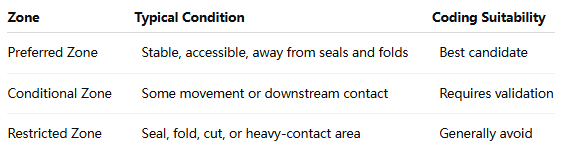
This simple classification can help packaging and production teams communicate more effectively.
Instead of saying "print somewhere on the front," the production specification can identify an approved coding zone.
That makes the process easier to reproduce when products, operators, or production shifts change.
Flexible Film Is Not One Material
Another important consideration is that flexible packaging may contain several material layers.
A package could combine:
1. Plastic film
2. Paper
3. Barrier layers
4. Adhesive layers
5. Printed graphics
6. Protective coatings
The visible outer surface therefore becomes the actual printing environment.
This is similar to the distinction discussed in Industrial Coding on Paper Bags and Multi-Layer Packaging, but flexible film introduces an additional challenge: the package can physically deform during production and handling.
That means manufacturers need to consider both surface condition and mechanical behavior.
The Production Trial Should End With a Finished Package
One of the most useful changes a manufacturer can make during validation is extending the test beyond the printing station.
Instead of stopping at:
"The code looks good after printing."
continue through the actual packaging sequence.
Film Sample
   ↓
Print
   ↓
Form / Fold
   ↓
Fill
   ↓
Seal
   ↓
Cut
   ↓
Handle
   ↓
Inspect Finished Package
The final inspection should answer a more meaningful question:
Does the identification remain usable after the package has completed the operations it was designed to perform?
This approach prevents a common disconnect between print approval and actual packaging performance.
Why Print Quality Alone Is Not Enough
A flexible packaging project can fail even when the initial print looks excellent.
For example, the code may become difficult to use because:
1. The final package folds across it.
2. A sealing operation partially removes its usable area.
3. The package changes shape after filling.
4. The printed location becomes difficult to access.
5. Downstream equipment cannot reliably inspect it.
Consequently, flexible film coding should be evaluated using at least three dimensions:
Print Quality + Package Geometry + Production Workflow
Ignoring any one of these can create problems later in the process.
Where Flexible Film Coding Fits in the Packaging Cluster
Flexible film is often used alongside other packaging formats.
A manufacturer may use:
1. Flexible film for primary packaging
2. Paper bags for industrial products
3. Corrugated cartons for shipping
Each level has a different identification role.
For example, the primary package may carry product or batch information, while the shipping carton provides warehouse and distribution identification.
For companies using cartons as the next level of packaging, Printing Durable Codes on Corrugated Shipping Cartons provides a separate perspective focused on warehouse movement and distribution.
The goal is not to force one coding method across every package.
The goal is to create a consistent identification system across different packaging stages.
When a Flexible Film Application Needs Extra Validation
Not every flexible packaging project requires the same level of testing.
Additional validation is particularly important when the application involves:
1. High production speeds
2. Very narrow coding areas
3. Frequent package folding
4. Multiple film structures
5. Aggressive sealing processes
6. Automated barcode inspection
7. Long distribution cycles
8. Multiple packaging suppliers
In these situations, testing should reproduce the actual production environment as closely as practical.
A small laboratory sample can confirm whether printing is possible.
A production trial determines whether the process is repeatable.
From Film Web to Finished Package: Where Coding Requirements Change
A flexible film application should not be evaluated at only one point in the manufacturing process.
The same printed area can behave differently as the material moves through production.
Before forming, the film may be flat and stable.
After forming, it may become curved.
After filling, the package may expand or change shape.
After sealing, part of the available surface may disappear.
This creates an important distinction between:
printing conditions and final-package conditions.
A successful coding strategy needs to account for both.
Stage 1: Flat Web
At the beginning of the process, flexible film is often supplied as a continuous web.
At this stage, production teams can evaluate:
1. Available printing area
2. Web direction
3. Graphic layout
4. Code position
Relationship between variable information and package artwork
This is often the easiest stage for achieving repeatable positioning.
However, it is not enough to approve the application.
The final package may have very different geometry.
Stage 2: Forming and Folding
As the film enters forming equipment, the original flat surface begins to change.
Depending on the packaging format, the film may be:
1. Folded around a product
2. Formed into a pouch
3. Wrapped around a container
4. Converted into a bag
5. Shaped into a three-dimensional package
A code positioned correctly on the flat web may therefore move relative to the finished package.
This is why the production team should define whether the coding requirement applies to:
the film position
or
the final package position.
Those are not necessarily the same thing.
Stage 3: Filling
Filling can introduce another variable.
A flexible package may become:
1. Wider
2. Taller
3. More curved
4. Less visually uniform
This is particularly important when the printed information must be scanned or inspected after filling.
A barcode that appears perfectly flat during initial testing may become less convenient to scan once the package changes shape.
For this reason, production validation should include filled packages whenever the identification is intended for downstream use.
Stage 4: Sealing
Sealing creates one of the most important boundaries in flexible packaging.
The package may contain designated sealing areas that should remain free from unnecessary information.
Coding too close to these regions can create several problems:
1. Reduced usable print area
2. Visual interference
3. Difficult inspection
4. Increased risk of damage during processing
A practical production specification should therefore define a clear separation between the coding zone and the sealing zone.
Stage 5: Cutting and Separation
In continuous packaging systems, the film eventually becomes individual packages.
The relationship between the printed code and the cut position must remain predictable.
This becomes particularly important when:
1. Package sizes change
2. Multiple SKUs share one production line
3. Film layouts are frequently revised
A stable coding position helps maintain consistent identification even as package dimensions evolve.
The Film-to-Package Transition Map
The following model provides a useful way to think about flexible film coding:
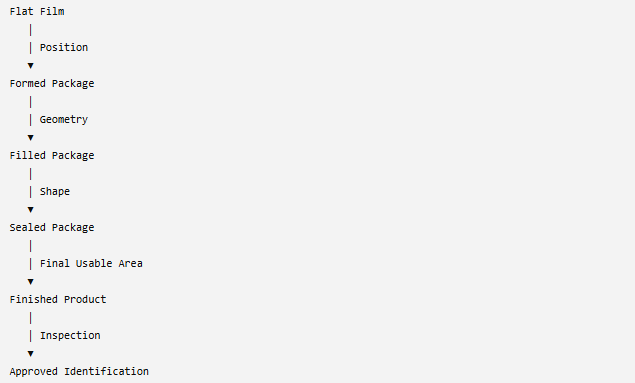
At each stage, the production team should ask:
Has the printed information remained where it needs to be?
This is more useful than evaluating print quality only at the printer.
Production Trade-Offs: Where Should the Code Go?
There is rarely a perfect coding position.
Instead, packaging teams often balance several competing requirements.
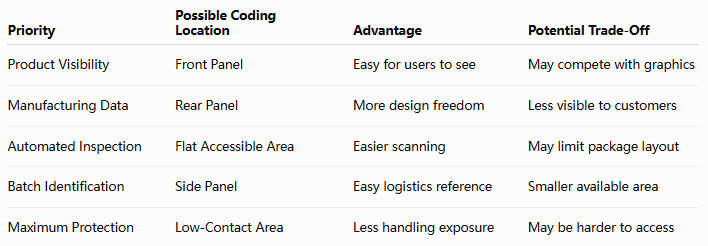
The right choice depends on the purpose of the code.
A manufacturing code does not necessarily need to occupy the same location as customer-facing product information.
Separating these requirements can make package layouts more efficient.
Not sure which printer fits your application?
Consulting experts' advice
Not sure which printer fits your application?
Consulting experts' adviceWhen Handheld Printing Makes Sense on Flexible Film
Flexible packaging is often associated with fully automated packaging systems.
However, there are production environments where handheld industrial inkjet printing can still provide practical value.
Examples include:
Small-Batch Packaging
Manufacturers producing multiple products in relatively limited quantities may need a flexible identification method without dedicating a printer to every packaging line.
Product Changeovers
Frequent SKU changes can make fixed coding arrangements less convenient.
A portable solution can provide additional flexibility during production changes or secondary operations.
Oversized or Irregular Packages
Some industrial flexible bags are difficult to integrate into conventional fixed printing configurations.
A handheld industrial printer may allow operators to place identification directly onto accessible package surfaces.
Secondary Coding
A manufacturer may already have printed primary packaging but later need to add:
1. Batch information
2. Production dates
3. Internal tracking codes
4. Customer-specific references
In these situations, flexible coding equipment can complement rather than replace an existing packaging system.
A Different Question for Production Managers
Instead of asking:
"Can we print this film?"
production managers should ask:
"Where in our process can identification be added with the least disruption to packaging performance?"
That question changes the entire evaluation.
It forces the team to examine:
1. Production sequence
2. Package geometry
3. Operator access
4. Inspection requirements
5. Changeover frequency
6. Downstream handling
The best printing location is often the point where these factors overlap most effectively.
When to Test the Finished Package Instead of the Raw Film
Raw-film testing is useful during early development.
Finished-package testing becomes essential when:
1. The package changes shape significantly after filling.
2. Codes must remain visible after sealing.
3. Barcodes are scanned after packaging.
4. The printed area experiences mechanical handling.
5. Customers read the identification from the finished package.
A two-stage validation strategy is therefore more informative:
Stage A — Film-Level Evaluation
Check:
1. Print location
2. Initial readability
3. Production positioning
Stage B — Finished-Package Evaluation
Check:
1. Final visibility
2. Shape-related distortion
3. Inspection accessibility
4. Downstream usability
This prevents manufacturers from approving a printing process too early.
Flexible Film Coding as a Production-System Decision
The strongest flexible packaging projects do not treat printing as an isolated equipment decision.
Instead, the coding method is evaluated together with:
1. Film construction
2. Package geometry
3. Filling process
4. Sealing process
5. Inspection requirements
6. Production volume
This systems-level approach is particularly important when the same packaging line handles multiple products.
A coding method that works perfectly for one package format may not be the most efficient solution for another.
Production Insight
The most reliable flexible film applications usually have one thing in common:
The coding location was determined by the complete packaging process, not by the printer alone.
Once this principle is understood, many apparent printing problems become easier to prevent.
Related Packaging Application
Flexible film often forms only one part of a broader packaging system.
Manufacturers producing industrial sacks and composite bags may encounter different material structures and production conditions. For those applications, Industrial Coding on Paper Bags and Multi-Layer Packaging provides a separate analysis focused on paper-based and multi-layer packaging formats.
This distinction is useful because flexible film should not be treated as a universal category. Package construction and production behavior determine the actual coding requirements.
Production Readiness Gate
Before a flexible film coding process moves from trial production to regular manufacturing, the team should confirm that the application works as a complete process.
This is different from simply approving a printed sample.
A production-ready application should answer four questions.
Is the code positioned correctly?
The approved location should remain consistent from the film stage through the finished package.
Does the package remain functional?
Printing should not interfere with:
1. Folding
2. Filling
3. Sealing
4. Cutting
5. Handling
Can the information be used downstream?
The final code should remain sufficiently accessible for its intended purpose, whether that is visual identification, barcode scanning, batch management, or internal traceability.
Can operators reproduce the result?
A successful sample is not enough.
The process needs to be practical for normal production personnel to repeat consistently.
Which Flexible Film Workflow Fits Your Operation?
Different production environments call for different approaches.
The following framework can help manufacturers narrow down the appropriate direction.
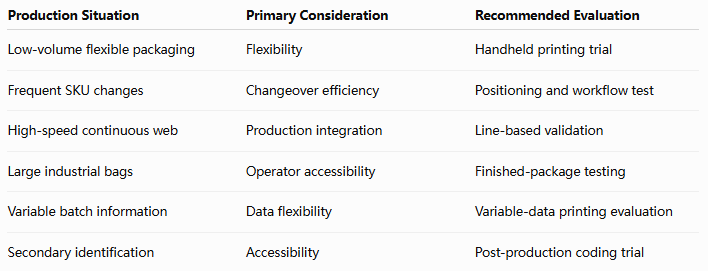
This does not mean that one printer configuration is automatically correct for every application.
The purpose is to match the coding method to the manufacturing environment.
Implementation Notes for Production Teams
Once a coding approach has been selected, several practical details should be documented before regular production begins.
Define the Approved Coding Area
The production specification should identify exactly where variable information is allowed.
This prevents operators from making individual decisions during each production run.
Establish a Reference Product
Choose a representative package as the production reference.
The reference should reflect normal conditions rather than an unusually clean or ideal sample.
Validate Different Package Sizes
If the same film structure is used for several package dimensions, each major format should be reviewed.
A coding position that works on a small pouch may not work equally well on a larger package.
Include Changeover Procedures
Flexible packaging lines frequently switch between products.
Coding instructions should therefore explain what changes when operators move from one SKU to another.
This can include:
1. Print position
2. Variable information
3. Package orientation
4. Inspection requirements
Clear changeover procedures reduce the risk of outdated or misplaced identification.
Why Sample Testing Is Especially Valuable for Flexible Film
Flexible packaging is highly application-dependent.
Two films can appear similar while behaving differently during actual production.
Likewise, two packages made from the same film may require different coding approaches because their:
1. Geometry
2. Sealing method
3. Filling process
4. Handling requirements
are different.
For this reason, sample testing is often more useful than selecting a printer solely from a specification sheet.
A real production sample can reveal whether the proposed solution fits the complete manufacturing process.
What to Provide When Requesting a Printing Evaluation
Manufacturers can usually obtain more useful technical recommendations when they provide representative application information.
Useful materials include:
1. Actual film samples
2. Finished packages
3. Package dimensions
4. Film structure information
5. Production speed
6. Desired code content
7. Typical print location
8. Photos of the packaging line
9. Information about filling and sealing
The more closely the test represents real production, the more meaningful the result becomes.
Building a Flexible Film Coding Strategy That Can Scale
A coding solution should not only work for today's production volume.
Manufacturers may later introduce:
1. Additional package sizes
2. New products
3. Different film structures
4. New customer requirements
5. Additional production locations
A scalable strategy makes these changes easier to manage.
The most useful approach is therefore not to optimize one isolated sample.
It is to establish a repeatable framework for evaluating future flexible packaging applications.
Flexible film challenges manufacturers because packaging performance and identification performance are closely connected.
The film must remain flexible.
The package must form correctly.
The sealing process must remain reliable.
The printed information must remain usable.
And the entire workflow must operate efficiently at production speed.
That is why the best flexible film coding decisions come from evaluating the complete package lifecycle, from the flat web through the finished product.
A successful industrial coding solution should fit naturally into that lifecycle rather than forcing the packaging process to work around the printer.
Need Help Testing Flexible Film?
If you are developing flexible packaging and need to determine whether a handheld inkjet printer is suitable for your application, testing the actual material and finished package is the most practical starting point.
Our team can help evaluate:
1. Flexible film
2. Laminated packaging
3. Pouches
4. Industrial bags
5. Variable batch coding
6. Barcode and QR code applications
7. Production and secondary coding requirements
You can provide your actual packaging samples and production requirements so the coding solution can be evaluated against your real application rather than a generic material sample.
Ready to Improve Your Printing Efficiency?
Get expert advice and the best solution tailored to your business.
Start your project✔ Fast response ✔ Custom solution ✔ No obligation
+MoreRelated recommendations
-
How to Print Durable Codes on Plastic Caps, Lids, and Closures
Learn how to print durable lot and date codes on plastic cap...
-
How to Print Batch Codes on Flexible Plastic Bags and Pouches
Learn how to print durable batch codes on flexible plastic b...
-
How to Print Expiry Dates on Plastic Bottles Without Smudging
Learn how to print expiry dates on plastic bottles without s...
-
PE vs PP vs PET vs PVC: Ink Adhesion Test
Compare PE, PP, PET, and PVC with a controlled ink adhesion ...
Contact Us

Service phone number+8618759952301
—— Add WeChat communication


