
Best Coding Practices for PVC Pipes and Plastic Tubing
2026-08-11(45)Views
PVC pipes and plastic tubing are manufactured differently from most rigid plastic products.
They are long, cylindrical, continuously produced products where identification often needs to remain useful throughout storage, transportation, installation, and service.
A code printed on a flat plastic component may only need to identify the product at one point in the manufacturing process.
A code on a pipe or tube can have a much longer job.
It may identify:
1. Product type
2. Nominal size
3. Material specification
4. Production batch
5. Manufacturer
6. Application category
7. Certification information
8. Installation reference
In many applications, the printed information becomes part of the product's identity.
That changes how manufacturers should approach industrial coding.
The objective is not simply to place ink on the outside of a pipe.
The objective is to create consistent, readable product identification that remains useful as the pipe moves through its lifecycle.
" style=" display:inline-block; padding:14px 32px; background:#ff6a00; color:#fff; font-size:16px; font-weight:600; border-radius:6px; text-decoration:none; "> Get a Free Quote for Your Printing NeedsThink in Terms of Product Lifecycle
PVC pipe identification can be viewed as a sequence rather than a single printing operation.
A typical lifecycle may look like this:
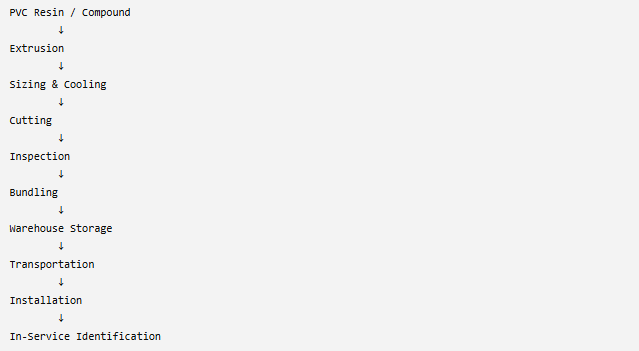
Each stage creates a different reason for the printed information to exist.
During extrusion, identification supports manufacturing traceability.
During warehouse storage, it helps employees distinguish similar products.
During transportation, it supports order verification.
During installation, it can help contractors identify the correct pipe specification.
This is why coding requirements should be established according to the entire product lifecycle, not only the extrusion line. For manufacturers evaluating different substrates and industrial marking applications, our Printing on Different Materials with Handheld Inkjet Printers: The Complete Industrial Guide provides a broader framework for understanding how material characteristics, product geometry, and production conditions influence coding decisions.
The Identification Problem Is Bigger Than the Printer
PVC pipe manufacturers often produce products that look extremely similar.
Two pipes may have almost identical:
1. Diameter
2. Color
3. Length
4. Surface appearance
Yet their specifications may differ significantly.
For example, products can vary by:
1. Pressure rating
2. Wall thickness
3. Intended application
4. Material specification
5. Product series
6. Certification
7. Customer requirement
Without clear identification, visually similar products can become difficult to distinguish once they enter inventory.
That creates a practical manufacturing problem:
The more similar the products look, the more valuable reliable printed identification becomes.
This is particularly important for manufacturers operating multiple extrusion lines or producing several specifications within the same facility.
Start With What the Code Needs to Accomplish
Before deciding how to print on PVC pipes, manufacturers should define the information hierarchy.
Not every piece of information needs the same treatment.
Product Identification
This tells operators what the product is.
Examples include:
1. Product name
2. Pipe type
3. Diameter
4. Grade
5. Model
Production Traceability
This connects the finished pipe to its manufacturing history.
Typical information may include:
1. Batch number
2. Production date
3. Production line
4. Shift information
Compliance Information
Depending on the product and market, identification may also include required specifications or certification-related information.
Customer-Specific Information
OEM or contract manufacturers may need to add:
1. Customer codes
2. Order references
3. Project numbers
4. Special identification marks
Separating these information categories makes the coding system easier to manage.
PVC Pipe Is Usually a Continuous-Production Product
One of the most important differences between pipe and many other plastic products is the production method.
PVC pipe is commonly produced through extrusion.
A simplified process looks like:
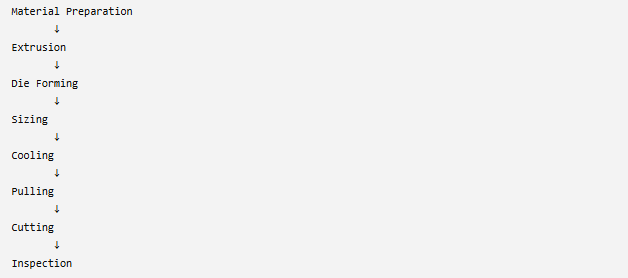
This creates a continuous manufacturing environment.
The pipe is not necessarily presented to the operator as an individual finished object during the early stages of production.
That means identification planning needs to account for the relationship between:
1. Extrusion speed
2. Pipe movement
3. Coding position
4. Product length
5. Cutting
6. Subsequent handling
The printing process therefore becomes part of the production flow.
Pipe Geometry Changes the Identification Strategy
A cylindrical surface creates a different visual environment from a flat sheet.
The printed area curves around the product.
This matters when deciding where information should be placed.
For example, manufacturers may need to determine whether the code should be:
1. Along the length of the pipe
2. Repeated at defined intervals
3. Positioned on one side
4. Distributed around the circumference
5. Applied before cutting
6. Applied after cutting
The correct answer depends on how the product will be manufactured and used.
There is no universal coding position for every PVC pipe application.
Longitudinal Identification vs. Section Identification
Two basic approaches are commonly considered for pipe products.
Longitudinal Identification
Information follows the length of the pipe.
This approach can be useful when operators need to identify the product while viewing a long section of pipe.
It also aligns naturally with continuous extrusion processes.
Section-Based Identification
Information is positioned at defined locations along the pipe.
This can be useful when:
1. Pipes are cut into standard lengths
2. Individual sections need identification
3. Packaging separates products into bundles
The key consideration is not simply how much information can be printed.
It is how often the information needs to be available.
Coding Frequency Should Match the Way the Product Is Handled
Consider two very different products.
Product A: Long Industrial Tubing
The tubing may be supplied in long lengths and stored on reels.
In this case, identification may need to repeat along the product so that information remains accessible during handling.
Product B: Short PVC Pipe Sections
The product may be cut into standardized lengths and bundled.
Here, identification may be planned around the finished sections rather than the continuous extrusion length.
This illustrates an important principle:
Coding frequency should be determined by product handling, not simply by printer capability.
The Difference Between PVC Pipe and PVC Tubing
Although the terms are sometimes used interchangeably, manufacturers should not assume that all PVC products have identical identification requirements.
PVC pipes may be used for:
1. Water systems
2. Drainage
3. Conduit
4. Industrial applications
5. Construction systems
PVC tubing may be used in applications requiring different dimensions, flexibility, packaging, or handling methods.
The product's physical format affects how identification should be positioned and inspected.
For manufacturers producing multiple product families, creating separate coding specifications can be more reliable than forcing every PVC product into one universal procedure.
Extrusion-Line Coding Logic: Connecting Production With Identification
PVC pipe and tubing manufacturing creates a special relationship between production speed and product identification.
The product is continuously formed before it becomes an individual finished unit.
That means the coding strategy must work with the movement of the product rather than treating every pipe as a separate object.
For extrusion operations, three variables are particularly important:
Product movement + coding position + finished length
When these three variables are coordinated, identification becomes much easier to standardize.
Coding Before Cutting or After Cutting?
One of the first production decisions is whether identification should be applied while the pipe is still part of the continuous extrusion process or after it has been cut.
Neither approach is automatically correct.
The better choice depends on the product and manufacturing workflow.
Coding During Continuous Production
Printing before cutting can provide a highly repeatable production sequence.
The general relationship becomes:
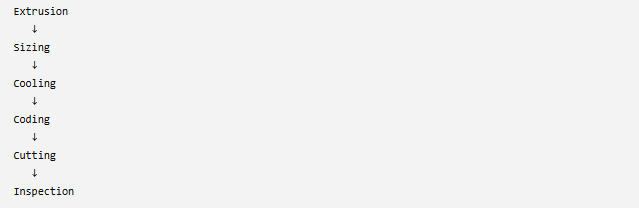
This can be useful when the same information needs to appear repeatedly along the product.
It can also reduce the need for a separate identification operation after cutting.
Coding After Cutting
Some products may be easier to identify after they have become individual pieces.
This approach can provide more flexibility when:
1. Different products require different identification
2. Individual pieces receive customer-specific information
3. Finished lengths vary
4. Secondary processing occurs after extrusion
The trade-off is that an additional handling step may be introduced.
Therefore, production teams should compare the operational cost of post-cut coding against the flexibility it provides.
Coding Location Should Follow Product Usage
A common mistake is selecting the coding location based only on where the printer is easiest to operate.
The better approach is to start with the person who will eventually use the information.
For example:
Extrusion Operator
May need the code to confirm production specifications.
Warehouse Operator
May need to identify products quickly during picking.
Distributor
May need to verify product specifications before shipment.
Installer
May need to confirm the correct pipe type during installation.
These users may interact with the same pipe at completely different points in its lifecycle.
A well-planned coding location should therefore balance production convenience with downstream usability.
Repetition Frequency Is a Production Decision
For long pipe or tubing products, repeating the same information can be more useful than printing a single code.
The correct interval depends on how the product is supplied and handled.
Consider three examples.
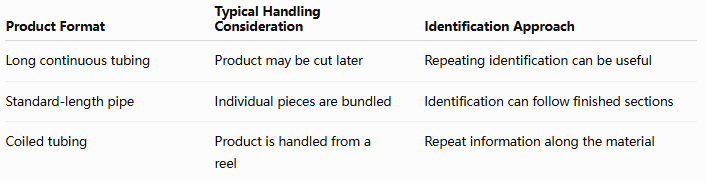
The goal is to make identification available where it is actually needed.
Printing more information is not necessarily better.
The right frequency is the one that supports efficient product handling without unnecessarily complicating production.
Managing Multiple PVC Specifications on One Production Site
PVC manufacturers often operate multiple product families.
A single facility may produce:
1. Different diameters
2. Different wall thicknesses
3. Different lengths
4. Different pressure classes
5. Different colors
6. Different application-specific products
This creates a risk that similar products will be confused during production or storage.
A standardized identification architecture can reduce that risk.
For example, the company can establish a consistent information hierarchy:
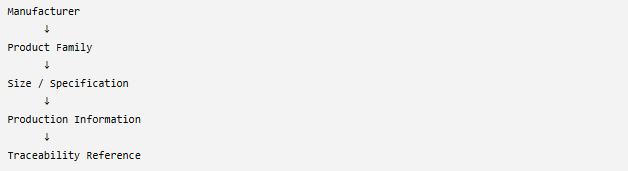
The exact information will depend on the manufacturer's requirements, but the hierarchy itself can remain consistent across product families.
Not sure which printer fits your application?
Consulting experts' advice
Not sure which printer fits your application?
Consulting experts' adviceWhen Product Specifications Change
Production environments often change faster than printed documentation.
A manufacturer may introduce:
1. A new pipe diameter
2. A new product grade
3. A new customer specification
4. A new extrusion line
5. A new production location
If coding instructions are built around individual products rather than a standardized information system, every change can create additional setup work.
A more scalable approach is to maintain a common coding framework while allowing product-specific fields to change.
For example:
Fixed information
1. Manufacturer
2. Product family
3. Standard identification format
Variable information
1. Size
2. Batch
3. Date
4. Production line
5. Customer reference
This separation makes product updates easier to manage.
Identification and Traceability Are Not the Same Thing
These two concepts are sometimes combined, but they serve different purposes.
Identification answers:
What is this product?
Traceability answers:
Where did this product come from?
A pipe may therefore contain both types of information.
For example:
Product Identification
PVC Conduit — 25 mm
Traceability
Batch 0826 — Line 03
The first helps users select the correct product.
The second helps manufacturers investigate production history when quality issues occur.
Combining both functions within one coding strategy can make product management considerably more effective.
Why Batch Information Matters for Extruded Products
If a manufacturer discovers a production issue, the ability to identify affected material can reduce the scope of investigation.
Without useful batch information, the company may have to investigate a much larger production period.
With appropriate traceability, the manufacturer may be able to narrow the investigation to:
1. Specific production dates
2. Specific extrusion lines
3. Specific shifts
4. Specific batches
This is one reason industrial coding should be viewed as part of quality management rather than simply a visual marking process.
Coding for Products That Enter Construction Projects
PVC pipes and tubing frequently become part of larger construction or infrastructure projects.
Once installed, the product may become difficult to access.
This changes the value of visible identification.
During installation, contractors may need to confirm:
1. Product type
2. Diameter
3. Application
4. Specification
5. Installation sequence
For this reason, manufacturers should consider whether identification needs to remain accessible after the product leaves the factory.
A code that is useful only during production may have limited value once the pipe enters the field.
Connection With Other Plastic Applications
PVC pipes are different from plastic packaging because their identification requirements are closely connected to product specifications and long-term traceability.
That distinction is important within this content cluster.
For manufacturers working with plastic packaging, Printing on Plastic Packaging Without Smearing or Ink Transfer focuses on packaging-line handling and the need to maintain clean printed surfaces during production.
PVC pipe coding has a different purpose.
The printed information often becomes part of the product's technical identity.
Likewise, manufacturers evaluating different plastic materials should not assume that the same coding strategy applies universally. How Ink Adhesion Varies Across Different Plastic Materials explores why plastic substrate behavior can differ between material families.
These pages therefore support different search intents while remaining connected within the broader industrial inkjet topic.
A Practical Coding Architecture for PVC Products
A manufacturer can simplify its internal system by separating coding information into three levels.
Level 1 — Product Identity
Information that tells users what the product is.
Examples:
1. Product family
2. Diameter
3. Grade
4. Application
Level 2 — Manufacturing Identity
Information that identifies when and where it was produced.
Examples:
1. Production date
2. Line number
3. Shift
4. Batch
Level 3 — Customer or Project Identity
Information that connects the product to a particular order or project.
Examples:
1. Customer reference
2. Purchase order
3. Project number
Not every pipe needs all three levels.
The framework simply gives manufacturers a structured way to decide what information belongs on the product.
The Best Coding System Is Usually the Most Predictable One
PVC pipe production can become complicated when product variants increase.
However, identification does not need to become equally complicated.
A consistent coding architecture allows operators to recognize information quickly even when the physical products change.
The objective should therefore be:
Different products, consistent identification logic.
That principle can reduce training requirements, simplify production documentation, and make downstream product verification easier.
Production Insight
For PVC pipes and plastic tubing, the most important coding decision is often not the printer model.
It is the relationship between the printed information and the way the product is manufactured, handled, identified, and eventually used.
Once that relationship is clearly defined, equipment selection becomes a much more practical engineering decision.
PVC Coding Decision Matrix
Once the identification requirements have been defined, manufacturers can compare different production approaches according to the way their PVC products are made and handled.
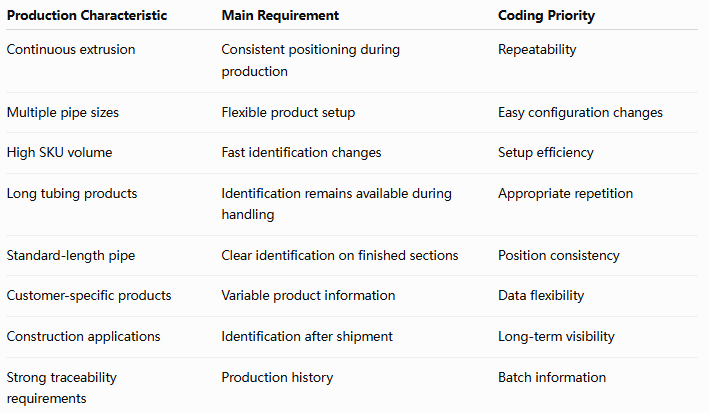
This type of matrix helps manufacturers evaluate coding as part of the production system rather than comparing printers by specifications alone.
Production Changeover Strategy
PVC extrusion facilities often produce several specifications on the same equipment.
Changeovers can therefore become an important source of identification errors.
A product may be physically correct while carrying information from the previous production run.
For this reason, coding should be incorporated into the changeover procedure.
A practical sequence can be:
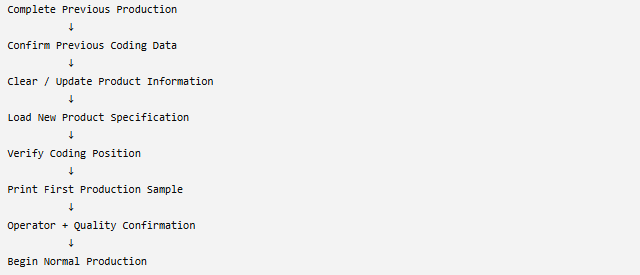
The purpose is not to create unnecessary administrative work.
It is to establish a clear separation between two production orders.
This becomes increasingly important when visually similar PVC products are produced consecutively.
First-Piece Approval Is More Valuable Than Continuous Adjustment
Once a new PVC product begins production, the first approved piece should establish the reference for the production run.
The approval can confirm:
1. Correct product information
2. Correct batch information
3. Correct print position
4. Correct orientation
5. Appropriate code frequency
After approval, operators can continue production against the established reference.
This is generally more reliable than allowing operators to make independent adjustments throughout the run.
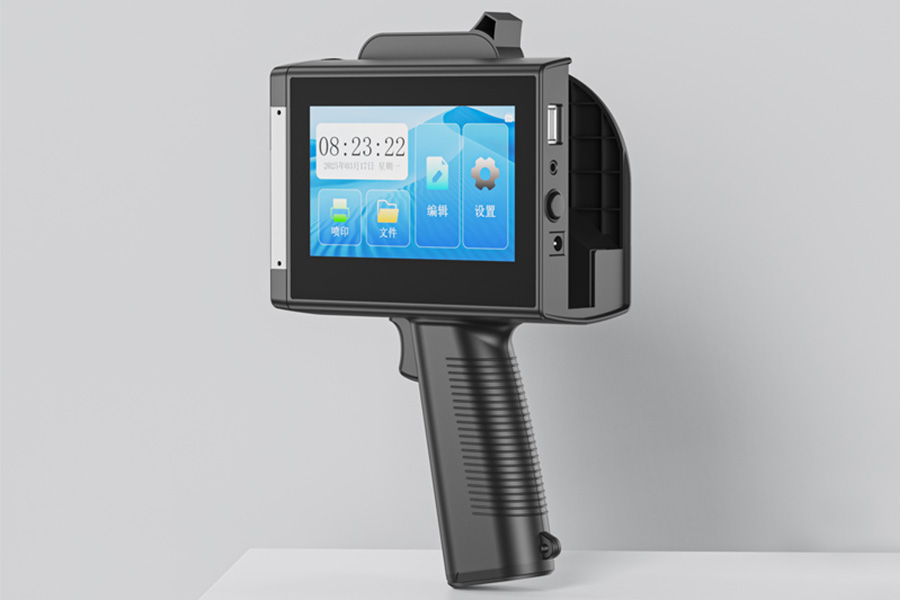
When to Consider a Handheld Inkjet Printer
A handheld industrial inkjet printer can be particularly useful when PVC pipe or tubing production requires flexibility rather than a permanently fixed coding station.
Potential applications include:
Secondary Identification
A manufacturer may already have automated identification on the extrusion line but require additional markings later.
Small Production Runs
Short runs with frequent specification changes may not justify dedicated equipment for every product configuration.
Custom Orders
Customer-specific products can require variable information that changes from one order to another.
Large-Diameter Products
Large or unusually shaped pipes may be easier to access manually during secondary identification operations.
Rework and Replacement Coding
Manufacturers may occasionally need to restore identification after handling, cutting, or other downstream processes.
In these situations, portability can become an operational advantage.
Sample Evaluation Should Represent the Real Product
A generic PVC sample can demonstrate whether a printer is capable of producing a mark.
It does not necessarily demonstrate whether the solution fits a specific production environment.
For a meaningful evaluation, manufacturers should ideally provide representative:
1. Pipe diameter
2. Surface condition
3. Product color
4. Finished length
5. Tubing format
6. Typical production information
If the application involves a specific production sequence, information about that workflow is equally valuable.
This allows the supplier to evaluate not only the printed mark but also the practical positioning and operating method.
What Manufacturers Should Discuss With a Supplier
A productive supplier conversation should go beyond:
"What is the printing speed?"
More useful questions include:
Can you test our actual PVC products?
Actual product samples provide much stronger evidence than generic demonstrations.
Can the system support our variable information?
If batch, date, size, or customer data changes frequently, the coding workflow needs to accommodate those changes efficiently.
Can the printer support our production environment?
The supplier should understand how products move through extrusion, cutting, bundling, and storage.
Can you help define the coding location?
A good industrial supplier should be able to discuss the application rather than simply sell a machine.
What happens after installation?
Technical support, operator training, troubleshooting, and replacement consumables can influence long-term production reliability.
From Product Marking to Product Information Management
The most effective PVC coding systems are not treated as isolated printing equipment.
They become part of the manufacturer's broader product information system.
The printed code can connect:
Production → Quality → Inventory → Distribution → Installation
That connection becomes especially valuable when manufacturers produce large numbers of visually similar products.
Instead of asking only whether the printer produces a clear mark, manufacturers should evaluate whether the coding strategy helps the organization answer three basic questions:
What is the product?
When and where was it produced?
Where does it belong?
When the identification system can answer these questions reliably, printing becomes a meaningful part of manufacturing control.
PVC pipes and plastic tubing require a different approach to industrial coding because they are continuously manufactured, geometrically different from flat products, and often used in applications where identification remains important after the product leaves the factory.
The strongest approach is therefore to design coding around the product lifecycle.
Start with the information that needs to be communicated.
Then determine:
1. Where the information should appear
2. How frequently it should repeat
3. When it should be printed
4. How product changes will be managed
5. How traceability information will be structured
6. How the finished product will be identified downstream
7. Only after these questions are answered should equipment selection become the primary discussion.
This approach helps manufacturers avoid choosing a printer first and trying to redesign the production process around it later.
Need a PVC Pipe or Tubing Coding Solution?
If your facility produces PVC pipes, plastic tubing, conduit, or other extruded products, our team can evaluate your actual products and production requirements.
We can help with:
1. PVC pipe product identification
2. Plastic tubing coding
3. Batch and date marking
4. Extrusion-line identification planning
5. Secondary coding
6. Variable production information
7. Custom industrial marking requirements
Ready to Improve Your Printing Efficiency?
Get expert advice and the best solution tailored to your business.
Get Your Free Quote Within 24 Hours✔ Fast response ✔ Custom solution ✔ No obligation
+MoreRelated recommendations
-
How to Print Durable Codes on Plastic Caps, Lids, and Closures
Learn how to print durable lot and date codes on plastic cap...
-
How to Print Batch Codes on Flexible Plastic Bags and Pouches
Learn how to print durable batch codes on flexible plastic b...
-
How to Print Expiry Dates on Plastic Bottles Without Smudging
Learn how to print expiry dates on plastic bottles without s...
-
PE vs PP vs PET vs PVC: Ink Adhesion Test
Compare PE, PP, PET, and PVC with a controlled ink adhesion ...
Contact Us

Service phone number+8618759952301
—— Add WeChat communication


