
Product Identification on Wooden Pallets and Timber Products
2026-08-12(41)Views
Wooden pallets and timber products create a very different identification environment from plastic packaging, metal components, or flexible films.
Wood is porous, fibrous, naturally variable, and often handled in demanding industrial environments.
A wooden pallet may be moved by forklifts, stacked in warehouses, exposed to dust, stored in outdoor areas, or shipped across multiple distribution points.
Timber products can experience similar variation.
Depending on the application, identification may need to remain useful on:
1. Wooden pallets
2. Timber boards
3. Construction wood
4. Crates
5. Wooden cases
6. Lumber bundles
7. Industrial wood components
8. Export packaging
This means industrial coding on wood should not be approached simply as a question of whether ink can be applied to a wooden surface.
The more important question is:
Can the identification remain useful throughout the way the wood product is manufactured, handled, stored, and used?
For manufacturers evaluating different substrate applications, the broader Printing on Different Materials with Handheld Inkjet Printers: The Complete Industrial Guide provides the larger framework for understanding how material properties and product conditions influence industrial coding decisions.
Why Wooden Products Need Their Own Identification Strategy
Wood is not a uniform industrial surface.
Two pieces of timber can differ in:
1. Grain direction
2. Surface roughness
3. Moisture condition
4. Saw-cut quality
5. Treatment
6. Coating
7. Dust accumulation
8. Natural color
9. Surface damage
A coding process that performs well on one wooden product may therefore require adjustment on another.
This does not necessarily mean that every wood application requires a completely different printing system.
It means that the condition of the actual surface should be considered when establishing the coding process.
Start by Defining What the Wood Product Needs to Communicate
The information printed on a wooden pallet is often different from the information printed on a timber component.
A useful way to separate these applications is by identification purpose.
Asset Identification
A reusable pallet may need an identifier that allows the company to recognize the pallet itself.
Examples include:
1. Pallet number
2. Asset ID
3. Company reference
4. Pool identification
The purpose is to distinguish one reusable asset from another.
Load Identification
The pallet may also need information about the goods being transported.
Examples can include:
1. Order number
2. Shipment reference
3. Product code
4. Customer reference
This information relates to the load rather than the pallet itself.
Production Identification
Timber manufacturers may need to identify:
1. Product grade
2. Production batch
3. Cutting reference
4. Manufacturing date
5. Product specification
Here, the printed information connects the timber product to its production process.
Project Identification
Construction materials may also require information connected to a particular project or delivery.
Examples include:
1. Project number
2. Installation area
3. Customer order
4. Material reference
Separating these purposes helps prevent unnecessary information from being placed on every product.
Wooden Pallets and Timber Products Are Not the Same Application
Although both are made from wood, their operating environments can be completely different.
A pallet is primarily a logistics asset.
Timber may become a structural, construction, manufacturing, or processing material.
That difference changes the identification requirement.
Pallet Identification
Usually emphasizes:
1. Asset recognition
2. Load association
3. Warehouse handling
4. Shipment reference
Timber Identification
May emphasize:
1. Grade
2. Dimension
3. Batch
4. Product specification
5. Manufacturing reference
This distinction is useful when developing coding standards for companies that manufacture or distribute multiple wood-based products.
Surface Condition Can Change During the Product's Life
A newly cut timber surface is not necessarily the same as the surface encountered later in the supply chain.
Wood products can pass through several conditions:
Freshly Processed
       ↓
Stacked
       ↓
Handled
       ↓
Stored
       ↓
Transported
       ↓
Used / Installed
During these stages, the surface can accumulate:
1. Dust
2. Sawdust
3. Dirt
4. Handling marks
5. Moisture
6. Abrasion
The coding strategy should therefore be based on the condition in which identification actually needs to be read.
If the code is only required immediately after production, the requirements may be relatively straightforward.
If the code must remain useful after transportation and outdoor storage, the application needs to be evaluated under more realistic conditions.
Where Should Identification Be Placed?
For wood products, location can be just as important as print quality.
The best position is usually one that provides a reasonable balance between:
1. Visibility
2. Accessibility
3. Surface condition
4. Handling exposure
5. Product geometry
A pallet, for example, may have several possible identification areas.
But not every surface is equally practical.
A code placed on a heavily exposed edge may experience more mechanical contact than one positioned on a relatively protected board.
Likewise, a timber product may have a preferred identification face depending on how it is stacked or bundled.
Pallet Identification Should Consider the Way Pallets Are Handled
A reusable pallet can pass through many environments during its useful life.
A simplified sequence might be:
Manufacturing
      ↓
Loading
      ↓
Forklift Handling
      ↓
Warehouse Storage
      ↓
Transportation
      ↓
Customer Receiving
      ↓
Return / Reuse
The identification requirement therefore extends beyond the original production location.
Warehouse employees may need to identify the pallet quickly.
Transport personnel may need to associate it with a shipment.
Asset-management systems may need to recognize it later.
This makes location and readability important parts of the coding strategy.
Timber Bundles Create Another Identification Challenge
Individual timber pieces may be difficult to identify when they are packaged into bundles.
In these cases, manufacturers often need to distinguish between:
Individual-product identification
and
Bundle-level identification.
A bundle label or printed mark can communicate information about the group without requiring every individual piece to carry identical information.
However, the correct approach depends on how the material is sold and used.
If individual pieces may be separated before installation, additional identification may be valuable.
If the bundle remains intact until final use, bundle-level identification may be sufficient.
The Role of Identification in Inventory Accuracy
Wood products can be particularly difficult to distinguish when inventory contains many similar dimensions.
For example, a warehouse may hold timber products with small differences in:
1. Length
2. Width
3. Grade
4. Treatment
5. Product series
Visual inspection alone may not always be sufficient.
Clear product identification can reduce the time required to confirm inventory.
This becomes increasingly valuable when warehouse operators need to locate a specific specification quickly.
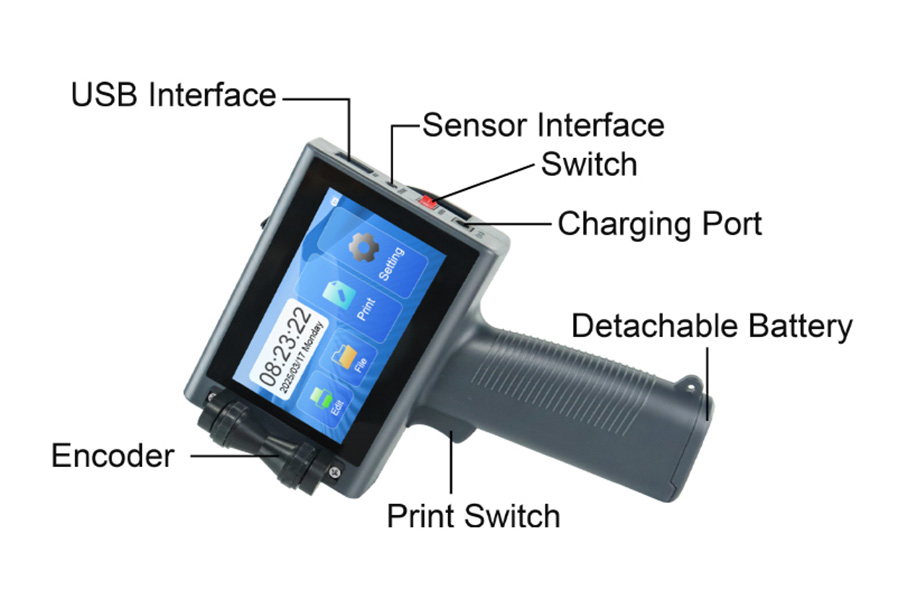
Not sure which printer fits your application?
Request a Custom Solution Today
Not sure which printer fits your application?
Request a Custom Solution TodayCoding Should Support the Warehouse, Not Just Production
A manufacturer may initially think about coding from the perspective of the production department.
However, the warehouse often becomes one of the most frequent users of the information.
Consider a typical sequence:
Production creates the product → Warehouse stores it → Order arrives → Operator retrieves it → Shipment leaves the facility.
If the identification is easy to locate and understand, each transition becomes simpler.
If identification is inconsistent, warehouse employees may need to rely on additional paperwork, visual inspection, or manual confirmation.
Therefore, coding design should consider the information needs of both production and inventory operations.
Wood Products Can Have Different Identification Priorities
A practical way to distinguish applications is to look at the product's main operational purpose.
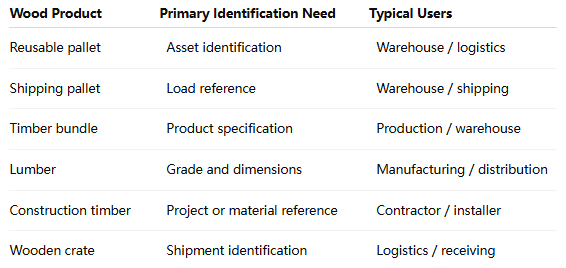
This illustrates why a universal coding template is rarely ideal.
The same printer may support multiple applications, but the information architecture should be adapted to the product.
What Makes Wood Coding Different From Plastic Coding?
Plastic products often provide a more controlled manufactured surface.
Wood introduces greater natural variation.
That means manufacturers should pay attention to:
1. Surface consistency
2. Grain
3. Roughness
4. Dust
5. Moisture
6. Treatment
7. Handling
This is one reason wooden products should be tested using representative production materials rather than relying entirely on generic demonstrations.
For manufacturers working with plastic substrates, How Ink Adhesion Varies Across Different Plastic Materials addresses a different class of surface behavior. Wood should not simply be treated as another type of plastic printing application.
Wooden Products in Construction and Industrial Supply Chains
Timber products frequently move through several organizations before reaching their final destination.
A material may move from:
Manufacturer → Distributor → Contractor → Job Site
At each stage, identification can help maintain product context.
This is particularly useful when multiple material specifications arrive at the same location.
A visible and understandable code can help answer a simple but important question:
What exactly is this piece of material, and where is it supposed to go?
For industrial suppliers, that information can have practical value well beyond the factory floor.
When Handheld Inkjet Printing Can Be Useful for Wood
Wood products vary considerably in size and shape.
Some applications may be difficult to accommodate with a permanently fixed printing position.
Handheld industrial inkjet printers can provide flexibility for applications such as:
Large Timber Products
Operators can move the printer to the accessible identification area instead of requiring the product to pass through a fixed printer.
Oversized Pallets
Large pallets may be easier to mark during assembly or after production.
Variable Orders
Customer-specific references can be added without redesigning the entire production setup.
Secondary Identification
A manufacturer may need to add information after the primary production process has already been completed.
Small-Batch Timber Products
For lower-volume or frequently changing products, portability can reduce the need for dedicated automated equipment.
The suitability of a handheld solution still depends on the actual production environment and identification requirements.
Do Not Treat Every Wood Surface as Equivalent
One of the most important principles for industrial wood coding is simple:
Test the surface that the customer will actually receive.
A clean, freshly prepared piece of timber may behave differently from:
1. Rough-sawn wood
2. Weathered wood
3. Treated timber
4. Dust-covered pallets
5. Recycled pallet boards
6. Coated wooden products
The goal of testing is therefore not merely to prove that printing is possible.
It is to determine whether the proposed coding process is practical under normal operating conditions.
A Better Way to Evaluate Wooden Product Coding
Rather than evaluating a wood printing application from one sample alone, manufacturers can divide the evaluation into three perspectives.
Production Perspective
Can operators apply the information efficiently?
Handling Perspective
Can workers locate and interpret the information during normal material movement?
End-Use Perspective
Will the information remain useful when the product reaches its intended destination?
This approach provides a more complete picture of application suitability.
The Most Valuable Code Is the One People Can Find
A technically excellent mark has limited value if nobody knows where to look for it.
For wooden pallets and timber products, identification consistency can therefore be more important than simply maximizing the amount of information printed.
A predictable location helps workers develop a visual routine.
For example:
"The product specification is always printed on this side."
That simple consistency can reduce the time required to locate information across large inventories.
Industrial coding on wooden pallets and timber products should be designed around how the product is identified and used, not simply around the fact that the substrate is wood.
The right approach begins with the product's purpose.
Then consider:
1. What information needs to be communicated
2. Who needs to read it
3. Where the product will be handled
4. How the surface may change
5. Whether identification applies to the individual product or a bundle
6. Whether the code must remain useful after transportation
Once these questions are clear, manufacturers can evaluate the appropriate printing method with much greater confidence.
For companies handling wood products across production, warehousing, distribution, and installation, a well-planned identification system can become an important part of operational control rather than just a printed mark.
Need Help Coding Wooden Pallets or Timber Products?
If you manufacture, distribute, or process wooden pallets, lumber, timber, crates, or other wood products, our team can evaluate your actual material and recommend a practical industrial coding approach.
We can help assess:
1. Wooden pallet identification
2. Timber product marking
3. Batch and product coding
4. Large wood component marking
5. Bundle identification
6. Construction material coding
7. Variable information printing
8. Handheld industrial inkjet applications
Send us your actual wood samples, product dimensions, and coding requirements to request a sample evaluation and discuss the right industrial marking solution for your application.
Ready to Improve Your Printing Efficiency?
Get expert advice and the best solution tailored to your business.
Get Your Free Quote Within 24 Hours✔ Fast response ✔ Custom solution ✔ No obligation
+MoreRelated recommendations
-
How to Print Durable Codes on Plastic Caps, Lids, and Closures
Learn how to print durable lot and date codes on plastic cap...
-

How to Print Batch Codes on Flexible Plastic Bags and Pouches
Learn how to print durable batch codes on flexible plastic b...
-
How to Print Expiry Dates on Plastic Bottles Without Smudging
Learn how to print expiry dates on plastic bottles without s...
-
PE vs PP vs PET vs PVC: Ink Adhesion Test
Compare PE, PP, PET, and PVC with a controlled ink adhesion ...
Contact Us

Service phone number+8618759952301
—— Add WeChat communication


