
How Many Prints Can One Handheld Inkjet Printer Cartridge Produce?
2026-08-14(53)Views
The 60-Second Answer
The number of prints in one handheld inkjet cartridge is determined by the ink used by one approved message—not by cartridge volume alone. A short date code may deliver a much higher yield than a large logo or QR-code layout. The fastest way to get a defensible answer is to test the exact message, calculate ink used per accepted print, and add an allowance for setup, cleaning, and rejects.
THREE NUMBERS YOU NEED
Start Here: Complete the Yield Worksheet
Before asking a supplier for “prints per cartridge,” complete the fields below. If one field is missing, the result is an assumption rather than an application-specific estimate.
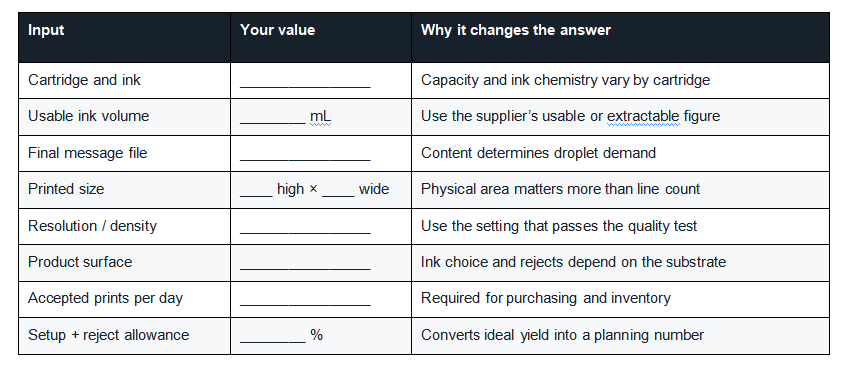
If the message dimensions are not final, settle the required 12.7mm, 25.4mm, or 50mm handheld inkjet printer print height before running the worksheet. Changing the physical layout later invalidates the consumption estimate.
The Cartridge Yield Calculator
Step A — Calculate theoretical yield

Example only: if a test uses 0.004 mL per mark and the verified usable volume is 42 mL, the theoretical result is 42 ÷ 0.004 = 10,500 marks.
Step B — Convert it to planning yield

If the business applies a 15% allowance for setup prints, nozzle servicing, unreadable marks, and normal variation, the example becomes 10,500 × 0.85 = 8,925 planned prints per cartridge. The 15% is illustrative; use the rate shown by your own production records.
Step C — Calculate ink cost per accepted print

At an illustrative delivered cartridge price of $55, the example cost is $55 ÷ 8,925 = $0.00616 per accepted mark, or about 0.62 cents. Keep freight, duties, and local taxes in the delivered price when they apply.
Worked Example: From Artwork to Purchase Quantity
A factory needs to mark 1,200 cartons per day, 22 days per month. The approved layout is a two-line lot and date code. A controlled test estimates 0.004 mL per mark, the cartridge has 42 mL of verified usable ink, and the plant uses a 15% operating allowance.
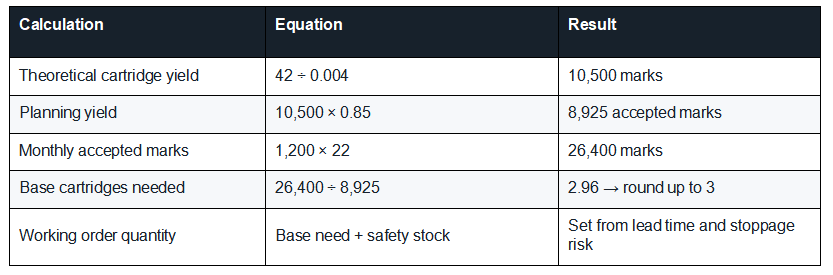
Safety stock is not the same as the operating allowance. The allowance protects the yield calculation; safety stock protects the operation against delayed deliveries, unexpected job changes, or an unusable cartridge.
Four Message Scenarios: Why One Yield Number Fails
The following scenarios are deliberately qualitative. They show which artwork characteristics must be tested without inventing a DEMIN-specific cartridge claim.
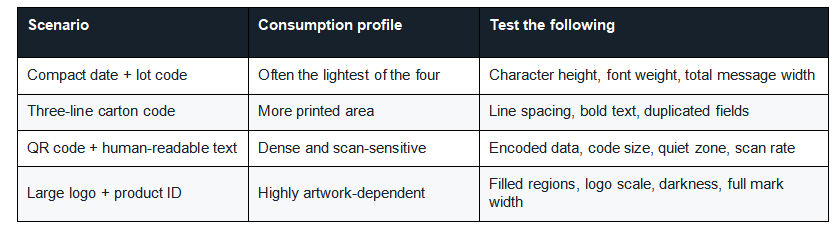
Do not compare these layouts by counting characters. Ten bold, oversized characters can consume more ink than a longer line of small text. Export each final message at actual size and test it as a separate job.
A 1,000-Print Cartridge Test You Can Repeat
Use a repeatable test when the job volume matters or when competing suppliers give very different yield claims. The objective is not to empty a cartridge in one sitting; it is to measure a representative production sample with enough documentation to reproduce the result.
Before the test
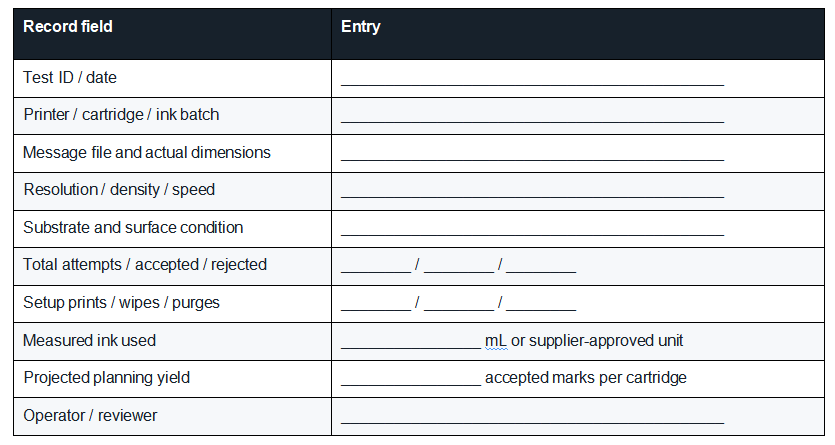
1. Assign a test ID and save a locked copy of the message file.
2. Record printer model, cartridge SKU, ink batch, stated capacity, and starting ink indication.
3. Record print height, message width, resolution, density, speed setting, and software version.
4. Use the actual product or an approved equivalent with the same surface behavior.
5. Define acceptance criteria before printing: legibility, missing nozzles, adhesion, drying, and barcode or QR-code scan performance.
During the test
6. Print 1,000 marks using the normal operator position and expected production pace.
7. Keep setup prints separate from the 1,000 production attempts.
8. Record every wipe, purge, restart, pause, error, and cartridge removal.
9. Count accepted marks and rejected marks separately; photograph representative failures.
10. Do not change artwork or quality settings midway. If a change is required, close the run and create a new test ID.
After the test
11. Record ending ink indication and any supplier-approved measurement of ink consumed.
12. Calculate acceptance rate: accepted marks ÷ total production attempts.
13. Calculate ink per accepted mark using the documented consumption measurement.
14. Project cartridge yield, apply the operating allowance, and label the result as a projection until verified over complete cartridge cycles.
15. Repeat the test with another operator or shift if hand technique is likely to affect rejects.
1,000-Print Test Record
How to Read the Test Result
A high projected yield is useful only if the marks pass the application. Review the test in this order:
1. Did every required character remain readable at normal viewing distance?
2. Did barcodes or QR codes scan at the required rate after the ink dried?
3. Did the mark resist the handling, rubbing, moisture, or process exposure required by the customer?
4. Was the operator able to reproduce the result at a sustainable pace?
5. Does the projected yield remain acceptable after setup, rejects, and servicing are included?
If the answer to the first four questions is no, lowering ink consumption is not an optimization. Correct the application first, then rerun the test.
Build a Monthly Cartridge Reorder Point
Factories need a reorder rule, not just an annual ink estimate. Use the validated planning yield and the supplier’s real lead time.

Example only: at 1,200 accepted marks per day, a 10-day replenishment window, and 8,925 planned marks per cartridge, lead-time demand is 1.35 cartridges. Round up to two before adding the safety stock selected by the business.
Track actual yield by job because a plant that alternates between date codes and large logos should not use one blended figure for every production order.
Copy-and-Send Supplier Request
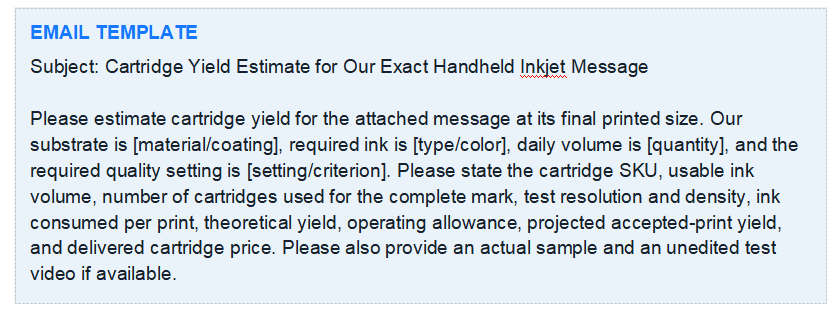
A useful response states the assumptions. A bare number such as “up to 50,000 prints” cannot be compared until the message, size, settings, cartridge, and definition of an accepted print are disclosed.
What Not to Combine With This Calculation
Cartridge yield answers one operating question. It does not establish whether the printer is the right size, whether the ink adheres to the product, or whether the operator can print consistently. Keep those decisions separate, then bring them together at the final purchasing stage.
For the wider ownership calculation—including equipment price, freight, maintenance, and downtime—use the handheld inkjet printer cost and operating expenses resource. This page stays focused on cartridge measurement so it does not duplicate the price guide.
Cartridge Yield FAQ
Can two 42 mL cartridges produce different numbers of prints?
Yes. Usable ink, ink formulation, printer settings, servicing behavior, artwork coverage, and rejected marks can differ. Run the same approved message and acceptance test on both systems.
Should setup prints count against cartridge yield?
They should be included in operational planning because the ink is consumed, but record them separately. That lets the factory distinguish unavoidable message consumption from a setup process that may be improved.
Is the printer’s remaining-ink percentage enough for a yield test?
Treat it as an operating indicator unless the manufacturer documents its measurement accuracy. Stronger validation combines the printer counter, accepted-mark records, cartridge changes, and a supplier-approved consumption method.
When should the yield test be repeated?
Repeat it when the artwork, physical size, ink, substrate, resolution, density, printer model, cartridge design, or operating environment changes materially.
Turn the Worksheet Into a Quote
The result you want from a supplier is not the largest possible yield. It is a conservative number of accepted marks, tied to a reproducible message and test method, with a delivered cost per mark.
Use the complete industrial handheld inkjet printer buying guide when you are ready to combine this cartridge result with print quality, substrate compatibility, print height, production volume, support, and the final model decision.

+MoreRelated recommendations
-
How to Print Durable Codes on Plastic Caps, Lids, and Closures
Learn how to print durable lot and date codes on plastic cap...
-
How to Print Batch Codes on Flexible Plastic Bags and Pouches
Learn how to print durable batch codes on flexible plastic b...
-
How to Print Expiry Dates on Plastic Bottles Without Smudging
Learn how to print expiry dates on plastic bottles without s...
-
PE vs PP vs PET vs PVC: Ink Adhesion Test
Compare PE, PP, PET, and PVC with a controlled ink adhesion ...
Contact Us

Service phone number+8618759952301
—— Add WeChat communication


