
Handheld Inkjet Printer Model Comparison: Which DEMIN Printer Fits Your Application?
2026-08-17(47)Views
A verified lineup map for M10, M20, H50, M100, T10, and T20
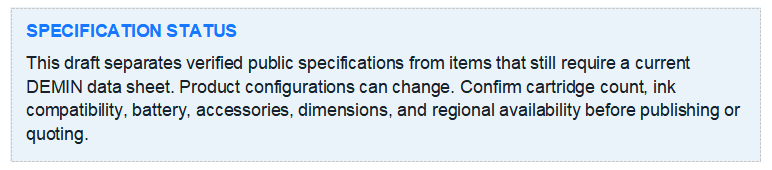
Choose the Job First. Choose the Model Second.
The best DEMIN handheld inkjet printer is not the model with the longest specification list. It is the smallest configuration that can print your approved message clearly, adhere to your product, and remain comfortable for the operator throughout the shift.
Start with four decisions: the required print height, the product surface, the content that must be printed, and the way the operator will use the printer. Those decisions divide the current DEMIN handheld lineup into practical shortlists.
DEMIN Handheld Printer Lineup: Verified Snapshot
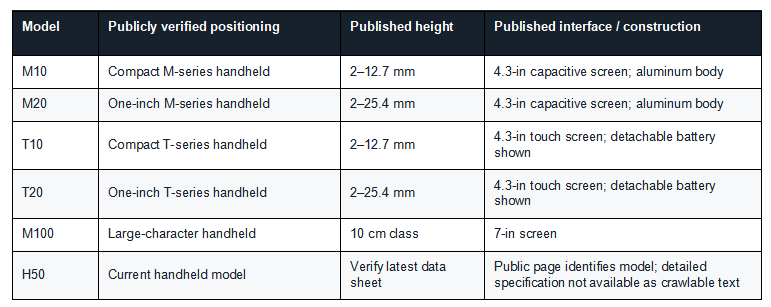
Sources are the current DEMIN product pages and their published product-parameter images reviewed for this draft. A specification shown only in an image should also be added as crawlable text on the final product or article page when possible.
The Fastest Route to a Shortlist
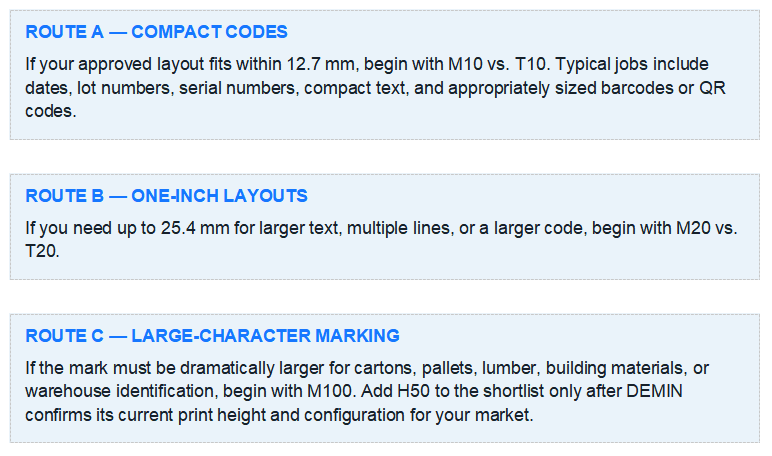
If you have not finalized the layout, review the 12.7mm, 25.4mm, and 50mm handheld inkjet printer print-height comparison before comparing model features. Print height is the first routing decision, not the final purchase decision.
M10 vs. T10: Two Compact-Coding Paths
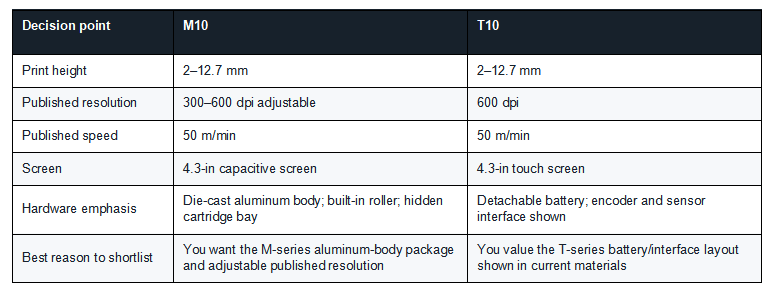
M10 and T10 both serve the compact 12.7 mm class, but their published product materials emphasize different hardware details. That makes the correct choice less about print height and more about construction, battery workflow, settings, and the exact accessory package offered in your region.
Choose M10 when…
1. Your code fits inside the 12.7 mm print band and you prefer the M-series industrial enclosure.
2. Adjustable 300–600 dpi is useful for balancing appearance, readability, and application testing.
3. A built-in roller, hidden cartridge compartment, and aluminum construction match your handling environment.
Choose T10 when…
1. Your code also fits inside 12.7 mm, but a detachable-battery workflow is valuable for long or distributed shifts.
2. The T-series control and interface arrangement is more comfortable for the intended operator.
3. You want the published 600 dpi configuration and will validate the actual message at production hand speed.
Do not decide between these two from a screen image. Request the same message on the same material, then compare start-up time, grip comfort, wheel contact, code distortion, cartridge installation, and battery change procedure.
M20 vs. T20: Two One-Inch Paths
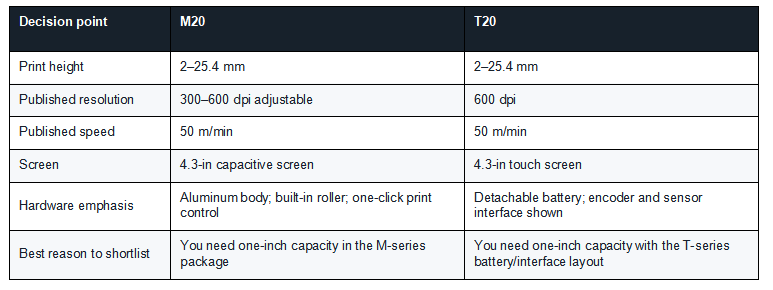
M20 and T20 extend the available height to 25.4 mm. They are better starting points when a 12.7 mm layout would force text or codes to become too small. The published speed and screen size are similar, so the decision again shifts to construction, resolution control, battery workflow, and application proof.
Choose M20 when…
1. The message needs up to 25.4 mm and the aluminum M-series body is preferred.
2. You want adjustable published resolution for testing different message types.
3. The built-in guidance hardware feels stable on the actual product.
Choose T20 when…
1. The message needs up to 25.4 mm and battery swapping is important to your shift plan.
2. The operator prefers the T-series form and control placement after a hands-on test.
3. Your application may benefit from the published sensor-interface arrangement, subject to confirmation of the exact workflow and included accessories.
A 25.4 mm maximum does not mean every job should use the full height. A smaller approved layout can still be the better production choice. Test the complete mark rather than filling the available area simply because it exists.
M100: When the Mark Must Be Seen
M100 is the clearest large-character option in the published lineup. DEMIN’s product material identifies it as a 10 cm large-character inkjet printer with a 7-inch screen. That places it in a different job category from the compact M10/T10 and one-inch M20/T20 pairs.
Good starting applications for M100
1. Large carton identification and warehouse routing marks
2. Pallet, crate, lumber, panel, or building-material codes
3. Large product IDs, grades, destinations, or handling information
4. Layouts that require large text, a logo, or a QR code with substantial vertical space
What to prove before choosing M100
1. The product offers enough flat, uninterrupted travel for the printer body and guide wheels.
2. The operator can keep the full print band level across the complete message.
3. The complete system’s cartridge count, alignment, consumption, and replacement procedure are acceptable.
4. The large mark remains readable and durable on the exact material after normal handling.
M100 should not be chosen for a compact date code merely because it has more capacity. A larger handheld assembly can demand more clearance and more disciplined movement. Use it when the application actually benefits from large-character output.
H50: Treat It as a Specification-Confirmation Model
H50 appears in DEMIN’s current handheld product category, but its public English page does not expose a detailed specification in crawlable text, and the page available during this review did not provide a product-introduction specification image that could be verified. For that reason, this article does not assign H50 a print height, resolution, speed, or cartridge configuration based on its name alone.
H50 can still be included in a supplier shortlist. Ask DEMIN for the current dated data sheet and compare it against the same application brief used for the other models.

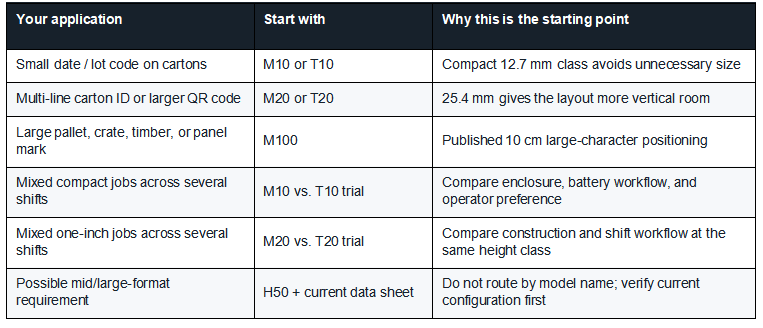
Application Dispatch: Match the Product to a Starting Model
Material Does Not Select the Model by Itself
DEMIN’s published parameter images list a wide set of possible materials, including cartons, plastics, metals, plates, pipes, stone, cable, electronic components, auto parts, and packaged goods. That does not mean one cartridge prints equally well on every member of those categories.
The model controls the printing platform; the ink and the surface determine adhesion, drying, contrast, and resistance. “Plastic” may mean untreated polyethylene, coated film, rigid PVC, or another surface with very different behavior. “Metal” may be bare, painted, anodized, oily, or dusty. Always identify the exact surface and test the proposed ink.
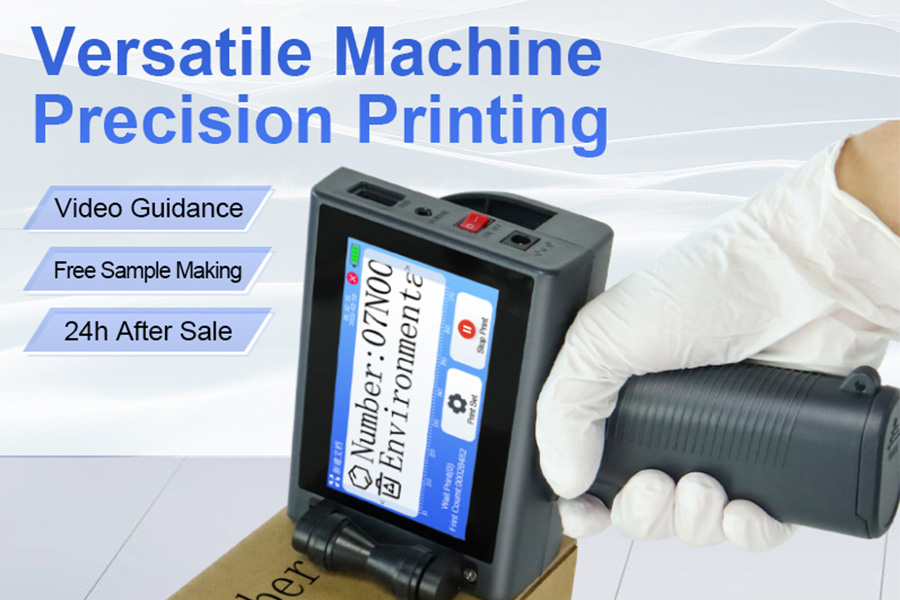
Six Buying Scenarios
1. Food cartons with date, lot, and QR code
Start with M10 or T10 if the complete approved layout remains readable within 12.7 mm. Move to M20 or T20 when the QR code or multiple lines require more physical height. Verify that the ink is suitable for the external packaging surface and the required handling conditions.
2. Plastic bottles or caps
The print band must fit the usable curve, but ink adhesion may be the harder problem. Begin with the smallest height class that fits the content, then test drying, rub resistance, condensation, wheel contact, and operator control on the actual bottle.
3. Metal parts and electronic housings
Compact traceability content may point to M10 or T10; larger identification may point to M20 or T20. Cleanliness, coating, oil, surface energy, and available flat travel can outweigh the nominal material label. Require samples after the normal cleaning and handling process.
4. Pipes, cable, and long products
The correct height depends on code size and curvature. Test guide-wheel stability, print distance, and character distortion along the actual diameter. If the product is moving continuously on a line, a handheld model may not be the right production architecture; discuss an online configuration instead.
5. Pallets, timber, and building materials
M100 is the logical first large-character candidate. Test roughness, dust, gaps, grain, surface flatness, and the operator’s ability to maintain full-height contact. If H50 is proposed, compare it only after its current specification is documented.
6. Distributor or multi-customer use
Do not choose one model solely to cover every possible request. Define the most common compact, one-inch, and large-character jobs; then decide whether a two-model kit is safer than an oversized compromise. Confirm language options, spare batteries, cartridge availability, training materials, and service coverage for each destination market.
The Proof Package That Should Decide the Order
A model comparison becomes reliable only when every candidate is tested against the same proof package. Send DEMIN:
1. The final message file at actual printed dimensions
2. Photos and physical samples of the exact product surface
3. Required ink color, drying time, adhesion, and resistance
4. Expected prints per shift and the operator’s working position
5. Required barcode or QR-code scan standard and scanner type
6. Destination country, power requirements, certifications, and delivery timing
7. A request for an unedited video showing setup and consecutive production-speed prints
For jobs where consumable economics matter, calculate handheld inkjet printer cartridge yield and cost per accepted print with the final message rather than using a generic “prints per cartridge” claim.
Score the Finalists
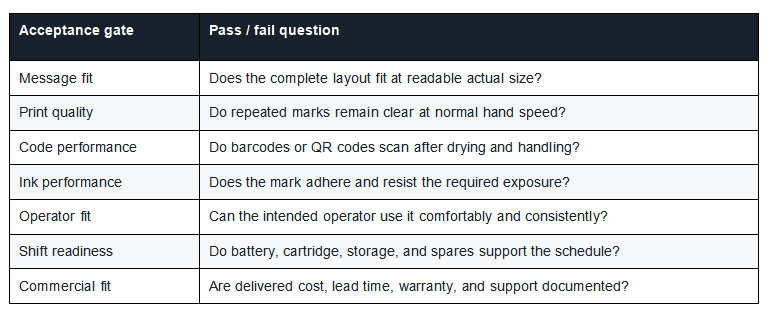
Reject any candidate that fails a required gate. Do not compensate for failed adhesion with a larger print height or compensate for poor operator control with a higher advertised resolution.
Model Comparison FAQ
Is M10 better than T10?
Neither is universally better. Both are published in the 12.7 mm class. M10 emphasizes an aluminum-body M-series package and adjustable 300–600 dpi; T10 publishes a detachable-battery layout and 600 dpi. Test both if those differences matter to the operator or shift.
What is the difference between M20 and T20?
Both publish a 2–25.4 mm height and 50 m/min speed. M20 emphasizes the aluminum M-series construction and adjustable resolution, while T20 materials show a detachable battery and T-series interface arrangement. Confirm current accessories and regional configuration.
Which DEMIN model is best for large characters?
M100 is the clearest verified starting point because DEMIN positions it as a 10 cm large-character printer. H50 may also belong in the shortlist, but its current specification must be confirmed before a factual comparison is published.
Can one model print on both cartons and plastic?
The printer may support both categories, but the same ink may not. Confirm the exact carton coating and plastic type, then sample-test the recommended cartridge on both surfaces.
Final Routing Recommendation
Use M10 vs. T10 for compact 12.7 mm coding, M20 vs. T20 for one-inch layouts, and M100 for verified 10 cm large-character work. Treat H50 as a data-sheet confirmation candidate until its current configuration is documented. Within each pair, let the sample, operator, battery workflow, construction, cartridge, and support package decide the winner.
For the complete decision—including print technology, material, ink, workflow, ownership cost, supplier support, and sample testing—use the complete industrial handheld inkjet printer buying guide as the core selection page.

Contact DEMIN for a model comparison and application-specific quote
+MoreRelated recommendations
-
How to Print Durable Codes on Plastic Caps, Lids, and Closures
Learn how to print durable lot and date codes on plastic cap...
-
How to Print Batch Codes on Flexible Plastic Bags and Pouches
Learn how to print durable batch codes on flexible plastic b...
-
How to Print Expiry Dates on Plastic Bottles Without Smudging
Learn how to print expiry dates on plastic bottles without s...
-
PE vs PP vs PET vs PVC: Ink Adhesion Test
Compare PE, PP, PET, and PVC with a controlled ink adhesion ...
Contact Us

Service phone number+8618759952301
—— Add WeChat communication


