
PE vs PP vs PET vs PVC: Ink Adhesion Test
2026-08-20(29)Views
In This Guide
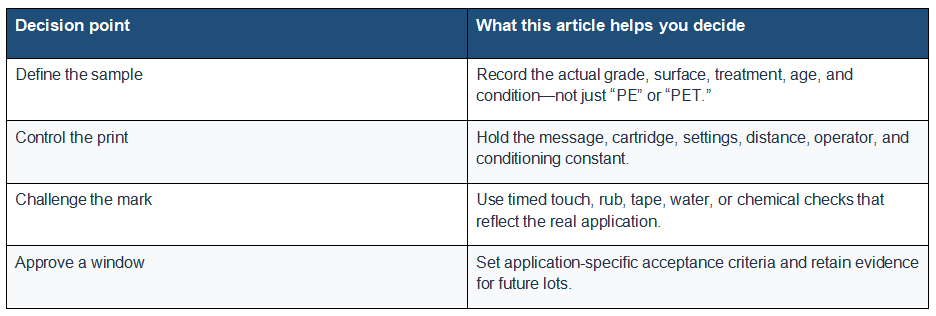
Why Four Resin Labels Are Not Four Test Results
A polyethylene cap, a polypropylene cup, a PET bottle, and a rigid PVC fitting may all look like ordinary plastic. To an ink, however, each surface is a combination of polymer chemistry, manufacturing history, treatment, additives, contamination, and topcoat. Even two parts sold under the same resin label may print differently.
That is why a useful adhesion comparison starts with traceability. The goal is not to declare one polymer “easy” and another “hard.” The goal is to identify a repeatable print window for the exact item a buyer plans to code.
Build the Sample Matrix Before You Open a Cartridge
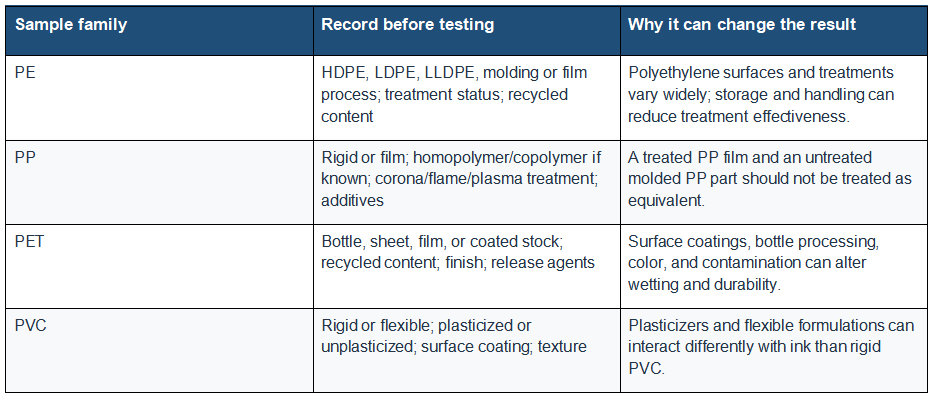
Assign each sample a unique ID. Photograph the unprinted surface and record the supplier, part number, lot, manufacturing date if available, storage conditions, cleaning method, and any known surface treatment. Do not clean one polymer and leave another untouched unless cleaning is itself the variable being tested.
The Controlled Test Protocol
Use the same message file and print setup across the comparison. If one surface needs a different ink, make that a second test round rather than silently changing two variables at once.
1. Condition and label the samples.Bring samples, printer, and cartridges into the same test environment. Mark every sample with a non-test identifier away from the print zone.
2. Document the surface.Note gloss, texture, curvature, dust, oil, condensation, static, treatment date, and any coating. A dyne pen or solution may provide a surface-energy screening point on suitable nonporous surfaces, but it is not an adhesion guarantee.
3. Lock the print variables. Use one cartridge lot, one message, one resolution/density setting, one print speed technique, one standoff distance, and one operator method. Record them.
4. Print replicates. Print enough pieces from each sample family to repeat every planned challenge and preserve an untouched control. Avoid judging a material from one attractive print.
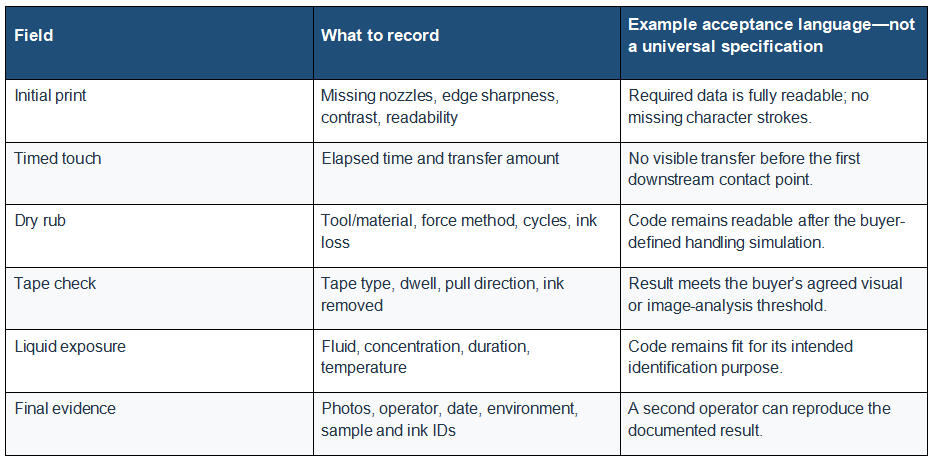
5. Run timed touch checks.At buyer-defined intervals, lightly touch or contact the mark using a consistent method. Record the earliest point at which it is safe for the next real handling step.
6. Run application-specific durability checks.Examples include a defined dry rub, tape pull, water exposure, condensation cycle, cleaner contact, abrasion, or transport simulation. Choose only tests that reflect the intended use.
7. Inspect and classify the failure.Record legibility, edge quality, transfer, color change, ink removal, and substrate damage. Photograph the same area before and after each challenge.
8. Repeat after time and process changes. Recheck after the required cure period and after any meaningful change in supplier, resin grade, treatment, coating, ink lot, or production environment.

Use a Scorecard That Separates Print Quality from Adhesion
How to Read the Failure Pattern
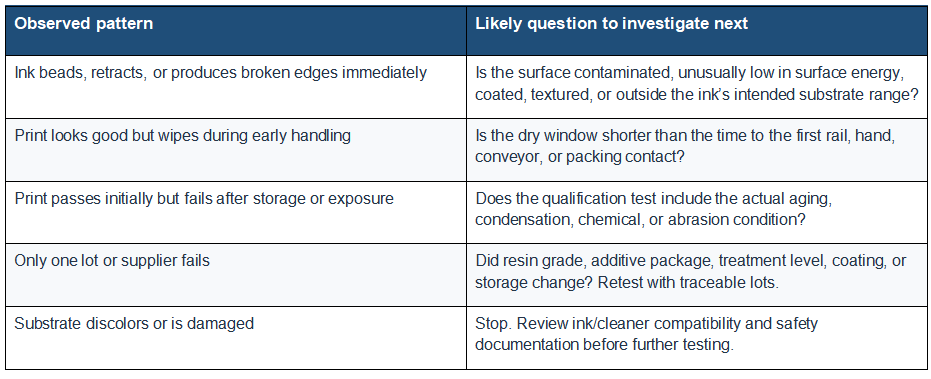
Material-Specific Questions Worth Asking
PE and PP: treatment status is often a major variable
Polyolefins such as PE and PP are frequently surface-treated for printing, coating, or bonding. Treatment can vary across the web or part and can change with handling and storage. Ask who treated the surface, by which process, when it was treated, and whether the print side is clearly identified. Use dyne testing only as a controlled screening method with current, properly handled tools and trained interpretation.
PET: identify the actual format and coating
A clear PET bottle, a PET label film, and a coated PET sheet are not interchangeable test surfaces. Capture the real component, color, finish, recycled-content specification, and production condition. If a supplier changes the topcoat or bottle process, treat it as a requalification event.
PVC: distinguish rigid from flexible
Rigid PVC pipe and flexible plasticized PVC can behave differently. Flexible formulations may contain additives that migrate or affect the surface over time. Include the expected storage duration and environment in the test, and review the ink supplier’s safety and compatibility documents for the exact use case.
What Supplier Data Can—and Cannot—Tell You
Supplier guides are useful for narrowing candidates, but they do not replace application testing. For example, HP’s published TIJ 2.5 ink guide documents different durability outcomes on treated versus untreated BOPP and LDPE under HP’s stated test conditions. That is evidence that treatment matters in those specific trials, not a promise that every treated film or every cartridge will behave the same way.
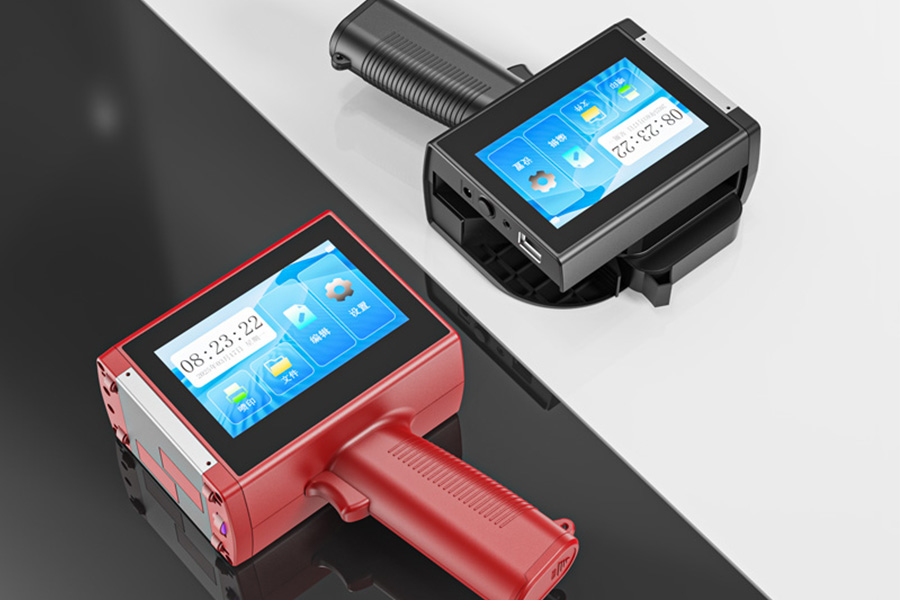
Before choosing a printer or ink, use the broader handheld inkjet printing on plastic guide to align substrate, ink, message size, handling, and sample validation. Then use this protocol to qualify the actual part.
Turn the Test into a Purchase Decision
1. Approve the system, not just the print. The qualified combination includes the substrate lot, pretreatment, ink, printer settings, operator method, environment, and downstream handling.
2. Define a requalification trigger. Supplier changes, treatment changes, new recycled-content targets, ink substitutions, and line-speed changes should prompt a focused retest.
3. Retain a reference sample. Keep an approved piece, original photos, settings, and test sheet so future lots can be compared against evidence.
4. Make the next application test specific. Bottle coding should reproduce bottle curvature and the real time to first contact; pouch coding should reproduce film support, wrinkles, seals, and fill condition.
For container-specific validation, see printing expiry dates on plastic bottles without smudging. For flexible structures, use the workflow for printing batch codes on flexible plastic bags and pouches.

Frequently Asked Buyer Questions
Which plastic is easiest to print: PE, PP, PET, or PVC?
There is no defensible universal ranking. Surface treatment, coating, additives, contamination, ink, geometry, and handling can outweigh the polymer label. Compare traceable samples under controlled conditions.
Does a high dyne reading guarantee ink adhesion?
No. A dyne result can help screen wetting conditions on suitable nonporous surfaces, but adhesion also depends on ink chemistry, contamination, coating, cure, and the durability challenge. Use it as one data point, not a pass certificate.
Can a good-looking sample print be approved immediately?
Not if the code must survive handling, condensation, chemicals, abrasion, or storage. Approve only after the printed sample passes application-specific checks at the required time points.
Ready to Improve Your Printing Efficiency?
Get expert advice and the best solution tailored to your business.
Get Your Free Quote Within 24 Hours✔ Fast response ✔ Custom solution ✔ No obligation
+MoreRelated recommendations
-
How to Print Durable Codes on Plastic Caps, Lids, and Closures
Learn how to print durable lot and date codes on plastic cap...
-
How to Print Batch Codes on Flexible Plastic Bags and Pouches
Learn how to print durable batch codes on flexible plastic b...
-
How to Print Expiry Dates on Plastic Bottles Without Smudging
Learn how to print expiry dates on plastic bottles without s...
-
PE vs PP vs PET vs PVC: Ink Adhesion Test
Compare PE, PP, PET, and PVC with a controlled ink adhesion ...
Contact Us

Service phone number+8618759952301
—— Add WeChat communication


