
When a Handheld Inkjet Printer Is Not the Right Tool
2026-02-12(195)Views
Handheld inkjet printers are widely praised for their flexibility, portability, and ease of use. They solve many real-world coding challenges, especially in variable or low-volume environments. However, they are not the right solution for every application.
Understanding when a handheld inkjet printer is not the best choice is just as important as knowing when it is. Making the wrong decision can lead to inefficiencies, compliance risks, and unnecessary costs.
Why Honest Limitations Matter in Equipment Selection
In industrial printing, overpromising leads to poor outcomes.
Operations that choose equipment without fully understanding its limitations often experience:
1.Print quality inconsistencies
2.Operator fatigue
3.Increased rework
4.Compliance issues
A realistic assessment protects both productivity and long-term ROI.
Extremely High-Speed Production Lines
Handheld inkjet printers are designed for manual, operator-controlled printing.
They are not suitable when:
1.Line speeds exceed what a human operator can safely match
2.Coding must occur continuously without interruption
3.Print positions require millisecond-level timing
In high-speed packaging lines, fully automated coding systems are better equipped to maintain consistency.
Applications Requiring Perfect Print Repeatability
Some industries demand absolute uniformity across millions of units.
Handheld printing may struggle when:
1.Print placement must be identical on every product
2.Visual inspection tolerance is near zero
3.Slight variations are unacceptable
Automated systems offer better control where repeatability is critical.
Environments with Minimal Operator Access
Handheld inkjet printers require direct access to the product surface.
They are not practical when:
1.Products move through enclosed conveyors
2.Print areas are shielded or inaccessible
3.Safety restrictions limit human interaction
In these cases, fixed-mounted printers provide safer and more reliable solutions.
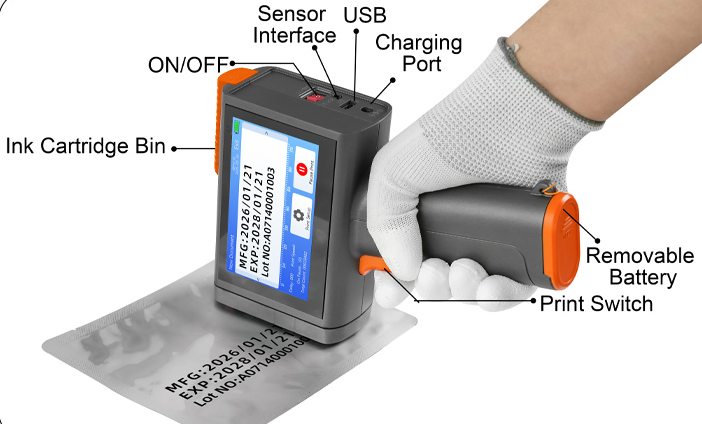
Highly Regulated Lines with Automated Validation
In some regulated industries, coding systems are fully integrated with:
1.Vision inspection
2.Serialization software
3.Automated rejection mechanisms
Handheld inkjet printers cannot replace:
1.Real-time automated verification
2.Closed-loop control systems
They may still play a support role, but not as the primary coding solution.
Large-Scale Continuous Production with No Variability
Handheld solutions shine in variable environments—but struggle in static ones.
If your production involves:
1.One product
2.One format
3.One code for long periods
Automation delivers better efficiency and lower labor dependency.
Operations with Limited Training or High Turnover
While handheld inkjet printers are easy to use, they still rely on human judgment.
They may not be ideal when:
1.Operator turnover is extremely high
2.Training time is minimal
3.Error tolerance is low
Inconsistent handling can affect print quality and compliance.
When Labor Cost Outweighs Flexibility
In regions where labor costs are high and automation is already established, relying on manual printing may increase operational expenses over time.
In such cases:
1.Automated systems reduce long-term labor dependency
2.Predictable output outweighs flexibility
Cost structure should always be part of the decision.
The Risk of Using the Wrong Tool for the Job
Using a handheld inkjet printer in unsuitable scenarios can lead to:
1.Production slowdowns
2.Operator frustration
3.Customer complaints
4.Failed audits
These issues are often misattributed to the printer—when the real issue is application mismatch.
The Smarter Approach: Matching Technology to Workflow
The most successful operations use a hybrid strategy:
1.Automated systems for high-speed, high-volume coding
2.Handheld inkjet printers for exceptions, rework, and variable data
This balanced approach maximizes efficiency without sacrificing flexibility.
Talk to Our Company Before You Decide
Choosing the right coding technology requires more than comparing features—it requires understanding your workflow.
Our company helps manufacturers evaluate when a handheld inkjet printer makes sense—and when it doesn’t. We focus on real production conditions, not generic specifications.
Contact our company today to get an honest, application-driven recommendation for your coding operation.
+MoreRelated recommendations
-
Handheld Inkjet Printer Warranty Questions Buyers Should Ask Before Ordering
Ask these handheld inkjet printer warranty questions to clar...
-
Handheld Inkjet Printer Order Checklist: Printer, Ink, Accessories, and Spare Parts
Use this purchase checklist to confirm the printer, ink, acc...
-
What Information Should You Send for an Accurate Handheld Inkjet Printer Quote?
Use this RFQ worksheet to send the material, message, print ...
-
How to Print Scannable Barcodes and QR Codes on Plastic Packaging
Learn how to print scannable barcodes and QR codes on plasti...
Contact Us

Service phone number+8618759952301
—— Add WeChat communication


