
Industrial Ink for Plastic and Film Packaging: Performance, Challenges, and Solutions
2026-05-29(4)Views
Plastic and film packaging are among the most widely used materials in modern industrial production, especially in food packaging, pharmaceutical labeling, logistics, and consumer goods.
However, printing on plastic and film surfaces is significantly more complex than printing on porous materials like paper. The main challenge is not just print quality—but ink adhesion, drying speed, and long-term durability.
This article explains how industrial inkjet ink performs on plastic and film packaging materials, what challenges manufacturers face, and how to achieve stable, high-speed production results.
Why Plastic and Film Packaging Is Difficult for Inkjet Printing
Unlike paper, plastic and film materials are:
1. Non-porous
2. Low surface energy
3. Chemically inert
4. Smooth and non-absorbent
This means:
Ink cannot “soak in” — it must dry and bond on the surface.
At high production speeds (50–300 m/min), this creates serious technical challenges:
1. Smudging
2. Ink transfer
3. Poor adhesion
4. Barcode unreadability
Related:
Ink Drying Time: What Affects Performance
Not sure which printer fits your application?
View the model that suits you
Not sure which printer fits your application?
View the model that suits youKey Requirements for Ink on Plastic and Film
To perform effectively, industrial ink must meet several critical requirements:
1. Fast Drying Capability
Ink must dry almost instantly after printing to avoid transfer during handling.
2. Strong Adhesion
Ink must bond to low-energy surfaces like:
1)PE (Polyethylene)
2)PP (Polypropylene)
3)PET films
3. Smudge Resistance
Printed marks must withstand:
1)Conveyor pressure
2)Packaging stacking
3)Friction during transport
Related:
How Quick Drying Ink Reduces Smudging
4. Chemical and Mechanical Resistance
Especially important in:
1)Food packaging
2)Industrial labeling
3)Outdoor packaging
Why Fast Drying Ink Is Essential for Plastic Packaging
On non-porous surfaces, drying relies entirely on:
1. Solvent evaporation
2. Resin film formation
3. Surface interaction
There is no absorption phase.
If drying is slow:
1. Ink remains wet on surface
2. Smudging occurs instantly
3. Barcode scanning fails
If drying is optimized:
1. Ink stabilizes in milliseconds
2. Production speed can increase significantly
3. Defect rate drops sharply
Related:
Why Fast-Drying Ink Is Essential for High-Speed Lines
Ink Drying Mechanism on Plastic Films
1. Solvent Evaporation Stage
Fast volatile solvents evaporate immediately after printing.
2. Surface Film Formation
Resins form a thin protective layer on the film surface.
3. Viscosity Locking
Ink rapidly increases viscosity, preventing movement or spreading.
Material-Specific Behavior
1. PE (Polyethylene)
1)Very low surface energy
2)Poor ink adhesion
3)High smudge risk
Requires:
1)High volatility solvent ink
2)Surface treatment (corona/plasma)
2. PP (Polypropylene)
1)Slightly better than PE
2)Still requires fast drying systems
3. PET Film
1)Better surface energy
2)More stable printing performance
4. Laminated Films
1)Extremely challenging
2)Requires specialized ink systems
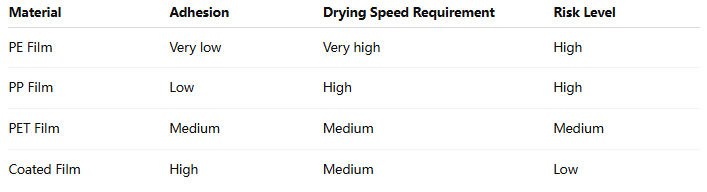
Industrial Comparison Table
Production Line Challenges
1. High-Speed Smudging
Occurs when ink has not fully stabilized before mechanical contact.
2. Barcode Failure
Caused by:
1)Ink spreading
2)Low contrast
3)Incomplete drying
3. Ink Transfer Between Layers
Common in stacking processes.
Related:
Common Ink Drying Problems and Solutions
Solutions for Plastic and Film Printing
1. Use Solvent-Based Fast Drying Ink
Most effective solution for non-porous materials.
Benefits:
1)Rapid evaporation
2)Strong adhesion
3)High-speed compatibility
2. Surface Treatment (Critical Step)
1)Corona treatment
2)Plasma activation
Increases surface energy → improves ink bonding.
3. Controlled Airflow Drying
Helps accelerate solvent evaporation.
4. Reduce Ink Volume
Thinner ink layers = faster drying + lower smudge risk.
Real Industrial Case Study
Problem:
A packaging manufacturer printing on PE film experienced:
1. Severe smudging at 140 m/min
2. Barcode scanning failure rate >20%
3. Frequent production stoppages
Root causes:
1. Water-based ink used
2. No surface treatment
3. Excess ink deposition
Solution:
1. Switched to solvent-based fast drying ink
2. Added corona treatment
3. Installed airflow drying system
Result:
1. 90% reduction in defects
2. Stable 180 m/min production
3. Barcode readability improved to 99%
Common Misunderstandings
Misconception 1:
“All inks work on plastic if drying is long enough”
× Wrong — plastic does not absorb ink.
Misconception 2:
“Surface treatment is optional”
× Wrong — it is often essential.
Misconception 3:
“Drying speed alone solves all problems”
× Wrong — adhesion chemistry is equally important.
FAQ
Q1: Why is plastic printing more difficult than paper?
Because plastic has no absorption and very low surface energy.
Q2: Can water-based ink be used on plastic?
Only with strong surface treatment and low-speed conditions.
Q3: What is the best ink for plastic packaging?
Solvent-based fast drying industrial ink.
Q4: Why does ink smear even after drying?
Because full film formation has not completed before mechanical contact.
If your production line is experiencing:
1. Smudging on plastic film
2. Barcode readability failures
3. Ink transfer during stacking
4. High-speed printing instability
We can help you with:
1. Plastic film ink compatibility analysis
2. Fast drying ink optimization
3. Industrial production line improvement solutions
Contact us to improve your plastic packaging printing stability and reduce defect rates.
Ready to Improve Your Printing Efficiency?
Get expert advice and the best solution tailored to your business.
Get a free quote✔ Fast response ✔ Custom solution ✔ No obligation
+MoreRelated recommendations
-
Why Fast-Drying Ink Is Essential for High-Speed Industrial Inkjet Production Lines
In modern industrial manufacturing, production speed has inc...
-
How Quick Drying Ink Reduces Smudging in Industrial Inkjet Printing
Smudging is one of the most common and costly problems in in...
-
Quick Drying Ink for Industrial Inkjet: Complete Guide
Industrial printing environments are becoming faster, more p...
-
Industrial Inkjet Troubleshooting Guide for Beginners
Industrial inkjet printers are widely used in manufacturing ...
Contact Us

Service phone number+8618759952301
—— Add WeChat communication


