
How to Know If Your Factory Needs a Handheld Inkjet Printer
2026-07-10(66)Views
In modern manufacturing, choosing the right marking method is no longer only a technical decision.
It is a production efficiency decision.
Factories today face increasingly complex requirements:
1. More product variations
2. Shorter production cycles
3. More customized orders
4. Higher traceability expectations
5. Greater pressure to reduce operating costs
For many manufacturers, product identification becomes a hidden production challenge.
A factory may still be using labels, stamps, or manual marking methods, but over time these approaches can create problems:
1. Too much preparation work
2. Increasing labor involvement
3. Higher risk of marking errors
4. Limited flexibility when products change
This leads many companies to consider a handheld inkjet printer.
However, the most important question is not:
“Should we buy a handheld inkjet printer?”
The better question is:
“Does our current manufacturing process have problems that a handheld inkjet printer can actually solve?”
A handheld inkjet printer can be an effective solution for manufacturers that need flexible, direct product marking.
But purchasing equipment without understanding the real production requirement can lead to unnecessary investment.
This guide helps manufacturers identify the situations where handheld inkjet printing creates genuine value, and when another solution may be more suitable.
Before making a final decision, companies can also review our complete handheld inkjet printer buying guide for manufacturers to understand the broader selection process, including application requirements, purchasing considerations, and long-term evaluation factors.
The Decision Is Not About Buying a Printer — It Is About Solving a Production Problem
Many manufacturing companies make the mistake of starting with equipment.
They ask:
1. Which printer is cheapest?
2. Which model has the highest resolution?
3. Which machine has the most features?
However, successful industrial equipment decisions usually begin with the production problem.
A printer is only valuable if it improves an existing workflow.
A Simple Example
Imagine two factories producing similar products.
Factory A
Production characteristics:
1. One standard product
2. Fixed packaging
3. Same printing information every day
4. High-volume continuous production
A fully automated printing solution may be more suitable.
Factory B
Production characteristics:
1. Multiple product models
2. Frequent customer changes
3. Different batch information
4. Small and medium production runs
A handheld inkjet printer may provide much greater value.
The difference is not the industry.
The difference is the production requirement.
A handheld inkjet printer becomes valuable when flexibility matters.
Why Some Manufacturing Processes Outgrow Traditional Marking Methods
Many factories begin with simple identification methods.
For example:
1. Manual writing
2. Stickers
3. Pre-printed labels
4. Basic stamps
These methods may work when production is simple.
The challenge appears when manufacturing becomes more dynamic.
Increasing Product Variety
Many manufacturers now produce more SKUs than before.
Instead of producing one product continuously, factories may handle:
1. Different models
2. Different customer versions
3. Different packaging requirements
This creates more frequent information changes.
Traditional methods often require additional preparation before production.
Growing Demand for Traceability
Modern supply chains require better product identification.
Manufacturers may need to track:
1. Production batches
2. Manufacturing dates
3. Product codes
4. Internal quality information
Direct printing helps create identification directly on products or packaging.
More Customized Manufacturing
Many businesses now provide customized production.
Customers may request:
1. Specific codes
2. Special markings
3. Different product information
A flexible marking process becomes increasingly important.
5 Manufacturing Situations That Usually Create the Need for Handheld Inkjet Printing
A factory does not need a handheld inkjet printer simply because it belongs to a certain industry.
The need usually appears because of specific operational conditions.
The following five situations are strong indicators.
Situation 1: Your Factory Handles Frequent Product Changes
One of the clearest signs is that production information changes regularly.
Examples:
1. Different customer orders
2. New product versions
3. Different batch numbers
4. Changing production dates
When information changes frequently, fixed labeling processes can become inefficient.
Common Problems
Factories may experience:
1. Waiting time for new labels
2. Incorrect label selection
3. Additional preparation work
4. Increased material waste
A flexible printing method allows operators to update information based on current production requirements.
Situation 2: Your Factory Produces Many Small or Medium Batches
Large-volume production often benefits from automation.
However, many manufacturers operate in high-mix environments.
They produce:
1. Smaller quantities
2. More product variations
3. More customized orders
In these situations, production flexibility is often more important than maximum speed.
Why This Matters
A marking solution designed for one fixed product may become inefficient when production changes frequently.
A portable printing solution allows manufacturers to adapt faster.
For companies evaluating which production environments benefit most from handheld inkjet technology, this topic is covered in more detail in:
Which Manufacturing Processes Benefit Most from Handheld Inkjet Printing?
Situation 3: Your Products Are Difficult to Mark Using Traditional Methods
Another strong indicator that your factory may need a handheld inkjet printer is when your products are difficult to identify using traditional marking methods.
Not every product is easy to label or process through a fixed printing system.
Many manufacturers work with products that are:
1. Large in size
2. Heavy to move
3. Irregularly shaped
4. Made from challenging materials
5. Produced in different locations within the factory
In these cases, the problem is not the need for more printing speed.
The problem is that the marking process does not match the physical reality of production.
Examples of Difficult-to-Mark Products
Large Industrial Components
For manufacturers producing:
1. Machinery parts
2. Metal assemblies
3. Industrial equipment
moving products to a fixed marking station may create unnecessary handling work.
A portable marking solution allows operators to bring the printer directly to the product.
Irregular or Customized Products
Some products do not follow a standard shape or production flow.
Examples:
1. Custom fabricated parts
2. Special packaging
3. Oversized containers
A flexible marking method makes it easier to adapt to different product conditions.
Products Located in Different Production Areas
Some factories do not have a single fixed production point.
Products may need identification:
1. Before packaging
2. During quality inspection
3. In warehouse areas
4. After assembly
A portable printer provides more operational flexibility.
Situation 4: Your Factory Relies Too Much on Manual Marking
Manual marking is still used in many manufacturing environments.
For some small operations, it may appear acceptable.
However, as production grows, manual marking can create hidden problems.
Common Issues With Manual Marking
Inconsistent Information
Different operators may write information differently.
This can affect:
1. Readability
2. Product identification
3. Quality control
Human Error
Manual processes increase the possibility of:
1. Incorrect dates
2. Wrong batch numbers
3. Missing information
These errors can become expensive when products have already entered the supply chain.
Limited Production Efficiency
Manual marking requires operator time.
When production volume increases, the marking process may become a bottleneck.
When This Becomes a Business Problem
Manual marking becomes a concern when:
1. Production volume increases
2. Customers require better traceability
3. More employees are involved
4. Quality requirements become stricter
A handheld inkjet printer can help standardize the marking process while keeping flexibility.
Situation 5: Your Factory Needs Better Traceability Without Full Automation
Traceability has become increasingly important across manufacturing industries.
Customers, distributors, and regulatory requirements often require companies to identify products more accurately.
Manufacturers may need to record:
1. Production dates
2. Batch numbers
3. Serial information
4. Internal tracking codes
However, not every factory needs a fully automated coding line.
The Middle Ground Between Manual Work and Full Automation
Many manufacturers face a common situation:
Manual marking is no longer efficient.
A fully automated system may be too expensive or unnecessary.
A handheld inkjet printer can provide a practical middle solution.
It offers:
1. Digital message control
2. Direct product marking
3. Flexible operation
4. Lower implementation complexity
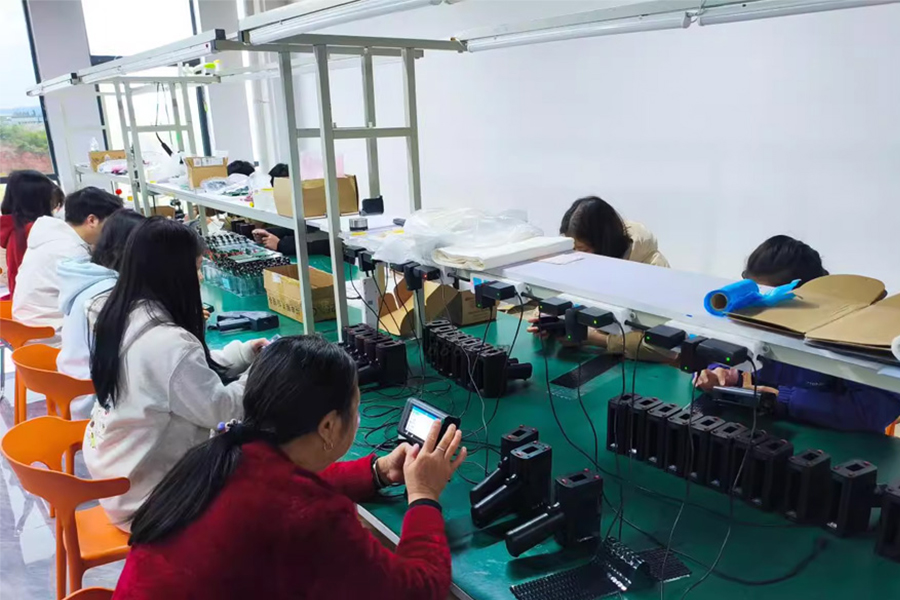
Factory Self-Assessment: Does Your Business Actually Need a Handheld Inkjet Printer?
Before contacting a supplier, manufacturers should evaluate their current situation.
The following assessment can help determine whether handheld inkjet printing matches your production needs.
Production Complexity Check
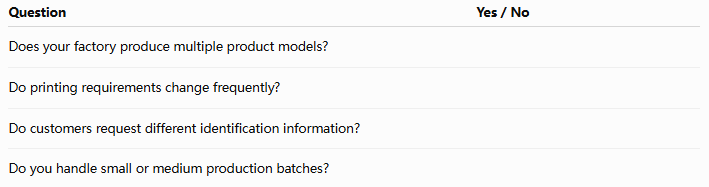
Current Marking Process Check

Product Handling Check
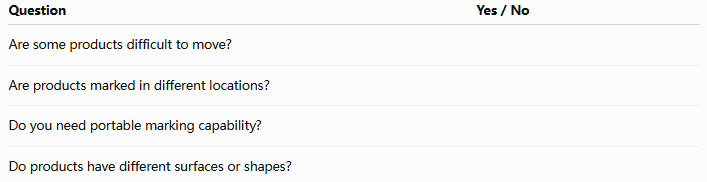
Handheld Inkjet Printer Readiness Score
A simple scoring method:
Give yourself one point for every “Yes” answer.

This score does not replace professional testing, but it helps identify whether further evaluation is worthwhile.
How a Handheld Inkjet Printer Can Create Real Manufacturing Value
A handheld inkjet printer should not be viewed simply as a printing device.
Its real value comes from improving production flexibility.
1. Faster Response to Production Changes
Manufacturing environments change constantly.
Orders may change.
Product information may change.
A flexible printing process allows factories to respond quickly.
2. Improved Marking Consistency
Digital printing reduces dependence on handwritten processes.
This helps improve:
1) Information accuracy
2) Product identification
3) Quality management
3. Reduced Operational Complexity
A factory may not need:
1) Additional label inventory
2) Complex installation
3) Permanent printing stations
A portable solution simplifies certain marking tasks.
4. Better Support for Growing Businesses
Many manufacturers start with simple identification methods.
As they grow, their requirements become more complex.
A handheld inkjet printer can support this transition by providing more professional marking capability without requiring a large infrastructure change.
When a Handheld Inkjet Printer May Not Be the Right Choice
A professional buying decision also requires understanding when a solution is not suitable.
A handheld inkjet printer may not be the best option when:
Your Production Is Fully Standardized
For example:
1. One product
2. One fixed message
3. Extremely stable production
In this case, a dedicated automated system may provide better efficiency.
Your Production Requires Maximum Line Speed
Factories with extremely high-speed continuous production may require integrated industrial coding equipment.
A handheld printer is designed for flexibility, not replacing every high-speed automated system.
Your Marking Requirements Are Not Clearly Defined
Before purchasing any equipment, manufacturers should understand:
1. What needs to be printed
2. Where printing occurs
3. How often information changes
Without clear requirements, it is difficult to select the right solution.
What Information Should You Prepare Before Contacting a Supplier?
When a factory decides to evaluate handheld inkjet printing, preparation improves the recommendation quality.
Before contacting a supplier, prepare:
1. Product Information
Provide:
1) Product photos
2) Material type
3) Surface condition
4) Product size
2. Printing Requirements
Explain:
1) What information needs to be printed
2) Required print size
3) Expected durability
4) Daily printing frequency
3. Production Environment
Describe:
1) Where printing happens
2) Indoor or outdoor conditions
3) Operator workflow
4) Current marking method
4. Existing Problems
The most valuable information is often the problem you want to solve.
Examples:
1) Reducing labeling work
2) Improving traceability
3) Printing on difficult products
4) Increasing production flexibility
Frequently Asked Questions
1. Is a handheld inkjet printer suitable for small factories?
Yes, in many cases.
Small and medium manufacturers often benefit because handheld inkjet printers require less installation complexity than automated systems.
They are especially useful when production involves:
1) Multiple products
2) Small batches
3) Frequent information changes
2. Can a handheld inkjet printer replace all labels?
Not necessarily.
Labels remain useful for:
1) Branding
2) Decorative packaging
3) Products requiring complete graphical designs
However, direct inkjet coding can replace labels for many identification tasks such as:
1) Batch numbers
2) Dates
3) Product codes
4) Traceability information
3. How do I know if my current marking method is inefficient?
Look for signs such as:
1) Excessive manual work
2) Frequent marking mistakes
3) Increasing label management
4) Slow product changes
If marking becomes a production obstacle, it may be time to evaluate alternatives.
4. Should every manufacturer buy a handheld inkjet printer?
No.
The correct solution depends on:
1) Product type
2) Production workflow
3) Printing requirements
4) Business goals
A professional evaluation is more important than simply following market trends.
The Right Time to Consider a Handheld Inkjet Printer
A factory does not need a handheld inkjet printer because it is a popular technology.
It needs one when its current marking process no longer supports production goals.
The strongest indicators include:
1. Increasing product variations
2. Frequent information changes
3. Difficult-to-mark products
4. Manual marking problems
5. Growing traceability requirements
For manufacturers facing these challenges, a handheld inkjet printer can provide a flexible way to improve product identification without adding unnecessary complexity.
The next step is not simply choosing a machine.
It is understanding your application, testing your requirements, and selecting a marking solution that fits your production process.
Need help deciding whether a handheld inkjet printer fits your production needs?
Send us your product photos, printing requirements, and current marking challenges. Our team can help evaluate your application and recommend a suitable industrial printing solution.
Ready to Improve Your Printing Efficiency?
Get expert advice and the best solution tailored to your business.
Contact us for a quotation✔ Fast response ✔ Custom solution ✔ No obligation
+MoreRelated recommendations
-
How to Print Durable Codes on Plastic Caps, Lids, and Closures
Learn how to print durable lot and date codes on plastic cap...
-
How to Print Batch Codes on Flexible Plastic Bags and Pouches
Learn how to print durable batch codes on flexible plastic b...
-
How to Print Expiry Dates on Plastic Bottles Without Smudging
Learn how to print expiry dates on plastic bottles without s...
-
PE vs PP vs PET vs PVC: Ink Adhesion Test
Compare PE, PP, PET, and PVC with a controlled ink adhesion ...
Contact Us

Service phone number+8618759952301
—— Add WeChat communication


