
Which Manufacturing Processes Benefit Most from Handheld Inkjet Printing?
2026-07-10(74)Views
Manufacturing has become more flexible than ever before.
Many factories are no longer producing only one standardized product at a high volume.
Instead, modern production environments increasingly involve:
1. Multiple product variations
2. Shorter production cycles
3. Customized orders
4. Frequent information changes
5. Higher traceability requirements
These changes have created new challenges for product identification.
A marking method that works well for one manufacturing process may not be suitable for another.
This is why evaluating handheld inkjet printing should start with the production process itself, not only the industry category.
A food manufacturer and a metal component manufacturer may use the same printing technology for completely different reasons.
One may need:
1. Fast batch code updates
Another may need:
2. Portable marking for large components
The important question is:
Which manufacturing processes gain the most value from flexible direct inkjet printing?
Manufacturers that are still evaluating whether this technology fits their operation can first review:
How to Know If Your Factory Needs a Handheld Inkjet Printer
to understand the typical production conditions where handheld printing becomes valuable.
This article focuses specifically on the manufacturing processes where handheld inkjet printing provides practical advantages.
Before selecting a printing solution, manufacturers should also understand the key factors involved in equipment evaluation, application requirements, and purchasing decisions. Reviewing this handheld inkjet printer buying guide for manufacturers can help companies build a clearer understanding of how to select the right marking solution for their production environment.
Why Manufacturing Processes Matter More Than Industry Names
Many buyers search by industry:
1. Food printer
2. Plastic printer
3. Metal printer
4. Packaging printer
However, the same industry can contain completely different production requirements.
For example:
Two food manufacturers may operate differently.
Factory A:
1. Produces one product continuously
2. Uses fixed packaging
3. Requires automated high-speed coding
Factory B:
1. Produces many customized products
2. Changes batches frequently
3. Needs flexible marking
Although both are food manufacturers, their ideal marking solutions may be different.
The real factors that determine suitability include:
1. Product movement
2. Production flexibility
3. Information changes
4. Batch requirements
5. Product size
6. Marking location
Process 1: Packaging and Secondary Packaging Operations
Packaging operations are among the most common applications for handheld inkjet printing.
Modern packaging environments often require frequent information updates.
Manufacturers may need to print:
1. Production dates
2. Expiration information
3. Batch numbers
4. Product codes
5. Shipping information
Why Packaging Processes Benefit From Handheld Printing
Packaging production often changes because companies handle:
1. Different customers
2. Different product versions
3. Different order quantities
Traditional pre-printed methods can become complicated when information changes frequently.
Example: Flexible Packaging Production
A packaging manufacturer may produce boxes for multiple customers.
Each customer requires:
1. Different codes
2. Different references
3. Different identification information
With a fixed preparation process, every change may require additional work.
A handheld inkjet printer allows operators to update printing information closer to the final production stage.
Common Packaging Applications
Handheld inkjet printing can be used for:
1. Cartons
2. Shipping boxes
3. Plastic packaging
4. Industrial containers
It is especially valuable when packaging requirements change regularly.
Process 2: Batch Coding and Product Identification
Many manufacturing processes require products to be identified after production.
The purpose is not decoration.
The purpose is control.
Manufacturers need identification for:
1. Tracking
2. Quality management
3. Inventory control
4. Customer requirements
Typical Batch Coding Requirements
Companies may need to print:
1. Batch numbers
2. Lot codes
3. Manufacturing dates
4. Internal tracking information
Why Flexibility Matters
Production information changes constantly.
A factory may produce:
Monday:
Product A
Batch 001
Tuesday:
Product B
Batch 002
The marking system must adapt quickly.
Handheld inkjet printing provides a practical solution because operators can change messages according to current production requirements.
Process 3: Plastic Product Manufacturing
Plastic manufacturing creates unique marking challenges.
Many plastic products have surfaces that are difficult to print on.
Examples:
1. Containers
2. Injection molded parts
3. Plastic components
4. Industrial plastic products
Why Plastic Manufacturing Requires Careful Marking
Plastic surfaces often have:
1. Smooth finishes
2. Low ink absorption
3. Different chemical properties
This means printing performance depends heavily on:
1. Ink compatibility
2. Surface condition
3. Application method
Production Processes Where Handheld Printing Helps
Examples include:
Injection Molding
After molding, manufacturers may need to identify:
1. Part numbers
2. Production batches
3. Quality information
Plastic Assembly Operations
Different components may require:
1. Model identification
2. Tracking codes
3. Customer information
For plastic manufacturers, direct printing can reduce dependence on additional identification materials.
Process 4: Metal Component and Industrial Parts Production
Metal manufacturing is another area where handheld inkjet printing can provide significant operational advantages.
Unlike small consumer products, many industrial metal components are:
1. Heavy
2. Large in size
3. Difficult to move
4. Manufactured in different production areas
In these environments, the challenge is often not printing capability.
The challenge is bringing the product and marking process together efficiently.
Why Metal Manufacturing Needs Flexible Identification
Industrial metal products often require identification throughout the manufacturing process.
Examples include:
1. Machine parts
2. Automotive components
3. Steel products
4. Fabricated assemblies
5. Industrial equipment
Manufacturers may need to mark:
1. Part numbers
2. Production batches
3. Model information
4. Quality inspection codes
5. Customer references
The Limitation of Fixed Printing Systems
A fixed printer works well when:
1. Product position is standardized
2. Production flow is consistent
3. Products pass through the same location
However, many metal manufacturing processes are different.
Products may be:
1. Too large to move easily
2. Produced in different workshops
3. Marked after assembly
4. Checked before shipment
In these cases, mobility becomes a major advantage.
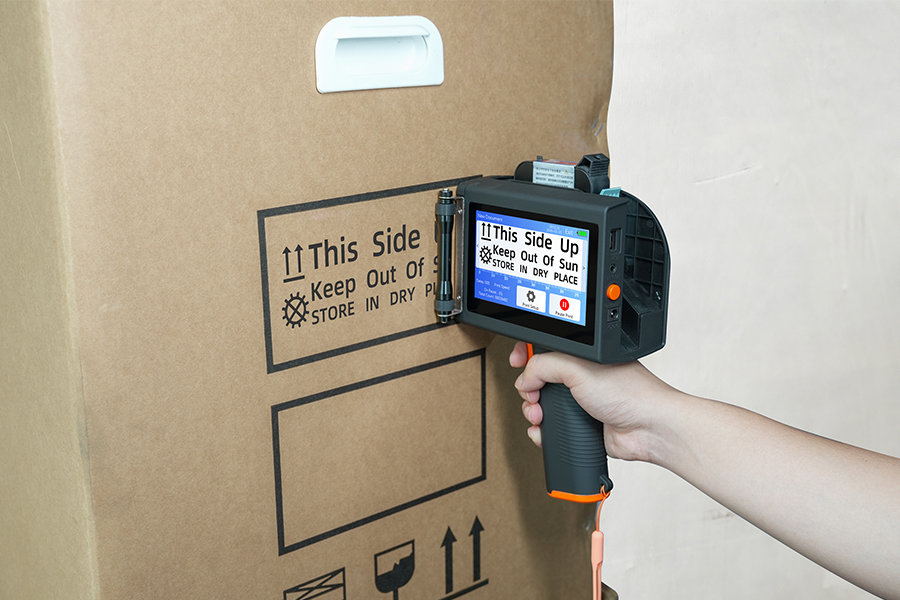
Example: Machinery Component Manufacturing
A manufacturer produces different machine components.
Each product requires:
1. Different identification codes
2. Different customer references
3. Different production information
Installing a fixed printing station for every product type would increase complexity.
A portable marking solution allows operators to print directly during production or inspection stages.
Process 5: Warehouse, Logistics, and Internal Material Management
Although handheld inkjet printers are widely associated with manufacturing, warehouse operations can also benefit from flexible direct marking.
Modern factories often manage large amounts of internal movement.
Materials and products may move between:
1. Production areas
2. Storage locations
3. Inspection departments
4. Shipping areas
Common Warehouse Identification Challenges
Companies may need to identify:
1. Temporary inventory
2. Production materials
3. Pallets
4. Containers
5. Internal tracking information
Traditional labels may work in many cases.
However, problems can appear when:
1. Information changes frequently
2. Products move between locations
3. Temporary identification is required
Why Portability Matters
A handheld printer allows operators to print information wherever the product is located.
This is useful when:
1. Items are too large for labeling equipment
2. Identification happens after movement
3. Warehouse layouts change frequently
Internal Manufacturing Traceability Example
A factory receives raw materials from different suppliers.
During production, materials need internal tracking.
Operators can use direct marking to add:
1. Internal codes
2. Process information
3. Identification numbers
This improves visibility throughout the production workflow.
Process 6: Customized and Small-Batch Manufacturing
One of the strongest application areas for handheld inkjet printing is customized manufacturing.
Traditional high-speed printing systems are often designed for:
1. Large volumes
2. Standardized products
3. Fixed information
However, many manufacturers today operate differently.
They produce:
1. Small quantities
2. Customer-specific products
3. Frequent variations
Why Small-Batch Production Needs Flexibility
A small-batch manufacturer may change:
1. Product design
2. Customer information
3. Production quantities
4. Marking requirements
multiple times per day.
A flexible printing solution helps reduce preparation time.
Example: Custom Industrial Products
A company produces specialized components for different customers.
Each order requires:
1. Different product codes
2. Different references
3. Different batch information
Instead of preparing multiple labeling systems, operators can update printing information based on the current order.
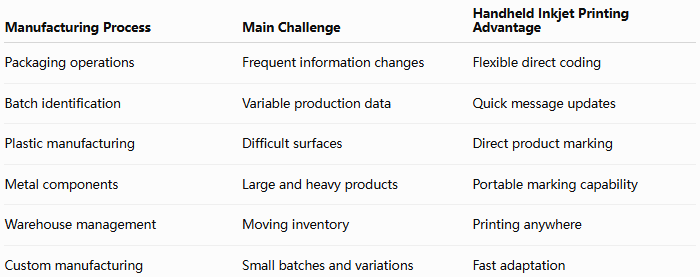
Production Process Comparison: Where Does Handheld Inkjet Printing Create the Most Value?
Production Characteristics That Indicate a Good Fit
The following production conditions usually indicate strong compatibility with handheld inkjet printing.
1. Products Change Frequently
If production information changes often, flexibility becomes important.
Examples:
1) Different customers
2) Different orders
3) Different batches
2. Products Are Not Easy to Move
If bringing products to the printer creates unnecessary handling work, a portable solution may be more efficient.
3. Identification Happens Outside One Fixed Location
Some manufacturing processes require marking at different points.
Examples:
1) Assembly area
2) Inspection area
3) Warehouse
4) Packaging area
4. Production Requires Variable Information
If every product needs unique information, direct digital printing provides more convenience.
When Handheld Inkjet Printing May Not Be the Best Process Solution
Understanding limitations is also important.
A handheld inkjet printer may not be the ideal choice when:
Extremely High-Speed Continuous Production Is Required
Large automated production lines may require integrated coding systems designed specifically for continuous operation.
Products Always Follow the Same Path
If products:
1. Always move through one location
2. Always require identical printing
3. Have stable production conditions
Printing Requirements Are Mainly Decorative
If the main purpose is:
1. Product graphics
2. Full-color branding
3. Marketing design
other printing technologies may be more suitable.
How to Determine If Your Manufacturing Process Is Suitable
Before investing, manufacturers should analyze five areas.
Product
Ask:
1. What materials require marking?
2. Are products easy to move?
3. Are surfaces flat or irregular?
Production Flow
Ask:
1. Where does marking happen?
2. How often does production change?
3. Is mobility important?
Information Requirements
Ask:
1. What information needs to be printed?
2. Does the content change frequently?
3. Is traceability required?
Operational Challenges
Ask:
1. What problems exist with current marking?
2. Does the current process slow production?
3. Are mistakes occurring?
Future Requirements
Ask:
1. Will product variety increase?
2. Will customers require more identification?
3. Will production become more customized?
How Handheld Inkjet Printing Fits Into Modern Manufacturing
The value of handheld inkjet printing is not simply replacing an existing printer.
Its value comes from helping manufacturers create a more flexible production environment.
Modern manufacturing increasingly requires:
1. Faster response
2. Better traceability
3. Lower process complexity
4. More customization
A portable direct printing solution supports these trends by allowing companies to mark products closer to where production decisions happen.
Frequently Asked Questions
1. Which industries use handheld inkjet printers most often?
Common industries include:
1) Food and beverage
2) Packaging
3) Plastic products
4) Metal manufacturing
5) Industrial components
6) Logistics operations
However, the production process is usually more important than the industry name.
2. Can handheld inkjet printers be used for plastic products?
Yes.
Many plastic manufacturers use handheld inkjet printing for:
1) Product codes
2) Batch information
3) Identification markings
However, print testing is important because different plastic materials have different surface characteristics.
3. Are handheld inkjet printers suitable for metal products?
Yes.
They are especially useful for large or heavy metal products where moving items to a fixed printer is inconvenient.
4. Can handheld inkjet printing replace automated production printers?
Not always.
Handheld printers are designed for flexibility and mobility.
Automated systems may still be better for extremely high-speed standardized production.
5. How do I know if my production process is suitable?
Evaluate:
1) Product variety
2) Information changes
3) Product movement
4) Marking location
5) Current production problems
A suitable solution depends on your specific workflow.
Match the Printing Method to the Manufacturing Process
The best marking technology is not determined only by industry.
It is determined by how products move, how information changes, and how production operates.
Handheld inkjet printing creates the greatest value in manufacturing processes that require:
1) Flexible product identification
2) Portable operation
3) Variable data printing
4) Direct marking capability
For factories dealing with changing production requirements, customized orders, difficult-to-move products, or growing traceability needs, handheld inkjet printing can become a practical improvement to the production workflow.
Before selecting equipment, manufacturers should evaluate their process requirements and choose a solution that fits their actual operating environment.
Need Help Evaluating Your Manufacturing Application?
Every production process is different.
Share your product type, material, printing requirements, and current marking method with our team. We can help determine whether a handheld inkjet printing solution is suitable for your application.
Ready to Improve Your Printing Efficiency?
Get expert advice and the best solution tailored to your business.
Get Your Free Quote Within 24 Hours✔ Fast response ✔ Custom solution ✔ No obligation
+MoreRelated recommendations
-
How to Print Durable Codes on Plastic Caps, Lids, and Closures
Learn how to print durable lot and date codes on plastic cap...
-
How to Print Batch Codes on Flexible Plastic Bags and Pouches
Learn how to print durable batch codes on flexible plastic b...
-
How to Print Expiry Dates on Plastic Bottles Without Smudging
Learn how to print expiry dates on plastic bottles without s...
-
PE vs PP vs PET vs PVC: Ink Adhesion Test
Compare PE, PP, PET, and PVC with a controlled ink adhesion ...
Contact Us

Service phone number+8618759952301
—— Add WeChat communication


