
Choosing the Right Ink for Non-Porous Plastic Surfaces
2026-07-30(7)Views
Why Ink Selection Matters More Than Printer Selection
When manufacturers experience poor print quality on plastic products, the first assumption is often that the printer is responsible.
Production teams may begin comparing print resolution, nozzle technology, or cartridge capacity, believing that a different handheld inkjet printer will solve the problem.
In many cases, however, replacing the printer produces little improvement.
The real issue lies elsewhere.
On non-porous plastic surfaces, the ink—not the printer—determines whether printed information remains attached throughout manufacturing, transportation, storage, and final use.
Unlike porous materials such as paper or corrugated cartons, non-porous plastics do not absorb liquid ink. Every printed droplet must remain on the surface until the solvent evaporates and the resin forms a stable bond.
If the ink formulation is incompatible with the substrate or production environment, problems such as smearing, poor scratch resistance, and barcode failure may occur regardless of printer quality.
For manufacturers evaluating complete coding solutions, our Printing on Different Materials with Handheld Inkjet Printers: The Complete Industrial Guide explains how substrate characteristics influence industrial printing performance across plastics, metals, packaging materials, glass, wood, and other common manufacturing surfaces.
This article focuses on a different question:
How should manufacturers choose the most appropriate ink when printing on non-porous plastic surfaces?
What Makes a Plastic Surface Non-Porous?
A non-porous surface does not allow liquid ink to penetrate into the material.
Instead, ink remains entirely on the outer surface until drying and curing are complete.
This creates two important consequences.
First, drying depends almost entirely on solvent evaporation rather than absorption.
Second, long-term durability depends on the interaction between the ink chemistry and the surface itself.
Typical non-porous plastic products include:
1. Injection-molded plastic housings
2. Plastic bottles
3. Cosmetic containers
4. Industrial storage bins
5. Plastic caps and closures
6. Electronic enclosures
7. Plastic trays
8. Medical containers
9. Plastic components used in automotive manufacturing
Although these products look different, they share one important characteristic:
The surface provides almost no assistance in drying the ink.
That is why ink selection becomes one of the most important decisions in the entire coding process.
Four Questions Every Manufacturer Should Ask Before Selecting an Ink
Rather than selecting an ink based on product descriptions alone, experienced production engineers begin by evaluating the operating environment.
Four questions typically determine which ink characteristics are required.
1. How Fast Is the Production Line?
Printing speed influences far more than productivity.
On high-speed production lines, products may be stacked, conveyed, or packaged only seconds after printing.
If the ink has not stabilized before the next production stage, transferred codes and blurred identification become much more likely.
Questions to consider include:
1) How many products are printed per minute?
2) Is there sufficient distance before products touch each other?
3) Does the line include automatic stacking or shrink wrapping?
4) Will products be manually handled immediately after printing?
The faster the production line, the greater the importance of rapid solvent evaporation and controlled curing.
2. What Happens to the Product After Printing?
Many manufacturers focus only on the printing stage.
However, post-print handling often determines whether a code survives until the customer receives the product.
For example:
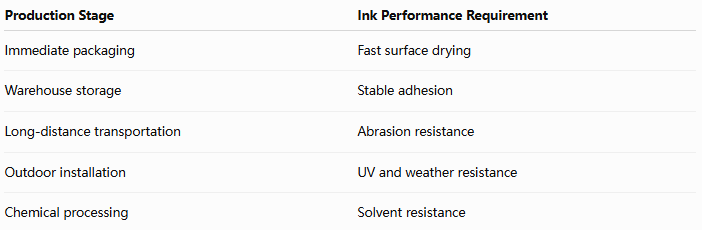
Selecting ink according to the product lifecycle is often more effective than selecting it according to printer specifications.
3. What Type of Information Is Being Printed?
Different applications require different priorities.
Simple batch numbers may tolerate slight edge variation.
Machine-readable QR codes require much tighter control over droplet placement and edge definition.
Manufacturers should therefore consider whether they are printing:
1) Batch numbers
2) Production dates
3) Expiration dates
4) Serial numbers
5) QR codes
6) GS1 barcodes
7) Logos
8) Variable production data
Higher coding complexity generally requires greater consistency in ink behavior.
4. What Environmental Conditions Exist?
Production conditions directly influence drying performance.
Engineers should evaluate:
1) Ambient temperature
2) Relative humidity
3) Air movement
4) Dust levels
5) Static electricity
6) Production shift changes
These variables often explain why identical equipment performs differently between production facilities.
Ink Performance Should Be Evaluated as a Complete System
Many purchasing decisions compare ink products using only one specification, such as drying time.
In practice, no single characteristic determines printing success.
Instead, manufacturers evaluate several performance indicators together.
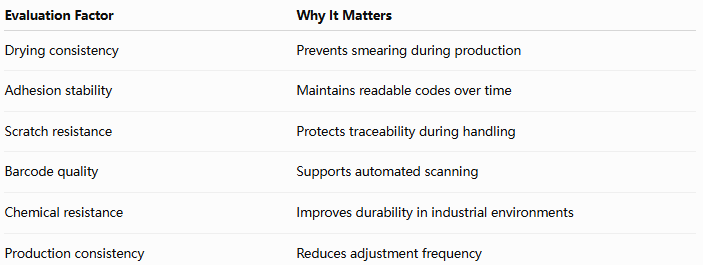
A balanced evaluation often produces better long-term results than optimizing only one parameter.
Looking Beyond "Fast Drying": What Really Defines a High-Performance Industrial Ink?
When evaluating industrial inks, many buyers immediately focus on one specification:
Drying time.
While drying speed is important, it represents only one part of overall ink performance.
In real manufacturing environments, a code must survive much more than the few seconds immediately after printing. It may be exposed to repeated handling, vibration, packaging equipment, warehouse storage, transportation, moisture, or even cleaning chemicals before reaching the end user.
An ink that dries quickly but fails during shipping creates just as many production problems as an ink that dries too slowly.
For this reason, experienced engineers evaluate ink performance across multiple dimensions rather than relying on a single specification.
Six Characteristics That Should Be Evaluated Together
A well-selected industrial ink should balance several performance indicators simultaneously.
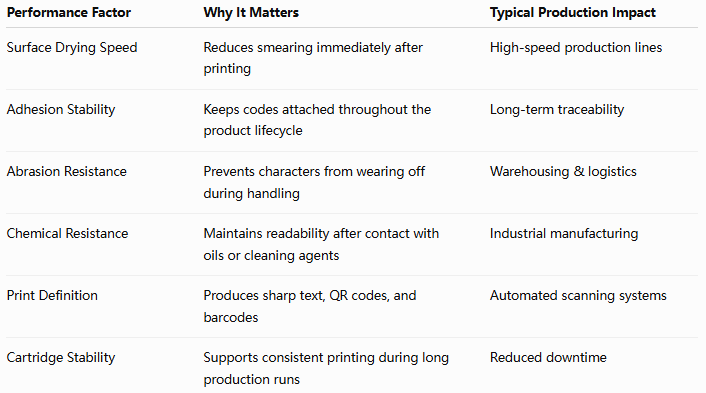
Instead of optimizing one characteristic at the expense of another, manufacturers generally seek the best balance for their production environment.
Ink Selection Should Match the Production Process
The same plastic product may require different inks depending on how it moves through production.
For example, a cosmetic bottle printed manually before packaging has different requirements than a detergent bottle traveling through an automated filling and labeling line.
The production process often influences ink selection just as much as the material itself.
Typical Production Scenarios
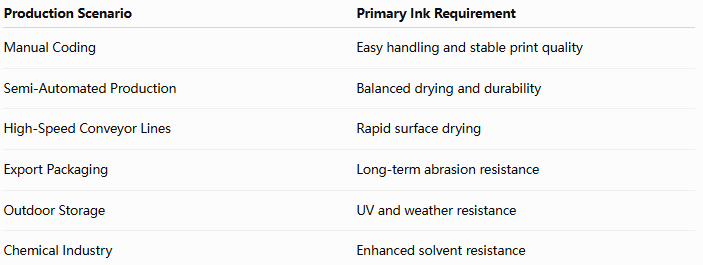
Understanding the complete production workflow helps avoid selecting an ink based only on laboratory specifications.
The Hidden Cost of Choosing Ink Based Only on Price
Ink is a consumable, making purchase price an important consideration.
However, focusing exclusively on cartridge cost often increases total production costs.
For example, a lower-priced ink may require:
1. More frequent printhead cleaning
2. Additional quality inspections
3. Slower production speeds
4. Reprinting rejected products
5. Increased operator intervention
These indirect costs frequently exceed the initial savings on consumables.
Many manufacturers therefore evaluate total operating efficiency rather than cartridge price alone.
Questions worth asking include:
1. How much production time is lost because of print quality issues?
2. How many rejected products are caused by poor adhesion?
3. Does the ink require frequent maintenance?
4. How stable is print quality during long production runs?
A slightly higher-cost ink that reduces downtime may provide a significantly lower total cost of ownership over the course of a year.
Common Ink Selection Mistakes
Selecting the wrong ink rarely causes immediate equipment failure.
Instead, it creates small production inefficiencies that accumulate over time.
Below are several common mistakes observed in industrial coding projects.
Mistake 1: Assuming One Ink Fits Every Product
Manufacturers producing multiple product lines sometimes try to simplify inventory by using a single ink formulation for every plastic surface.
While convenient, this approach often results in inconsistent durability and unnecessary print adjustments.
Not sure which printer fits your application?
Consulting experts' advice
Not sure which printer fits your application?
Consulting experts' adviceMistake 2: Ignoring Downstream Production Steps
An ink that performs well immediately after printing may fail once products enter automatic packaging, palletizing, or transportation.
Always evaluate the complete production process rather than the printing stage alone.
Mistake 3: Testing Only in Ideal Conditions
Many successful laboratory tests fail during actual production because operating conditions are very different.
Production testing should reflect real:
Line speeds
Temperatures
Humidity levels
Product handling methods
Mistake 4: Replacing the Printer Before Evaluating the Ink
Poor adhesion is frequently blamed on the printer.
However, many printing problems originate from an unsuitable ink formulation rather than the printing hardware.
Changing equipment before verifying ink compatibility often increases costs without solving the underlying issue.
Choosing Ink for High-Speed Plastic Packaging Applications
One of the most demanding applications for non-porous plastics is high-speed packaging.
In these environments, products may move directly from printing to sealing, wrapping, labeling, or palletizing with very little time available for curing.
As production speeds increase, manufacturers must balance three competing objectives:
1. Fast surface drying
2. Reliable code durability
3. High-quality barcode readability
Optimizing these factors requires more than selecting a "fast-drying" ink. Production line speed, substrate movement, contact points, and handling methods all influence the final result.
Manufacturers operating food, beverage, pharmaceutical, or consumer goods packaging lines can gain additional insights from Printing on Plastic Packaging Without Smearing or Ink Transfer, which focuses specifically on preventing smearing and maintaining print quality in continuous packaging operations.
Ink Evaluation Checklist Before Production Approval
Before approving an ink for mass production, many manufacturers complete a structured validation process.
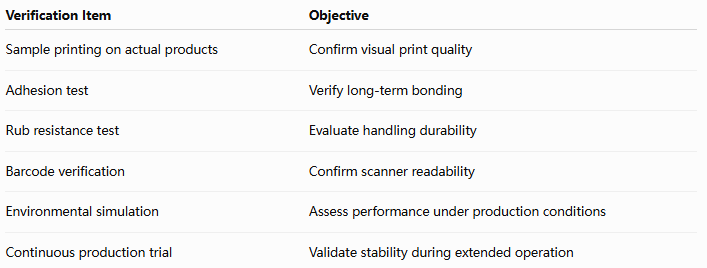
This process helps establish repeatable standards while reducing unexpected quality issues after production begins.
Need Help Selecting the Right Ink?
If you're printing on non-porous plastic products and need guidance on ink compatibility, drying performance, or production optimization, our engineering team can recommend the most suitable ink and handheld inkjet printing solution for your application.
Case Study Scenarios: How Different Production Requirements Influence Ink Selection
Even when manufacturers use the same handheld inkjet printer, the optimal ink can vary depending on production objectives.
The following examples illustrate how production requirements—not just substrate type—shape ink selection decisions.
Case 1: High-Speed Consumer Goods Packaging
A packaging manufacturer operates multiple production lines for household products. Finished packages move directly from coding to automatic sealing and palletizing with only a few seconds between each process.
The engineering team's primary concern is preventing code transfer during production.
Instead of selecting the fastest available printer, they prioritize an ink with:
1. Rapid surface drying
2. Stable barcode definition
3. Consistent performance during continuous operation
4. Reliable readability after palletizing
In this scenario, drying performance has a greater impact on production efficiency than maximum print resolution.
Case 2: Industrial Storage Containers
Another manufacturer produces reusable plastic containers for industrial chemicals.
Unlike retail packaging, these products are repeatedly transported, stacked, cleaned, and returned for reuse.
The priority shifts from drying speed to long-term durability.
Engineers therefore place greater emphasis on:
1. Abrasion resistance
2. Chemical resistance
3. Adhesion stability
4. Long service life
Although production speed remains important, the ink must continue performing after months of industrial use.
Case 3: OEM Plastic Components
A contract manufacturer supplies plastic housings to multiple equipment brands.
Each customer applies different quality standards, barcode requirements, and traceability specifications.
Rather than maintaining separate printers for every project, the factory standardizes its equipment while selecting different ink formulations according to each customer's production requirements.
This approach simplifies equipment management while maintaining flexibility across multiple product lines.
Building an Internal Ink Selection Standard
One characteristic shared by efficient manufacturing facilities is standardization.
Instead of selecting inks individually for each production order, many companies establish documented selection standards that engineers can reuse.
A typical internal standard may include:
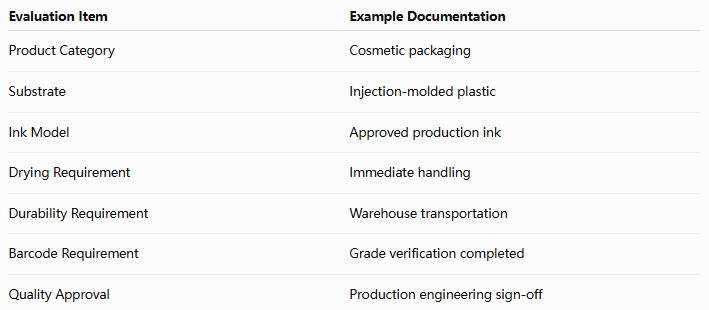
Creating standardized documentation reduces setup time, improves consistency, and makes operator training easier.
Ink Selection Decision Flow
The following workflow provides a practical framework for selecting an ink before introducing a new plastic product into production.
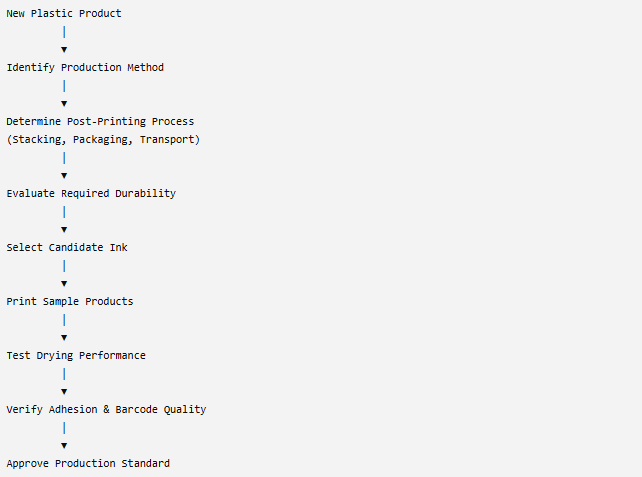
Following a structured process helps minimize repeated adjustments while improving production efficiency.
Frequently Asked Questions
Should ink selection begin with the material or the production process?
Both matter, but production requirements determine which ink characteristics are most important. A material that prints well in manual production may require a different ink on a high-speed automated line.
Why do two factories using the same plastic achieve different results?
Production speed, temperature, humidity, handling methods, packaging equipment, and quality standards all influence final print performance.
Is faster drying always better?
Not necessarily.
An extremely fast-drying ink may not provide the optimal balance between adhesion, durability, and print definition for every application.
The objective is to select an ink that matches the production process rather than simply choosing the fastest option.
How often should ink compatibility be re-evaluated?
Whenever significant changes occur, including:
1. New product introductions
2. Different raw material suppliers
3. Modified production speeds
4. Environmental changes
5. Updated customer specifications
Periodic verification helps maintain stable production quality.
Can one production line use multiple approved inks?
Yes.
Many manufacturers maintain several qualified ink formulations for different product families while using the same handheld inkjet printer platform.
This provides greater flexibility without increasing equipment complexity.
What is the most common purchasing mistake?
Comparing ink products only by cartridge price.
A more effective approach is to evaluate overall production efficiency, maintenance requirements, reject rates, and long-term operating costs.
Should production testing include transportation simulation?
Whenever products will be stacked, shipped, or handled repeatedly, transportation simulation provides valuable information about long-term code durability.
Does changing ink require changing the printer?
In many cases, no.
Many handheld inkjet printing systems are designed to support multiple compatible industrial ink formulations, allowing manufacturers to optimize printing performance without replacing equipment.
Selecting the right ink for non-porous plastic surfaces is a production decision rather than simply a purchasing decision.
Successful manufacturers evaluate the complete printing process—including production speed, downstream handling, environmental conditions, durability requirements, and quality standards—before approving an ink for mass production.
By adopting a structured evaluation process and validating performance under real operating conditions, manufacturers can improve print consistency, reduce rejected products, and extend the reliability of their coding systems.
Rather than searching for a universal ink, the most effective strategy is to match ink performance to the specific production environment and establish standardized operating procedures that can be repeated across future projects.
Optimize Your Plastic Printing Process with Expert Support
Choosing an industrial ink involves more than reviewing technical specifications.
If your production line prints on non-porous plastic products and you need guidance on drying performance, durability, barcode quality, or production optimization, our technical specialists can help.
We provide:
1. Ink compatibility assessments
2. Sample printing and performance testing
3. Production parameter recommendations
4. Handheld inkjet printer selection
5. OEM and customized coding solutions
6. Technical support for industrial manufacturing environments
Ready to Improve Your Printing Efficiency?
Get expert advice and the best solution tailored to your business.
Get Your Free Quote Within 24 Hours✔ Fast response ✔ Custom solution ✔ No obligation
+MoreRelated recommendations
-
Choosing the Right Ink for Non-Porous Plastic Surfaces
Learn how to choose the right industrial ink for non-porous ...
-
How Ink Adhesion Varies Across Different Plastic Materials
Learn why ink adhesion differs across PE, PP, PET, PVC, ABS,...
-
Printing on Different Materials with Handheld Inkjet Printers: The Complete Industrial Guide
Learn how to print on different industrial materials with ha...
-
Common Buying Mistakes That Lead to Expensive Printing Problems
Discover the most common handheld inkjet printer buying mist...
Contact Us

Service phone number+8618759952301
—— Add WeChat communication


