
Best Applications for Handheld Inkjet Printers in Manufacturing
2026-06-23(350)Views
Many manufacturers first encounter handheld inkjet printers while searching for a solution to a specific problem.
Perhaps labels are falling off products.
Maybe production dates need to be updated multiple times a day.
Or perhaps a new customer requires QR code traceability on packaging that was never designed for automated coding.
In these situations, the question is usually not:
"What is a handheld inkjet printer?"
The real question is:
"Can this solve my production problem?"
That is why understanding actual applications is more valuable than studying technical specifications alone.
A handheld printer may seem like a simple coding device, but in practice, it can solve challenges related to traceability, inventory management, packaging flexibility, product identification, and production efficiency.
This article examines the most effective manufacturing applications for handheld inkjet printers, including real-world scenarios where portable coding systems often outperform traditional marking methods.
Why Application Matters More Than Specifications
Many buyers begin their evaluation by comparing:
1. Print resolution
2. Screen size
3. Ink cartridge capacity
4. Battery life
While these factors matter, they rarely determine project success.
The most important consideration is whether the printer matches the operational challenge.
For example:
A 600 DPI printer provides little value if the selected ink does not adhere to the product surface.
Similarly, an expensive automated coding system may not solve a problem that actually requires mobility and flexibility.
Before selecting equipment, manufacturers should first understand their coding requirements and production workflow.
Businesses that are still evaluating technology options often start by understanding how handheld inkjet printing technology works, which provides context for the applications discussed throughout this article.
Application #1: Printing Production Dates and Batch Codes on Packaging
This is by far the most common industrial use case.
Nearly every manufacturing industry requires some form of date coding.
Typical information includes:

Industries frequently using date coding include:
1. Food processing
2. Beverage production
3. Cosmetics
4. Pharmaceuticals
5. Household products
Why Handheld Printers Work Well
Many facilities operate multiple packaging lines or temporary packaging stations.
Installing fixed coding systems everywhere can be costly.
A handheld printer allows operators to move between workstations while maintaining consistent coding standards.
Example
A snack food manufacturer running seasonal packaging promotions needed to update production information across several packaging formats.
Rather than purchasing multiple fixed printers, the company deployed handheld units that could be used wherever packaging changes occurred.
The result was lower equipment investment and faster production changeovers.
Application #2: Carton and Secondary Packaging Identification
Primary packaging is not the only place where coding matters.
Warehouses and distribution centers often require identification codes on:
1. Shipping cartons
2. Master cases
3. Export packaging
4. Pallets
Common Information Printed
1. Product codes
2. Batch numbers
3. Shipment identifiers
4. Destination information
5. QR codes
Because carton sizes vary significantly, handheld systems often provide more flexibility than fixed installations.
Real-World Scenario
A logistics operation processing products for multiple retailers needed different carton markings depending on destination requirements.
Portable coding allowed warehouse staff to apply correct information without moving cartons through dedicated printing stations.
Application #3: Product Traceability and QR Code Printing
Modern supply chains increasingly depend on traceability.
Many manufacturers now require every product to carry information that can be tracked throughout its lifecycle.
Typical traceability data includes:
1. Serial numbers
2. QR codes
3. DataMatrix codes
4. Production records
5. Inspection data
Why Traceability Matters
Traceability supports:
1. Product recalls
2. Quality investigations
3. Regulatory compliance
4. Inventory management
5. Customer confidence
Example
An electronics manufacturer introduced QR code tracking on assembly components.
Each code linked directly to production data, allowing rapid identification of affected batches during quality investigations.
This reduced troubleshooting time and improved overall production visibility.
Organizations implementing similar systems often need guidance on printing batch numbers and expiry dates efficiently, particularly when variable data requirements become more complex.
Application #4: Printing Directly on Plastic Products
Plastic products are everywhere in modern manufacturing.
Examples include:
1. Bottles
2. Containers
3. Caps
4. Packaging trays
5. Industrial components
Historically, many companies relied on labels.
However, direct printing offers several advantages.
Benefits of Direct Printing
1. Reduced label costs
2. Improved durability
3. Faster production
4. Better appearance
Industry Example
A cleaning products manufacturer previously applied adhesive labels containing production information.
Frequent exposure to moisture caused label deterioration.
Direct printing eliminated the issue while simplifying production.
Application #5: Marking Metal Components
Metal marking presents unique challenges.
Manufacturers often need to identify:
1. Steel parts
2. Aluminum components
3. Fabricated assemblies
4. Automotive parts
Information may include:
1. Part numbers
2. Batch codes
3. Inspection status
4. Traceability information
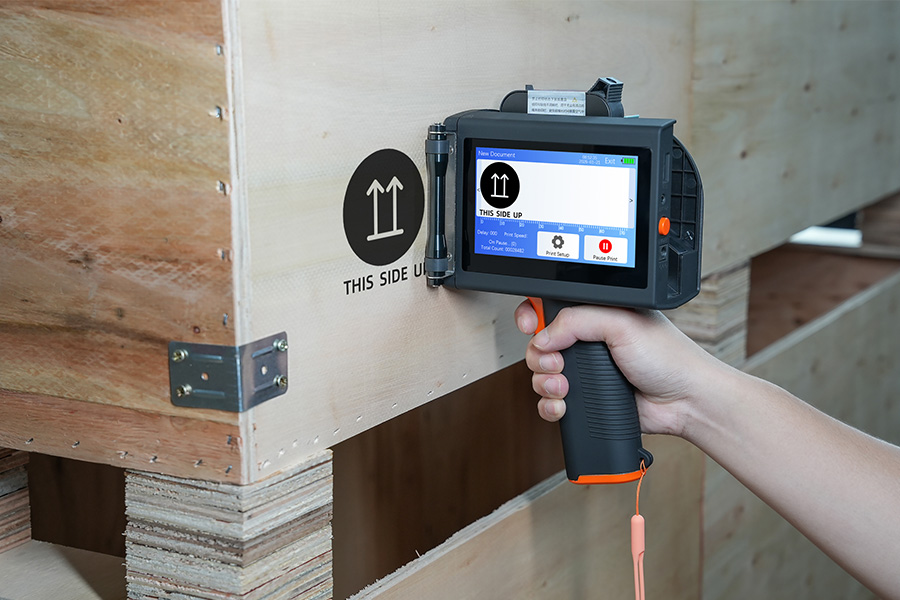
Because many metal products vary in size and shape, handheld systems can be easier to deploy than conveyor-based coding equipment.

Case Example
A steel fabrication company needed to mark large structural components that could not easily pass through traditional coding stations.
Portable printers allowed operators to mark parts directly on-site.
Application #6: Coding Construction and Building Materials
The construction materials industry frequently handles oversized products.
Examples include:
1. PVC pipes
2. Cement bags
3. Wood panels
4. Insulation materials
5. Structural products
These products often create challenges for fixed coding systems.
Why Handheld Systems Excel
Operators can bring the printer directly to the product rather than bringing the product to the printer.
This simple difference often improves workflow efficiency dramatically.
Application #7: Warehouse Inventory Management
Many people associate coding systems exclusively with manufacturing.
However, warehousing has become one of the fastest-growing application areas.
Warehouse teams use handheld printers to identify:
1. Inventory locations
2. Storage containers
3. Pallets
4. Shipping units
Operational Benefits
1. Faster inventory tracking
2. Improved stock visibility
3. Reduced manual labeling
4. Better shipping accuracy
As warehouse automation expands, portable coding systems continue to play an important supporting role.
Application #8: Contract Packaging Operations
Contract packaging environments are unique.
Unlike traditional factories producing a limited product range, contract packers may handle dozens of customer projects every month.
Each project can require:
1. Different packaging formats
2. Different codes
3. Different compliance requirements
Why Flexibility Matters
Frequent product changes make fixed systems less practical.
Portable printers enable rapid adjustments without major setup procedures.
Example
A contract packaging company serving food and cosmetics customers used handheld printers to switch between projects several times per day.
The ability to update templates instantly reduced downtime and improved customer responsiveness.
Application #9: Low-Volume and High-Mix Manufacturing
Not every factory produces massive quantities of identical products.
Many manufacturers operate in:
1. Custom production
2. Specialty manufacturing
3. Industrial fabrication
4. Made-to-order environments
These operations often prioritize flexibility over throughput.
Ideal Conditions for Handheld Printing
√ Multiple product variations
√ Frequent coding changes
√ Small production batches
√ Variable product dimensions
In these situations, portable coding frequently provides a better balance between cost and efficiency than fully automated systems.
This is one reason manufacturers often spend time comparing handheld and automated coding solutions before committing to major equipment investments.
Application #10: Temporary Production Lines and Expansion Projects
Manufacturing facilities regularly encounter situations where coding needs arise unexpectedly.
Examples include:
1. Seasonal production increases
2. Temporary packaging stations
3. Pilot production projects
4. New product launches
Installing permanent coding infrastructure may not be justified.
Handheld systems offer a practical alternative.
Real Example
A beverage manufacturer launching a limited-edition product line needed temporary coding capacity for three months.
A portable solution allowed the project to proceed without disrupting existing production operations.
Which Industries Benefit Most?
Although handheld printers appear across many sectors, adoption is especially common in:
|
Industry |
Typical Application |
|
Food & Beverage |
Date Coding |
|
Pharmaceuticals |
Traceability |
|
Cosmetics |
Batch Coding |
|
Electronics |
Component Identification |
|
Logistics |
Carton Marking |
|
Construction Materials |
Product Identification |
|
Automotive |
Part Tracking |
|
Packaging |
Variable Data Printing |
Signs a Handheld Printer May Be Right for Your Operation
The following conditions often indicate a strong fit:
Your Products Vary Frequently
Frequent code changes favor portable solutions.
You Have Multiple Production Areas
Mobility becomes valuable when coding requirements exist in several locations.
You Need Fast Deployment
Handheld systems require minimal installation.
You Produce Small or Medium Volumes
Flexibility often outweighs automation benefits.
You Need Variable Data Printing
Modern systems handle dynamic coding efficiently.
For businesses evaluating broader implementation strategies, a complete guide to handheld inkjet printer applications and selection can help determine how portable coding fits into long-term production planning.
Frequently Asked Questions
What is the most common use of a handheld inkjet printer?
Printing production dates, batch numbers, and traceability information on packaging.
Can handheld printers print QR codes?
Yes. Most industrial models support QR codes and other machine-readable formats.
Are handheld printers suitable for metal products?
Yes. With appropriate inks, they can print effectively on many metal surfaces.
Can handheld printers replace labels?
In many applications, direct printing can reduce or eliminate the need for labels.
Which industries use handheld coding systems the most?
Food, beverage, packaging, logistics, pharmaceuticals, electronics, construction materials, and manufacturing.
The value of a handheld inkjet printer is not determined by its technical specifications alone.
Its true value comes from the operational challenges it solves.
Whether printing batch codes on food packaging, marking steel components, coding warehouse cartons, or supporting traceability initiatives, handheld systems provide flexibility that many modern production environments require.
As manufacturing continues moving toward shorter production runs, increased traceability, and greater operational agility, portable coding technology is likely to become even more important across industrial applications.
Ready to Improve Your Printing Efficiency?
Get expert advice and the best solution tailored to your business.
Start your project✔ Fast response ✔ Custom solution ✔ No obligation
+MoreRelated recommendations
-
Handheld Inkjet Printer Warranty Questions Buyers Should Ask Before Ordering
Ask these handheld inkjet printer warranty questions to clar...
-
Handheld Inkjet Printer Order Checklist: Printer, Ink, Accessories, and Spare Parts
Use this purchase checklist to confirm the printer, ink, acc...
-
What Information Should You Send for an Accurate Handheld Inkjet Printer Quote?
Use this RFQ worksheet to send the material, message, print ...
-
How to Print Scannable Barcodes and QR Codes on Plastic Packaging
Learn how to print scannable barcodes and QR codes on plasti...
Contact Us

Service phone number+8618759952301
—— Add WeChat communication


