
Portable vs Industrial TIJ Printers
2026-06-16(189)Views
Choosing the Right Thermal Inkjet System for Your Production Needs
Thermal Inkjet (TIJ) technology is widely used in both portable handheld devices and fully integrated industrial production systems.
Although both types use similar printing principles, their design purpose, performance capability, and application scenarios are completely different.
Choosing the wrong type can lead to production inefficiency, higher long-term cost, or system integration failure.
1. What Is a Portable TIJ Printer?
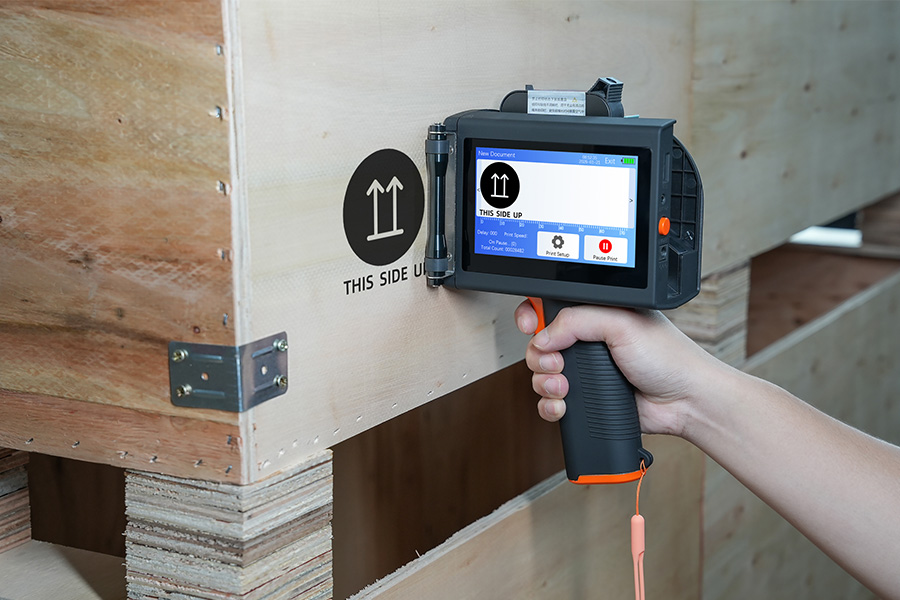
Portable TIJ printers are handheld coding devices designed for flexible, small-scale marking applications.
Key characteristics:
1)Handheld operation
2)Battery-powered system
3)Manual printing control
4)Lightweight and mobile design
5)Suitable for small batch production
Typical applications:
1)Warehouse labeling
2)Manual packaging marking
3)Small batch product coding
4)On-site marking tasks
Portable TIJ systems are mainly used where automation is not required.
2. What Is an Industrial TIJ Printer?
Industrial TIJ printers are fully integrated systems designed for automated production lines.
Key characteristics:
1)Fixed installation on production lines
2)PLC / encoder integration
3)High-speed continuous printing
4)Real-time variable data output
5)Designed for 24/7 operation

Not sure which printer fits your application?
View the model that suits you
Not sure which printer fits your application?
View the model that suits youTypical applications:
1)Automated packaging lines
2)Food & beverage production
3)Pharmaceutical manufacturing
4)Logistics sorting systems
For full system understanding:
→ Thermal Inkjet (TIJ) Printer: Complete Guide for Industrial Use
3. Key Differences Between Portable and Industrial TIJ Printers
|
Feature |
Portable TIJ Printer |
Industrial TIJ Printer |
|
|
Operation Mode |
Manual |
Automated |
|
|
Production Speed |
Low |
Medium–High |
|
|
Integration |
None |
PLC / MES / ERP |
|
|
Print Stability |
Operator dependent |
System controlled |
|
|
Maintenance Level |
Low |
Very low (automated) |
|
|
Scalability |
Limited
|
High |
4. Application-Based Selection Logic
4.1 Choose Portable TIJ Printer if:
1)You have small batch production
2)No automated conveyor system
3)Need flexible on-site marking
4)Budget is limited
5)Printing is not continuous
4.2 Choose Industrial TIJ Printer if:
1)You run continuous production lines
2)You need high-speed printing
3)You require barcode/QR traceability
4)You use automation systems (PLC/MES)
5)Downtime must be minimized
For barcode applications:
→ TIJ Printer for Barcode Printing
For system integration:
→ TIJ Printer Integration with Production Lines
5. Cost Comparison (Real Industrial Perspective)
|
Cost Factor |
Portable TIJ |
Industrial TIJ |
|
Initial Cost |
Low |
Medium–High |
|
Labor Cost |
High |
Low |
|
Downtime Risk |
Medium |
Low |
|
Long-term ROI |
Lower |
Higher |
Key Insight:
Portable systems look cheaper initially, but industrial systems usually deliver better ROI in production environments.
For cost breakdown:
→ TIJ Printer Cost Breakdown: What to Expect
6. Production Efficiency Impact
Portable TIJ limitations:
1)Manual operation reduces consistency
2)Operator fatigue affects print quality
3)Not suitable for high-speed production
4)Higher error rate in repetitive tasks
Industrial TIJ advantages:
1)Fully synchronized with production line
2)Stable 24/7 operation
3)Minimal human intervention
4)Consistent print quality across batches
7. Real Industrial Insight
In real manufacturing environments:
1)Portable TIJ is mainly used for temporary or low-volume tasks
2)Industrial TIJ dominates automated packaging lines
3)Many factories upgrade from portable → industrial when scaling production
4)Automation integration is the key turning point in equipment selection
8. Decision Model

9. Common Mistakes in Selection
Choosing portable TIJ for production line use
1)Ignoring future scalability needs
2)Underestimating labor cost of manual printing
3)Not considering integration requirements
4)Selecting based only on initial price
These mistakes often lead to early equipment replacement and higher total cost.
Choosing between portable and industrial TIJ printers is not just a product decision—it directly affects production efficiency, labor cost, and long-term scalability.
If you are unsure which system fits your production environment, we can help you:
1. Analyze your production workflow
2. Recommend portable vs industrial configuration
3. Evaluate automation upgrade potential
4. Optimize long-term cost structure
5. Design integration-ready printing systems
Request a TIJ System Selection Proposal
Get a tailored recommendation based on your actual production scenario—not generic product specs.
FAQ
Is portable TIJ suitable for production lines?
No, it is mainly designed for manual or small batch operations.
What is the main advantage of industrial TIJ printers?
Automation, stability, and integration with production systems.
Which one is more cost-effective long term?
Industrial TIJ is more cost-effective for continuous production environments.
Can portable TIJ print barcodes?
Yes, but it is less stable compared to industrial systems.
When should I upgrade to industrial TIJ?
When production becomes continuous, automated, or requires high traceability accuracy.
Ready to Improve Your Printing Efficiency?
Get expert advice and the best solution tailored to your business.
Get Your Free Quote Within 24 Hours✔ Fast response ✔ Custom solution ✔ No obligation
+MoreRelated recommendations
-
Handheld Inkjet Printer Warranty Questions Buyers Should Ask Before Ordering
Ask these handheld inkjet printer warranty questions to clar...
-
Handheld Inkjet Printer Order Checklist: Printer, Ink, Accessories, and Spare Parts
Use this purchase checklist to confirm the printer, ink, acc...
-
What Information Should You Send for an Accurate Handheld Inkjet Printer Quote?
Use this RFQ worksheet to send the material, message, print ...
-
How to Print Scannable Barcodes and QR Codes on Plastic Packaging
Learn how to print scannable barcodes and QR codes on plasti...
Contact Us

Service phone number+8618759952301
—— Add WeChat communication


