
TIJ Printer for Barcode Printing
2026-06-15(163)Views
Industrial High-Resolution Coding Solution for Packaging, Logistics , Manufacturing
Barcode printing has become a critical component of modern industrial production systems. From product traceability to warehouse management and regulatory compliance, accurate barcode marking directly affects supply chain efficiency.
Thermal Inkjet (TIJ) printers are widely used in barcode printing applications due to their high resolution, stable variable data output, and easy integration into production lines.
1. Why Barcode Printing Matters in Modern Industry
Barcodes are essential for:
1)Product identification
2)Inventory tracking
3)Supply chain management
4)Anti-counterfeit verification
5)Logistics automation
A poorly printed barcode can lead to:
1)Scanning failure
2)Shipment delays
3)Compliance issues
Warehouse inefficiency
This is why high-precision printing systems are required in industrial environments.
2. Why TIJ Printers Are Ideal for Barcode Printing
TIJ technology is particularly well-suited for barcode applications due to its high-resolution inkjet mechanism.
Key advantages:
1)High DPI output (300–600 DPI)
2)Sharp edges for machine readability
3)Stable variable data printing
4)Clean and low-maintenance operation
5)Easy integration into automated lines
Unlike older coding systems, TIJ printers can produce crisp, scannable barcodes even at high production speeds.
For full system understanding:
→ Thermal Inkjet (TIJ) Printer: Complete Guide for Industrial Use
3. Barcode Printing Quality Factors
Barcode readability depends on several technical factors:
3.1 Print Resolution (DPI)
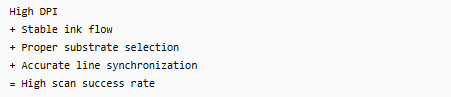
Higher DPI = sharper barcode edges = better scan success rate.
3.2 Ink Absorption
Different substrates affect ink spreading:
|
Material |
Barcode Quality Impact |
|
Carton |
Excellent |
|
Coated paper |
Good |
|
Plastic film |
Requires solvent ink |
|
Metal surface |
Requires specialty ink |
3.3 Print Speed Synchronization
If encoder sync is incorrect, barcode distortion may occur.
For integration setup:
→ TIJ Printer Integration with Production Lines
4. Industrial Applications of Barcode TIJ Printing
Food & Beverage Packaging
1)Expiry date + barcode combination
2)Batch tracking
3)Retail compliance labeling
Logistics & Warehousing
1)Shipping labels
2)Warehouse scanning codes
3)Inventory tracking automation
Pharmaceutical Industry
1)Drug serialization
2)Anti-counterfeit verification codes
3)Regulatory compliance tracking
Electronics Manufacturing
1)Component identification
2)PCB traceability codes
3)Serial number labeling
5. TIJ vs Other Barcode Printing Technologies
|
Feature |
TIJ Printer |
CIJ Printer |
Laser |
|
Barcode Quality |
Very High |
Medium |
High |
|
Maintenance |
Low |
High |
Medium |
|
Flexibility |
High |
High |
Low |
|
Cost Efficiency |
Medium–High |
Medium |
High initial cost |
|
Integration Ease |
Very Easy |
Moderate |
Complex |
Key Insight:
TIJ is the best balance between barcode quality + cost + ease of integration in most packaging environments.
For deeper comparison:
→ TIJ Printer vs CIJ: Which Is Better?
6. Common Barcode Printing Problems
Blurry barcode edges
Cause:
1)Low DPI
2)Ink spread
Solution:
1)Increase resolution
2)Use correct ink type
Barcode not scannable
Cause:
1)Incorrect scaling
2)Poor contrast
Solution:
1)Adjust print size
2)Improve ink contrast
Misaligned barcode position
Cause:
1)Encoder mismatch
Solution:
2)Recalibrate production line sync
For troubleshooting:
→ Common TIJ Printer Problems
7. Barcode Printing Performance Optimization Model
8. Real Industrial Insight
In real production environments:
1)Barcode readability is more important than visual quality
2)70% of barcode failures come from setup issues, not printer hardware
3)Integration accuracy affects scan success rate more than printer brand
4)TIJ systems reduce barcode rejection rates in packaging lines
If your production line requires reliable, high-speed barcode printing, selecting the right TIJ system is critical for operational efficiency and compliance.
We can help you:
1. Design barcode printing systems for your production line
2. Select correct TIJ printer configuration
3. Optimize barcode readability and scan success rate
4. Match ink with packaging materials
5. Integrate printing with automation systems
Request a Barcode Printing Solution Proposal
Get a customized industrial barcode printing system based on your real production requirements.
FAQ
Can TIJ printers print readable barcodes?
Yes, TIJ printers are widely used for high-resolution barcode printing in industrial environments.
What DPI is needed for barcode printing?
Typically 300–600 DPI depending on barcode type and size.
Can TIJ print QR codes and barcodes together?
Yes, TIJ systems support variable data including QR codes and barcodes simultaneously.
What materials can TIJ barcode printers print on?
Carton, paper, plastic film, and coated packaging materials (with correct ink selection).
Is TIJ better than laser for barcode printing?
TIJ is more flexible and cost-effective for packaging applications, while laser is more permanent but less flexible.
Ready to Improve Your Printing Efficiency?
Get expert advice and the best solution tailored to your business.
Start your project✔ Fast response ✔ Custom solution ✔ No obligation
+MoreRelated recommendations
-
Handheld Inkjet Printer Warranty Questions Buyers Should Ask Before Ordering
Ask these handheld inkjet printer warranty questions to clar...
-
Handheld Inkjet Printer Order Checklist: Printer, Ink, Accessories, and Spare Parts
Use this purchase checklist to confirm the printer, ink, acc...
-
What Information Should You Send for an Accurate Handheld Inkjet Printer Quote?
Use this RFQ worksheet to send the material, message, print ...
-
How to Print Scannable Barcodes and QR Codes on Plastic Packaging
Learn how to print scannable barcodes and QR codes on plasti...
Contact Us

Service phone number+8618759952301
—— Add WeChat communication


